No travel team commitments.
Just Noah, a mound, a catcher, and an old scout who cared more about his arm than his numbers.
At first, Noah was angry with his mother.
Not loudly.
Quietly.
He washed dishes harder than necessary.
Answered in short sentences.
Spent nights staring at the photograph of Elias Vale.
One evening, Marisol found him sitting on the apartment steps, turning a baseball in his hand.
“I know you’re mad,” she said.
Noah did not look up.
“You lied my whole life.”
Marisol sat beside him.
“Yes.”
He waited for excuses.
She did not give him any.
After a while, she said, “I thought if I kept the name buried, the danger would stay buried too.”
“Was Dad dangerous?”
“No. The people around him were.”
“Then why did he leave us with nothing?”
Marisol closed her eyes.
Pain crossed her face.
“He didn’t.”
Noah looked at her.
She took a folded letter from her pocket.
“I was going to give this to you when you were older. Then I told myself older meant sixteen. Then eighteen. Then someday. I kept moving someday.”
Noah took the letter.
The paper was worn at the folds.
On the front, in handwriting he had never seen, was written:
For Noah, when he asks why.
His hands trembled.
He opened it.
My son,
If you are reading this, then your mother finally decided the truth would hurt less than silence. Do not be angry at her forever. Be angry for a while if you need to. She earned some of that because all parents do. But she also carried you through a storm I helped create.
Noah swallowed hard.
I left because a man with money believed he could own my arm, my name, and eventually you. I was young enough to sign foolish papers and old enough to know they were wrong. I thought leaving would pull the danger away from you. Maybe I was brave. Maybe I was a coward. Most days, I was both.
The words blurred.
Marisol sat still beside him.
If you throw, throw because you love the sound of the ball finding the glove. Not because someone claps. Not because someone writes your name. Not because a man in sunglasses says you are special. Special is a word adults use when they want a piece of you. Be whole instead.
Noah covered his mouth.
I do not know if I will make it back. I pray I do. But if I don’t, remember this: I was not absent because you were unwanted. I was absent because I loved you badly, desperately, and in the only way I thought might keep you safe.
Remember my hand, but choose your own path.
Dad
Noah folded the letter slowly.
For a long time, he said nothing.
Then he whispered, “Do you hate him?”
Marisol looked toward the apartment parking lot.
Somewhere nearby, a car alarm chirped.
“No,” she said. “I hate what fear made us do.”
Noah leaned into her.
She held him.
Not everything healed that night.
But something opened.
The following month, Walter received a phone call.
He did not tell Noah at first.
He called Marisol.
Then he drove to their apartment in a quiet sedan and sat at the kitchen table with both hands wrapped around a cup of coffee he never drank.
Marisol knew before he spoke.
“You found something.”
Walter nodded.
Noah stood in the doorway.
“What?”
Walter looked at him.
“I found a man in Oregon who used to pitch in an adult wood-bat league under the name Eli Vargas.”
Marisol sat down slowly.
Noah’s heart began pounding.
“Is it him?”
“I don’t know,” Walter said carefully. “The man disappeared from that league eight years ago. But the motion described by one teammate matches your father.”
Noah’s hope rose so fast it hurt.
“Where is he now?”
Walter’s voice softened.
“I don’t know.”
The hope fell, but did not die.
That was the dangerous thing about hope.
Even a small piece could keep breathing.
Walter placed a photograph on the table.
Blurry.
Taken from a team website years earlier.
A man stood near a dugout wearing a cap low over his face.
The image was not clear.
But Marisol began to cry the moment she saw it.
Noah touched the picture.
“Dad?”
No one answered.
No one could.
But from that day on, Elias Vale stopped being only a ghost.
He became a question with a shape.
Noah kept training.
Not because he wanted scouts to love him.
Not because he wanted to prove Jaxon wrong.
But because throwing made him feel connected to something he had lost before he knew he had it.
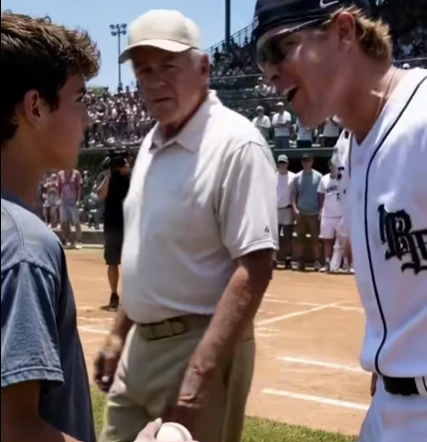
Three months after the showcase, Westbrook Athletic Park held a fall charity game.
Walter arranged for Noah to attend quietly, not as a headline. Marisol agreed because the event raised money for public field renovations, and because Noah had asked without begging.
Jaxon Reed was there too.
This time, there was no camera crew following him.
His father still came, but he stood farther back from the fence.
Jaxon approached Noah before warmups.
Noah stiffened.
Jaxon held a baseball in one hand.
“I saw one of your bullpen sessions,” he said.
Noah said nothing.
Jaxon shifted awkwardly.
“You’re good.”
“Thanks.”
A pause.
Then Jaxon looked toward the field.
“My dad says I’m supposed to act confident.”
Noah waited.
“Sometimes I act like a jerk instead.”
That was more honest than Noah expected.
Jaxon looked at him.
“I’m sorry. For real this time.”
Noah studied him.
There was still pride in Jaxon.
Still sharp edges.
But there was also a boy under all the cameras, trying to understand who he was when no one was filming.
Noah nodded.
“Okay.”
Jaxon held out the ball.
“Want to warm up?”
Noah looked toward Marisol.
She gave a cautious nod.
Walter smiled from behind home plate.
Noah took the ball.
They played catch in left field.
Lightly at first.
Then with rhythm.





