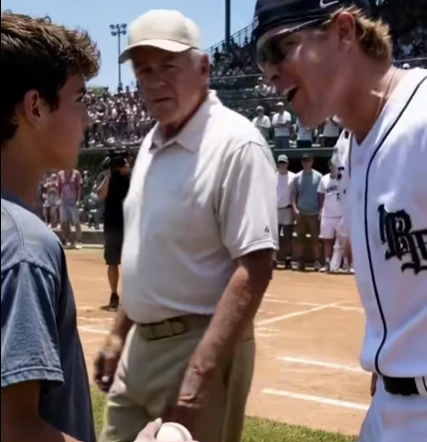
He looked toward his mother.
She nodded once.
Then he looked at the photograph in his mind.
His father’s fingers across the seams.
Remember my hand.
Noah rubbed the ball once.
Then set the grip.
First pitch.
He lifted his leg.
Turned.
Released.
The ball moved with the same impossible smoothness as before.
Pop.
The catcher caught it at the knees.
The radar gun operator looked at the screen.
“Eighty-five.”
A murmur moved through the crowd.
Second pitch.
High outside.
“Eighty-four.”
Noah stepped off.
Breathed.
Walter said nothing.
That helped.
Most adults filled nervous silence with instructions. Walter let him own it.
Third pitch.
Eighty-six.
Strike.
The catcher looked back toward the scouts, eyes wide.
Fourth pitch.
The cleanest yet.
Eighty-six again, with late life that made the glove jump.
Coach Cole whispered, “Good Lord.”
Jaxon heard it.
His jaw tightened.
Noah took the ball for the fifth pitch.
His hand trembled now.
Not from fatigue.
From everything.
The lie about his father.
The photograph.
His mother’s fear.
Jaxon’s laughter.
Walter’s question.
The strange feeling that a man he had never known was somehow standing behind his shoulder.
He looked at Marisol.
She touched her heart.
Noah understood.
He did not throw for Walter.
Not for the scouts.
Not for Jaxon.
Not even for Elias Vale.
He threw for himself.
The fifth pitch left his hand quieter than all the others.
It seemed almost gentle until it reached the plate.
The catcher’s glove cracked shut.
The radar gun operator stared.
“Eighty-eight.”
The field exploded into whispers.
Not cheers.
Not at first.
People were too shocked.
Then a few claps came from behind the fence.
One scout.
Then another.
Then Coach Cole.
Even some players joined in.
Noah stepped off the mound quickly, embarrassed by the sound.
Walter approached him.
“You did well.”
Noah looked down.
“I missed one.”
Walter smiled.
“That makes you a pitcher, not a machine.”
Jaxon walked past them toward the dugout, face hard.
But before he reached it, Coach Cole stopped him.
“Jaxon.”
“What?”
“Apologize.”
Jaxon stared.
“For what?”
Coach Cole’s voice sharpened.
“For mocking a player in front of the whole field.”
Jaxon looked toward his father.
For once, Brent Reed did not rescue him.
He only looked away.
Jaxon turned back to Noah.
His apology came through clenched teeth.
“Sorry.”
Noah studied him.
He could have nodded and let it end.
But something in him had changed on that mound.
“Say what you’re sorry for,” Noah said.
The field went still again.
Jaxon blinked.
“What?”
Noah’s voice shook, but he did not stop.
“My mom says people say sorry sometimes just to escape the room. Say what you’re sorry for.”
Walter looked down to hide a smile.
Jaxon’s face burned.
He looked at the grass.
“I’m sorry I called you the snack-bar kid.”
Noah waited.
“And for laughing.”
Noah nodded once.
“Okay.”
It was not friendship.
It was not forgiveness wrapped in music.
It was just a line drawn in the dirt.
A small one.
But real.
After the showcase ended, the parking lot buzzed with rumors.
Who was Noah Bennett?
Was he really Elias Vale’s son?
Where had he been playing?
Who trained him?
Was he signed with anyone?
Did he have social media?
Could someone contact his family?
Marisol kept Noah close beside her as they walked toward their old Honda near the back of the lot.
Walter followed, holding a folder full of papers he had not yet opened.
“No contracts,” Marisol said before he spoke.
Walter nodded.
“No contracts.”
“No agents.”
“No private trainers calling my phone.”
“No.”
“No videos posted without permission.”
“I will ask the event director to restrict official footage.”
She stopped beside the car.
“You can do that?”
Walter smiled faintly.
“I am old, not decorative.”
For the first time all day, Marisol almost laughed.
Noah leaned against the car, exhausted.
Walter looked at him.
“There will be people who want to turn you into a story by morning.”
Noah glanced at his mother.
“I don’t want that.”
“Good,” Walter said. “Then we start there.”
Marisol looked at the old scout.
“What do you want?”
Walter took a long time to answer.
“I want to help him safely. If he wants to play, he should have a place to learn without being owned by adults. If he doesn’t, then today stays only a day when he threw five pitches and learned the truth.”
Noah looked at him.
“You really knew my dad?”
Walter’s face softened.
“Yes.”
“What was he like?”
Marisol looked away, bracing herself.
Walter smiled sadly.
“He was quiet until he had a baseball. Then everything about him made sense.”
Noah looked down at his own hand.
Walter continued, “He hated being called a star. He liked gas-station burritos, old music, and throwing at sunset because he said the air felt kinder.”
Marisol laughed through sudden tears.
“He did say that.”
Noah’s throat tightened.
“Did he love me?”
Marisol made a small sound and pulled him close.
Walter’s eyes shone.
“Yes,” he said. “He carried your baby picture in his glove.”
That broke Noah.
He turned into his mother’s shoulder, crying in a way he had been too proud to cry since he was little.
Marisol held him with one arm and covered her mouth with the other.
Walter looked away toward the field lights.
Some things were too sacred to watch too closely.
In the weeks that followed, Noah’s life changed, but not as fast as other people wanted.
Walter kept his promise.
He spoke to the showcase director and blocked public release of Noah’s full pitching footage. A few short clips still leaked online, but not enough to identify his school or address. Scouts called Walter instead of Marisol. He turned away anyone who sounded more interested in owning Noah than helping him.
Marisol remained cautious.
She allowed one weekly session at a quiet public field with Walter present.
No radar gun for the first month.
No breaking balls.
No interviews.





