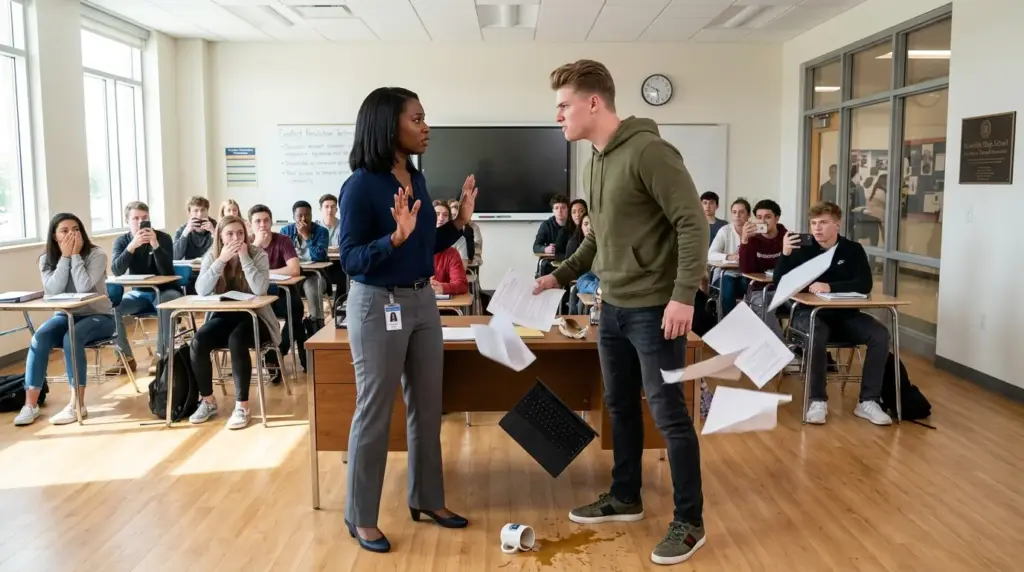
At first, Tyler hated it.
Then something slowly began to shift.
He met veterans with real trauma.
He heard stories about restraint under impossible pressure.
He began to understand what he had done.
It did not excuse anything.
But it began to change him.
Maya received offers within days.
Principal positions at three schools.
District curriculum director.
Speaking engagements nationwide.
She declined them all.
Instead, she met Coach Rita at a coffee shop and slid a folder across the table.
Rita opened it.
Educator Safety and De-escalation Initiative.
Maya looked at her.
“I’m not going back to classroom teaching. Not yet.”
Rita read the proposal, then smiled.
“You want a co-founder?”
“I was hoping you’d ask.”
They launched the nonprofit within two months.
Veterans groups funded it.
Education organizations endorsed it.
The first workshop hosted fifty teachers.
The second hosted two hundred.
By month six, they were booked a year ahead.
Maya taught defensive tactics.
Rita covered psychology, pressure, fear, documentation, and recovery.
Both emphasized legal protection.
“Self-defense is not about fighting,” Maya told every class. “It is about protecting your right to exist safely while keeping your humanity.”
Results followed quickly.
Teacher assault rates dropped in participating districts. Schools began reviewing educator protection laws. Grants funded safety training. Law schools studied Maya’s case as a landmark example of proportional response, privilege, and legal strategy.
Riverside High changed too.
New principal.
New policies.
Zero tolerance for donor influence.
The student paper became a real accountability force because Jaime Torres had shown everyone what documentation could do.
The gymnasium still bore the Brennan name, but now a new plaque sat beside the entrance.
Money cannot buy immunity from consequences. Truth, accountability, and integrity matter more than wealth or status.
Six months later, Maya spoke at the Veterans Center about transitioning from military service into civilian life.
Tyler sat in the audience wearing a community service vest, cleaning supplies beside him.
Their eyes met.
Maya nodded once.
Tyler nodded back.
After the talk, he approached her carefully.
“Miss Thompson?”
“Tyler.”
“I wanted to say I’m sorry. For everything. I know it doesn’t fix anything.”
Maya studied him.
She saw something different now.
Not redemption.
Not yet.
But maybe the beginning of accountability.
“Sorry is a start,” she said. “What matters is what you do next.”
“I’m trying to figure that out.”
“Good. Keep trying.”
Then she walked away without looking back.
That night, Maya delivered a keynote at a national education conference.
Five hundred attendees filled the room.
Her title was:
When Restraint Requires More Strength Than Violence.
She told her story.
The harassment.
The attack.
The lawsuit.
The truth.
Then she ended with a challenge.
“Self-defense is not about hurting someone. It is about protecting your right to exist safely while maintaining your humanity. Restraint requires more strength than violence ever will.”
The standing ovation lasted three minutes.
This was her mission now.
Not one classroom.
Thousands of them.
Teaching educators that they had the right to protect themselves without shame.
Teaching them to document injustice.
To know their rights.
To challenge systems that protected bullies over victims.
To understand that boundaries were not aggression.
That dignity was not defiance.
That safety was not something they had to earn after being hurt.
Months later, a young teacher at one of Maya’s workshops raised her hand.
“What if I’m not strong enough?”
Maya smiled.
“Strength isn’t always muscle. Sometimes it is knowing your worth and refusing to let someone else take it. You are already strong enough. I’m just here to help you remember.”
The teacher cried.
Maya hugged her.
That was the work now.
Not revenge.
Not performance.
Not proving what she could do with her hands.
It was reminding people that they deserved safety, dignity, protection, and justice.
It was teaching them they did not need permission to claim it.
Maya Thompson had spent years trying to prove violence was not the only answer.
And in the end, she had been right.
Violence was not the answer.
But neither was silence.
Neither was surrender.
Neither was letting powerful people rewrite the truth simply because they owned more expensive pens.
Sometimes the strongest thing a person could do was stand still.
Document everything.
Tell the truth.
Protect themselves.
And refuse to let the world call survival a crime.





