She stayed after school.
She emailed his parents.
Tyler showed up once for extra help, spent twenty minutes on his phone, then left without speaking.
When final grades posted, Tyler received the first F of his life.
His parents erupted.
His father called emergency meetings.
His mother threatened to pull funding.
Principal Watkins called Maya into his office.
“Is there any way to reconsider?”
Maya sat across from him, hands folded in her lap.
“He didn’t do the work.”“I understand that, but—”
“Academic integrity is not negotiable.”
Watkins rubbed his forehead.
“You’re putting me in an impossible position.”
Maya stood.
“Then maybe the position is the problem.”
She walked out.
Tyler spent winter break stewing.
His college acceptances had been deferred twice already. The F meant another semester at Riverside while former classmates moved on with their lives.
He needed someone to blame.
And Maya was the easiest target.
Three days into the new semester, Maya assigned a group project on systemic inequality. Students had two weeks to complete it.
Tyler submitted his on the third day.
Maya read the first paragraph and stopped.
Every sentence sounded generic.
Empty.
Artificial.
She ran it through detection software.
Ninety-six percent match.
The next morning, she handed it back with a red F and a note written beneath the grade:
Redo this in your own words. Due Friday.
Tyler did not look at the paper.
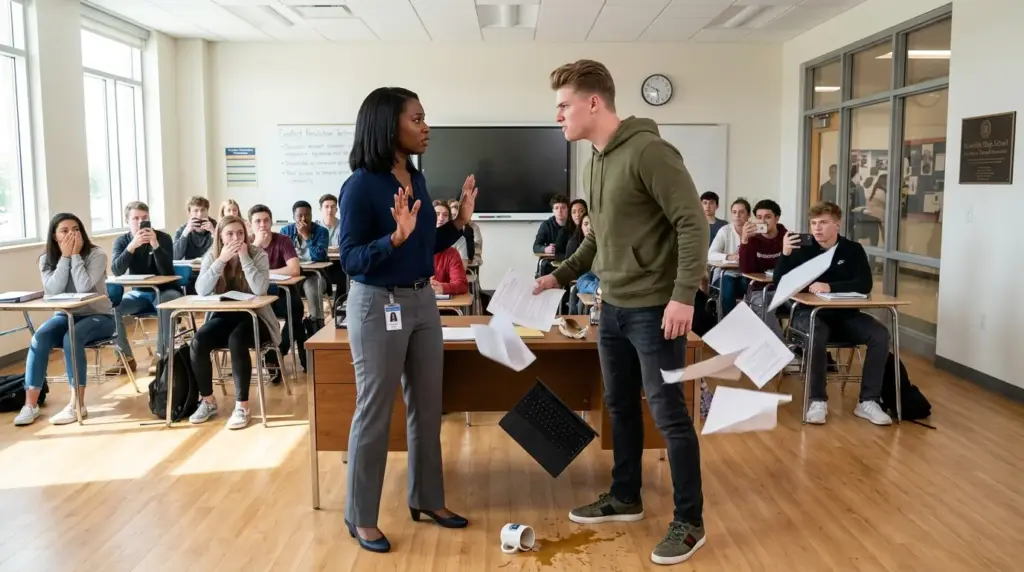
He walked straight to her desk during class while twenty-six students watched.
He was six-foot-two, athletic, and used his height like a weapon.
“You’re making a mistake,” he said.
Maya looked up calmly.
“The mistake was submitting plagiarized work.”
“My dad funds your salary.”
“Then he would want you to earn your grade honestly.”
Tyler leaned down until his face was inches from hers.
“Nobody fails me.”
He slammed her laptop shut.
The sound cracked across the room like a gunshot.
His hand stopped inches from Maya’s fingers.
Maya did not flinch.
“Leave my classroom.”
Tyler smirked.
“Make me.”
Then he walked out and slammed the door behind him.
Maya sat still for five seconds.
Then she opened her grade book and continued the lesson.
Her hands did not shake.
After class, she reported the incident to Principal Watkins. She brought printed evidence of plagiarism. She documented Tyler’s threat.
Watkins sighed before she finished.
“Can we find a compromise?”
“A compromise on academic integrity?”
“Tyler is under immense pressure.”
“That is not my concern.”
“His parents are already upset about last semester.”
Maya looked at him.
“Then maybe someone should tell them their son failed because he chose not to work.”
Watkins leaned forward.
“Maya, you’re putting me in a very difficult position here.”
“I’m doing my job.”
“So am I.”
“No,” Maya said quietly. “Your job includes protecting teachers and students. Not protecting donors from consequences.”
She stood.
“I’ve done my part. Do yours.”
She walked out.
Watkins did not call her back.
He knew she was right.
He also knew what was coming.
That afternoon, Maya found her car in the parking lot with a long scratch keyed down the driver’s side, deep enough to reach metal.
Her phone buzzed.
A text from an unknown number.
You should have given me the grade.
Tyler posted the first video that night.
He had filmed their confrontation from his angle, edited out his threats, removed the laptop slam, and kept only Maya’s face and her words:
Leave my classroom.
His caption read:
Teacher targets me for my background. This is discrimination.
Within twelve hours, the video hit fifty thousand views.
Comments exploded.
Half supported Tyler.
Half called it fake.
Nobody had the full context.
Maya’s phone filled with notifications. Angry voicemails. Emails calling her racist against white students. Direct messages filled with slurs she had not seen since leaving the South.
Someone found her home address and posted it online.
Wednesday morning, Maya’s car would not start.
Someone had poured sugar in the gas tank.
The repair cost eight hundred dollars she did not have.
Thursday, Tyler arrived at class fifteen minutes late with three friends behind him. All four held phones pointed at Maya.
She continued teaching.
They sat in the back row, talking loudly, laughing, filming every attempt to get a reaction from her.
Maya documented everything.
Timestamps.
Names.
Behavior.
She sent reports to Watkins after each class.
Watkins replied with one-line emails.
Noted.
Will address.
Thank you.
Nothing changed.
Friday afternoon, Coach Rita found Maya in her classroom during lunch. Maya was eating half a sandwich at her desk while grading papers.
“You okay?” Rita asked.
“I’m fine.”
“That’s not what I asked.”
Maya set down her pen.
“What do you want me to say?”
“I know what you can do,” Rita said. “And I know what you’re choosing not to do.”
“That’s exactly right. I’m choosing.”
Rita sat on the edge of a student desk.
“He’s escalating. You see that, right?”
“I’m handling it by documenting. By reporting to Watkins.”
Rita shook her head.
“That man cares more about donations than doing what’s right.”
“What would you have me do?”
“Be ready. That’s all I’m saying.”
Then Rita left.
Maya sat alone with half a sandwich, a stack of reports, and the growing certainty that no one with power intended to protect her.
Tyler spent Friday night in his mansion bedroom, scrolling through comments on his video.
Most people believed him now.
The narrative had shifted.
Teacher with anger issues.
Veteran who could not adjust to civilian life.
Pattern of targeting wealthy students.
Tyler smiled.
His father had texted earlier:
Fix your grade situation or you’re cut off.
Two college rejections sat in his inbox. His former classmates posted about campus life, parties, freedom, and everything Tyler believed he deserved.
His phone buzzed.
A group chat with his three friends.
Bro, your video’s blowing up.
She looks so pressed in class now.
What’s next?
Tyler thought about it.





