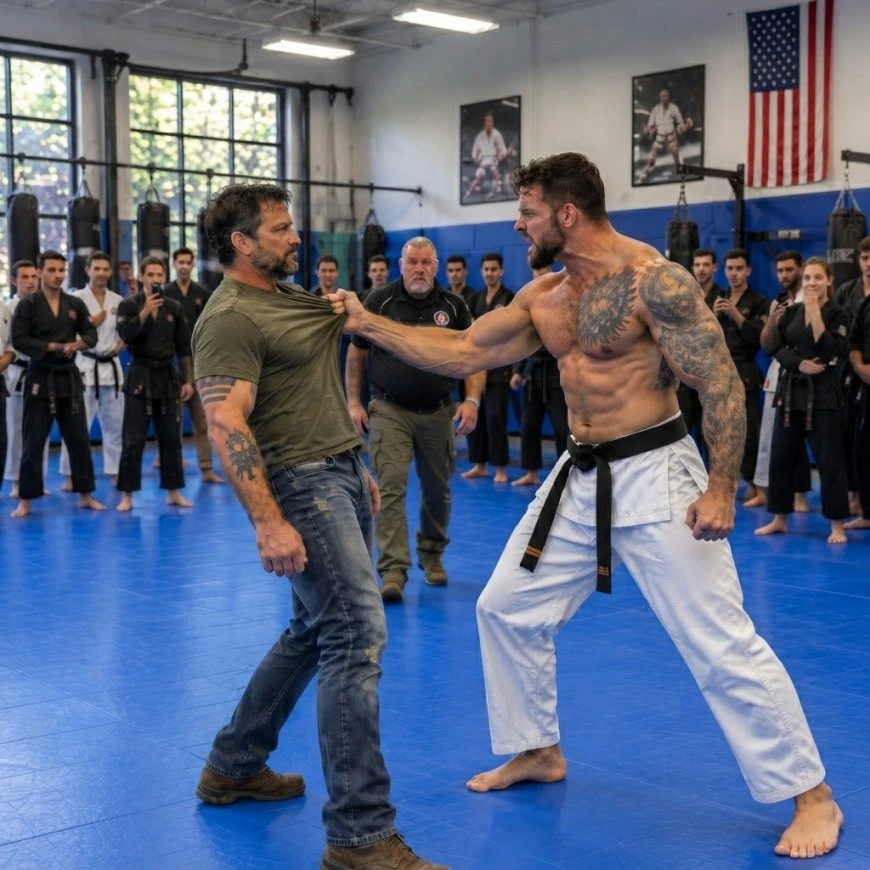
PART 2
When the fabric cleared my shoulders, the atmosphere in the room physically altered.
It was not a subtle shift. It was the immediate, suffocating sensation of all the air being sucked out of a confined space.
The parents and students with their phones raised had expected a joke. They had expected the pale, soft, unconditioned skin of a middle-aged warehouse worker who spent his nights signing clipboards and his days sleeping.
Instead, they were suddenly looking at a topographical map of extreme, sustained violence.
Thick, jagged scarring tracked across both of my forearms, crisscrossing in pale silver lines that disappeared into the sleeves of my tight black undershirt. A massive, raised starburst of scar tissue dominated my left shoulder—the kind of catastrophic physical trauma that does not come from a car accident, a slip in a warehouse, or a bad fall.
It was the kind of tissue damage that only comes from high-velocity impact. Shrapnel.
And there, situated near my lower ribs, partially faded by time but unmistakably clear to anyone who knew the sacred geometry of the crest, was the eagle, the anchor, and the trident.
The Naval Special Warfare insignia.
In the back row, the heavy-set father who had served on a Navy destroyer in the early two-thousands stopped chewing his gum.
His jaw locked. He sat up completely straight in his folding chair, his eyes zeroing in on the faded ink on my ribs. All the casual amusement drained from his face in a single second. He leaned toward the woman sitting beside him, his wife, his voice dropping to a harsh, urgent whisper that carried through the sudden, eerie quiet of the gym.
“Oh my god,” the veteran whispered, his face going noticeably pale.
“What?” his wife asked, irritated. “What is it?”
“That man on the mat,” the veteran said, his voice trembling slightly. “He isn’t a sailor. Not in any ordinary sense of the word. We need to move toward the door.”
Bryce Keller registered the scars the way an arrogant man registers a sudden change in the weather—briefly, and with immediate, reckless dismissal.
He had competed against military veterans before. He had rolled with army mechanics and supply clerks in semi-pro kickboxing tournaments. In his incredibly narrow mind, what the military trained people to do in the desert and what a seasoned, twenty-eight-year-old black belt did on a padded, brightly lit mat were categorically different universes.
He didn’t know I had spent over a decade conducting rapid hostage extractions and close-quarters clearances in rooms much smaller, much darker, and infinitely deadlier than this gym.
Bryce rolled his neck, trying to play to the cameras. He snapped his gloves together, the leather making a sharp crack in the quiet room, and launched his opening combination without ceremony.
He threw a straight right hand, intending to blind my vision, immediately followed by a vicious low kick aimed directly at my lead thigh.
It was a textbook entry. It was designed to chop a man’s base out from under him, cripple his mobility, and end the fight before the amateur even realized it had started.
To the crowd watching through their glowing phone screens, the combination looked terrifyingly fast. A blur of movement.
To me, it moved with the slow, annotated, agonizing clarity of something I had seen ten thousand times in ten thousand different variations.
The right hand passed through empty space.
I hadn’t leapt backward. I hadn’t scrambled or flailed. I had simply tilted my head a microscopic four inches to the left at the exact millisecond the leather fist arrived.
As Bryce’s low kick swung in like a baseball bat, I didn’t retreat. I slightly shifted my weight, grounded my back foot, and raised my shin, turning the absolute hardest part of my bone directly into his incoming strike.
The bones collided.
Crack.
It sounded like a wooden beam snapping in half inside an empty church.
Bryce’s expression shattered.
It wasn’t just physical pain—though the pain radiating up his leg was undoubtedly blinding. It was the sudden, horrifying psychological realization that his best opening strike had severely damaged his own leg, and the man standing across from him in only a pair of socks had barely moved his feet.
The crowd went completely silent.
The only sound left in the gym was the thumping, aggressive bass of the hip-hop track Bryce had left playing on the overhead sound system to make himself look cooler.
Bryce masked his limp with pure ego. He aggressively pushed forward, cycling rapidly through his offense. He was desperate to erase the humiliation of that first blocked kick.
He threw hooks, rapid level changes, and a complex feint sequence that had won him two regional tournaments last year. He swung with genuine technical quality, putting his entire rotational mass behind his tightly wrapped gloves.
None of it landed.
My defensive movements were almost insultingly small. Minimalist.
A tiny shoulder roll that let a cross glide harmlessly past my ear by a millimeter. A slight rotation of the hips that made a crushing body shot glance off empty air. A rear step timed so perfectly that Bryce’s most devastating combinations arrived at a spatial coordinate my head had already vacated a second earlier.
I didn’t counter-attack. I didn’t raise my hands in a traditional guard.
I didn’t gesture to the crowd, flex my muscles, or try to look tough. I simply made his entire offensive arsenal disappear into thin air, over and over again.
Slowly, one by one, the people holding their phones began to lower them.
The math of what they were witnessing was breaking their brains. It violated everything they thought they knew about violence.
Bryce’s breathing was growing ragged. His chest heaved against his rash guard, sweat pouring down his face, his feet dragging slightly on the friction of the mat.
I stood perfectly balanced in the center of his gym, breathing slowly and evenly through my nose. My heart rate was entirely resting. I had not thrown a single offensive strike.





