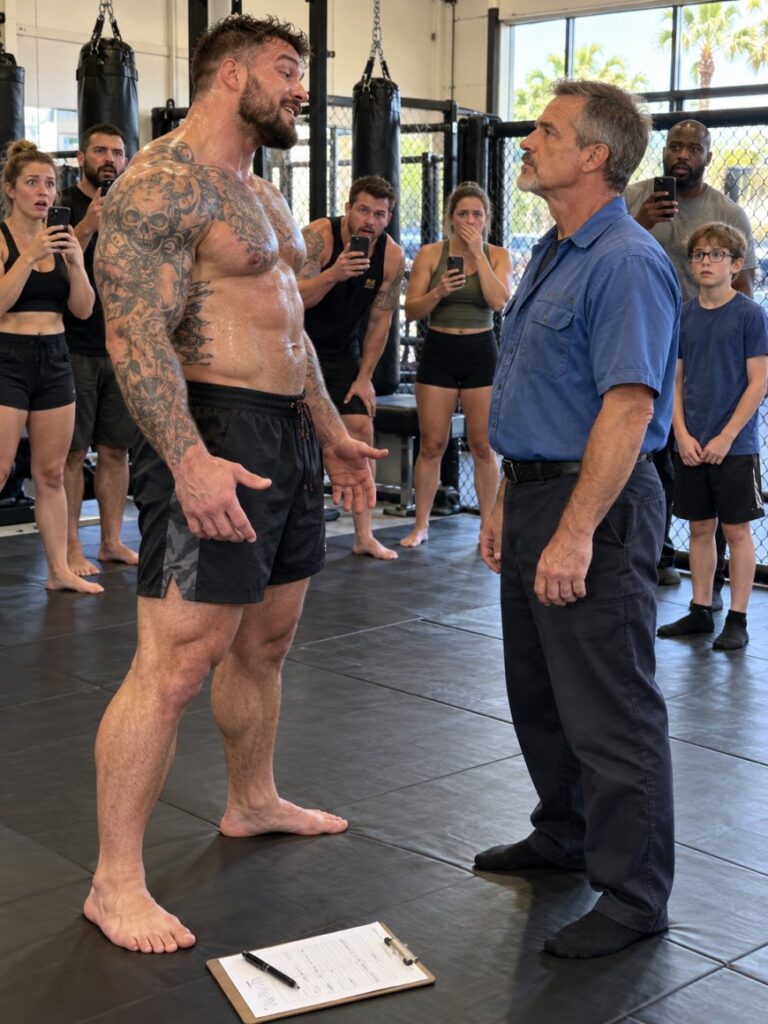
The word was still hanging in the air when I moved.
Not toward him. Toward the center.
My socks made almost no sound on the mat. That seemed to bother Bryce more than anything else. He kept looking at my bare feet, then at my hands, then back at the cameras.
He wanted a reaction. He wanted fear he could film.
I gave him neither.
“Last chance,” he said. “Gloves.”
I shook my head.
“You’re going to regret that.”
“Start when you’re ready,” I said.
The gym had gone so quiet I could hear the ventilation hum above the mat. I could smell rubber, sweat, and the lemon disinfectant they used on the equipment. Someone’s phone camera light blinked near the front row.
Bryce rolled his neck. He bounced twice on the balls of his feet.
Then he came.
His jab was fast. It was meant to measure me, to make me flinch so he could follow with the right hand. I tilted my head maybe three inches. The jab passed by my ear.
His low kick came next, aimed at my lead thigh. I raised my shin just enough. Bone met bone with a flat, heavy sound.
Bryce’s eyes changed.
Not pain. Calculation.
He had expected me to retreat. He had expected me to cover up. He had expected a dock worker in his forties to survive on luck for thirty seconds and then fold.
I hadn’t moved my feet.
He reset and came again. A one-two. A hook. A level change. His technique was real. I’ll give him that. He had trained hard. He had speed.
But he was fighting for the phones.
Every time he threw, his eyes flicked toward the crowd. Every time he missed, his jaw tightened. Every time I didn’t answer, he got louder in his own head.
“You’re just running,” he said.
“I’m standing still,” I said.
A few people laughed. It slipped out before they could stop it.
Bryce heard it. His face darkened.
He came forward with more commitment. A right hand, then a left hook, then a knee. I let the right pass. I rolled under the hook. I turned my hip so the knee caught air.
I didn’t counter.
Not yet.
I was reading him.
His right shoulder dropped a half second before every serious strike. He held his breath when he stepped into range. His eyes fixed on the target before the technique started. And when he got frustrated, he abandoned the plan and reached for something big.
He was a performer. A good one. But performance has patterns.
I had spent years learning patterns.
Bryce threw a combination that would have looked beautiful on a highlight reel. He finished with a spinning back kick. I stepped inside the arc and let it pass behind me.
The room made a sound. Not cheers. A murmur.
He heard it too.
“You think you’re better than me?” he said.
“No,” I said. “I think you’re performing.”
He rushed me.
I caught his wrist.
Not deflected. Not slapped away. Caught. The way you catch a ball thrown at your chest.
He tried to pull back. His arm didn’t move.
I held him there long enough for every person in that gym to understand the position. Long enough for Bryce to feel the difference between strength built for cameras and strength built for survival.
Then I spoke.
“Your right shoulder drops before every hard shot,” I said. “You hold your breath when you enter. Your eyes tell me where you’re going before your feet do.”
His jaw flexed.
“And you’re fighting for the people watching,” I said. “Not for the man in front of you. That’s a losing condition. No matter how good you are.”
I released him.
He stumbled back two steps.
The silence was different now. It wasn’t the silence of an audience waiting for blood. It was the silence of people realizing they had been watching the wrong man the whole time.
Bryce’s face went through several things quickly. Embarrassment. Rage. Then something colder.
“Grappling,” he said. “Let’s see what you’ve got on the ground.”
He shot for my legs.
It was a good takedown. Fast, committed. Against most men, it would have worked.
I sprawled. My hips dropped. His hands found nothing but mat.
Then I secured his wrist, used his own momentum, and brought him down.
He landed on his side. I moved into position, locked his arm, and stopped.
One small adjustment and I could have damaged the joint badly enough that he would never make a fist the same way again.
I held it.
Bryce’s muscles corded. He tried to bridge. He tried to roll. He tried to power out.
Nothing moved.
I leaned close to the side of his head.
“What you’ve been telling these children,” I said quietly, “is that strength gives you the right to hurt someone smaller. That’s not martial arts. That’s not discipline. That’s not instruction.”
He spat something I didn’t catch.
I let go.
I stood and took two steps back.
Being released was worse for him than being submitted. I saw it in his eyes. He understood that I could have ended it there, and I had chosen not to.
To a man like Bryce Keller, mercy was a bigger insult than pain.
He got up slowly. His students were watching. His cameras were watching. The parents who had paid him money were watching.
He smiled, but it was broken at the edges.
“Gloves,” he said. “For fairness.”
I turned toward the equipment shelf.
I shouldn’t have.
I heard the shift of his weight before I saw it. The sharp intake of breath. The slap of his foot on the mat.
He threw a kick at the back of my head.
If it had landed, it would have been over. Not a fight. An injury. A man lying on a gym floor with his son watching.





