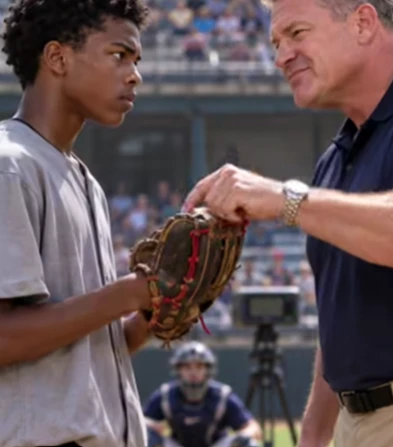
The baseball Coach Brent Harlan chose for Isaiah Reed was so badly damaged that another coach had already thrown it into the practice bucket.
Its white leather was scratched and dirty. Two sections of red stitching had loosened, and a dark brown stain marked the place where it had struck the muddy ground countless times.
Brent held it between his fingers like something unpleasant.
Then he smiled.
“If you throw faster than sixty miles an hour,” he announced, loud enough for the college scouts behind home plate to hear, “you can keep your job.”
Laughter traveled through the bleachers at Dawson Field.
Fifteen-year-old Isaiah Reed stood beside the pitching mound, his worn baseball glove hanging from his left hand.
He was tall for his age but painfully thin, with deep brown skin, short black curls, and dark eyes that revealed more than he wanted anyone to see.
His oversized gray jersey had faded after years of washing. Red string held together the cracked leather of his glove. His black cleats were so worn that he could feel the dirt through one thinning sole.
Brent stepped closer.
“Well, boy? Are you going to throw, or should I find somebody who knows what he’s doing?”
Isaiah looked toward home plate.
Sixteen-year-old Tyler Knox waited behind it, wearing navy catching equipment.
Beyond Tyler, several college recruiters sat with radar guns and notebooks.
A hundred conversations had stopped.
Nearly four hundred families had come to Dawson Field that morning to watch talented young baseball players compete for scholarships and opportunities.
Now they were watching the hired ball boy being humiliated.
Isaiah’s fingers curled tightly around his glove.
He knew Brent expected him to fail.
What Brent didn’t know was that Isaiah had been preparing for this moment for almost an entire year.
And that morning, before the sun had risen above the rooftops, Isaiah had made his mother a promise he was suddenly afraid he might break.
At 4:47 that morning, Isaiah had awakened to the sound of his mother coughing in the kitchen.
Their small house stood in an aging neighborhood on the outskirts of town, where cracked sidewalks disappeared beneath weeds and most families depended on jobs that never seemed to pay enough.
A ceiling fan clicked above Isaiah’s bed.
Across the hallway, his nine-year-old sister Naomi slept beneath a faded yellow blanket.
Isaiah climbed quietly from bed, pulled on his practice clothes, and entered the kitchen.
His mother, Rochelle Reed, sat at the table beneath a flickering fluorescent light.
A stack of bills lay beside her elbow.
Her hotel cleaning uniform hung over the back of a chair, and the dark circles beneath her eyes were deeper than usual.
She was threading a needle through the torn leather of his baseball glove.
“Mom,” Isaiah whispered. “You should be sleeping.”
Rochelle looked up.
“Good morning to you, too.”
She smiled, but Isaiah could see the exhaustion beneath it.
“You got home after midnight.”
“And you have baseball practice before sunrise. Looks like neither of us knows how to behave.”
He stepped closer.
She had been repairing the glove with bright red string because they couldn’t afford a replacement.
The glove had already survived countless practices, two broken laces, and a summer rainstorm that had stiffened its leather.
“It’s going to fall apart anyway,” Isaiah said.
“Not today.”
Rochelle pulled the thread tight.
“There. One more morning.”
Isaiah glanced at the bills.
The electricity payment was overdue.
A grocery receipt lay beside an unopened notice from the landlord.
Rochelle noticed him looking.
“Don’t start worrying about that.”
“I’m not.”
“Isaiah.”
He looked away.
She set down the needle.
“Your job is to be fifteen. My job is to take care of this family.”
“But I can help.”
“You already do.”
Her voice softened.
“Sixty dollars every weekend matters, baby. But it isn’t worth letting somebody convince you that you’re less than anyone else.”
Isaiah didn’t answer.
They both knew whom she meant.
Coach Brent Harlan.
The man who controlled nearly everything at Dawson Field.
Brent operated the Southern Plains Youth Showcase, supervised the elite training programs, and decided which young athletes received access to the stadium’s best equipment.
His sixteen-year-old son, Mason, was the program’s celebrated star.
Isaiah was the boy who carried the buckets.
Rochelle folded her hands.
“Did he give you trouble yesterday?”
“Nothing new.”
“That wasn’t my question.”
Isaiah hesitated.
“He told me to stop watching the bullpen.”
“Why?”
“Said parents weren’t paying to watch the hired help.”
Rochelle’s expression changed.
For a moment, the exhaustion disappeared beneath something harder.
“And what did you tell him?”
“Nothing.”
“Why not?”
“Because Naomi needs groceries.”
Silence filled the kitchen.
Rochelle looked at the glove in her hands.
Then she stood, crossed the room, and pulled her son into an embrace.
He was nearly taller than she was now, but she held him as tightly as she had when he was small.
“Listen to me,” she whispered. “You can work for a man without belonging to him.”
Isaiah swallowed.
“I know.”
“And you don’t have to prove your worth to somebody determined not to see it.”
He wanted to believe her.
But at fifteen, with an empty refrigerator and a dream that seemed to cost more than his mother earned in a month, believing was difficult.
When he left, Rochelle pressed two pieces of toast wrapped in a napkin into his hand.
“Eat both.”
“What about Naomi?”
“She has breakfast.”
“Mom.”
“I said eat.”
He kissed her cheek.
At the doorway, she called after him.
“Isaiah?”
He turned.
“Promise me something.”
“What?”
“Don’t let anyone make you hurt yourself just to earn their approval.”
He smiled faintly.
“I promise.”
Neither of them knew how difficult that promise would become before noon.
Dawson Field looked different in the darkness.
Without spectators, sponsors, or expensive uniforms, it was simply a baseball diamond beneath a pale morning sky.
The bleachers stood empty.
Dew glistened on the grass.
A thin ribbon of mist hovered over the outfield.





