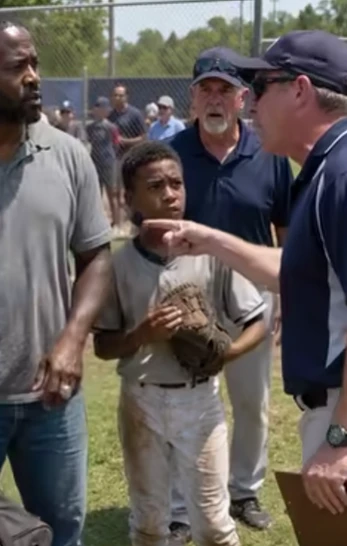
The youth baseball tryout in Georgia was crowded before sunrise.
A gray-blue morning hung over the fields outside Marietta, the kind of early spring morning when the grass was still wet, the metal bleachers were cold, and every parent carried coffee like it was part of the uniform.
The lights above Field Three buzzed against the dim sky.
Kids in matching travel-team jackets jogged along the foul line.
Their bags had embroidered names.
Their bats were wrapped in expensive tape.
Their cleats clicked sharply against the concrete paths as if even their footsteps had been trained.
Parents lined the fence with folded arms and hopeful faces.
Some talked about private hitting coaches.
Some compared tournament schedules.
Some complained about hotel prices for weekend showcases while making sure everyone heard they could afford them.
Near the main gate stood Darius Cole with his twelve-year-old son, Malik.
They did not look like most of the families there.
Malik wore a plain navy jersey with no team logo.
His cleats were clean but scuffed at the toes.
His baseball bag had one zipper that stuck unless he pulled it at the right angle.
Against his chest, he held an old brown glove that had been oiled, repaired, and loved so many times the leather looked almost alive.
His eyes, though, were fixed on the field.
Not on the other kids.
Not on the parents.
Not on the coaches.
The field.
The bright dirt near shortstop.
The white lines.
The batting cage beyond first base.
The mound rising under the lights like a promise.
Darius looked down at his son.
“You ready?”
Malik nodded too quickly.
“Yes, sir.”
Darius smiled a little.
“You don’t have to answer like you’re in court.”
Malik swallowed.
“I’m ready.”
Darius knew he was nervous.
He knew because Malik’s left thumb kept rubbing the heel of the old glove.
He knew because Malik had barely slept the night before.
He knew because at breakfast, Malik had buttered the same piece of toast for nearly two minutes without taking a bite.
Darius had not pushed him.
He had simply packed the water bottles, checked the glove, loaded the old bat into the car, and driven through the dark while Malik stared out the passenger window.
They had practiced for this morning for months.
Before school.
After homework.
In empty parks.
In church parking lots when the fields were locked.
Darius worked nights as a warehouse supervisor now, and sometimes his back ached so badly he had to stretch before throwing batting practice.
But when Malik asked, “Can we take ten more swings?” Darius almost always said yes.
Because baseball had saved Darius once.
Not completely.
Nothing saved a person completely.
But baseball had given him direction when the world wanted him angry.
It had given him discipline when grief made him reckless.
It had given him rooms he never thought a boy from South Georgia would enter.
And now Malik loved it too.
That was the dangerous part.
A father can survive being disappointed for himself.
It is harder when the dream belongs to his child.
Darius walked with Malik toward the registration table.
A white canopy had been set up near the gate.
Three folding tables sat beneath it.
A printed sign read:
NORTH GEORGIA ELITE BASEBALL TRYOUTS
12U AND 13U SELECT PROGRAM
Behind the table sat a woman in a team jacket, typing names into a tablet.
Beside her was a stack of forms, wristbands, and numbered tryout stickers.
Darius waited until she looked up.
“Good morning,” he said. “My son is here for the tryout.”
The woman glanced at Malik, then back at the tablet.
“Name?”
“Malik Cole.”
She typed.
Her lips pressed together.
“I don’t see him.”
Darius kept his voice calm.
“We emailed twice this week. I was told there might still be a walk-up evaluation if space was available.”
“Registration closed yesterday.”
“Yes, ma’am. That’s why I emailed.”
She sighed as if his politeness was already too much work.
“Coach handles exceptions.”
Before Darius could respond, a man in sunglasses stepped under the canopy.
He was in his early forties, broad-shouldered, with a tight team polo and a whistle hanging around his neck.
His cap read NG ELITE.
His name was stitched on the sleeve.
COACH RAY BENTON.
He looked at Darius first.
Then at Malik.
Then at Malik’s glove, his bag, his plain jersey, his scuffed cleats.
The look took less than two seconds.
Darius had lived long enough to understand looks that quick.
They were not observations.
They were decisions.
“What’s the issue?” Coach Benton asked.
The woman nodded toward Darius.
“Walk-up.”
Benton removed his sunglasses and looked Malik over again.
“We’re full.”
Darius stayed polite.
“I understand registration closed yesterday. I emailed twice because we didn’t get the announcement until late. I was told he could still be considered if there was space.”
Benton’s mouth twitched.
“Travel baseball isn’t for everybody.”
Malik’s face changed.
It was small.
A blink.
A tightening around the mouth.
The kind of hurt a child tries to hide because he does not want his father to see it.
Darius placed one hand gently on his son’s shoulder.
“He just wants a fair look.”
Benton smiled.
Not kindly.
“A fair look costs money, time, and the right program.”
A few parents nearby went quiet.
One mother looked down at her coffee.
Another father pretended to check his phone.
The woman at the table stopped typing but did not look up.
Malik lowered his head.
Darius took one slow breath through his nose.
He had learned that breath years ago.
In locker rooms.
In press conferences.
In stadium tunnels.
In rooms where people mistook calm for permission.
He looked at Coach Benton.
“My son has put in the time.”
Benton leaned one hand on the table.
“Look, I’m sure he’s a good kid. But we run a competitive program. We can’t just let anyone walk in because they feel like trying out.”
Darius’s fingers tightened slightly on Malik’s shoulder.





