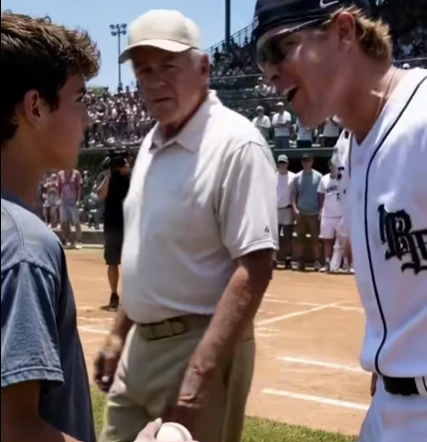
The baseball showcase in southern California was filled with cameras before the first pitch was even thrown.
White tents stood behind home plate.
College scouts sat in folding chairs with clipboards on their knees.
Parents pressed against the fence with phones ready.
Young players in perfect uniforms warmed up under the afternoon sun, their sleeves tight, their cleats clean, their names already printed on glossy roster sheets.
It was the kind of event that made boys feel like stars before they had earned anything.
And standing near the edge of the field, beside the concession stand, was Noah Bennett.
Fourteen years old.
Skinny arms.
Dusty sneakers.
An old baseball glove with cracked leather hanging from one hand.
He had not been invited.
He had only come because his mother worked the concession stand.
Noah was supposed to help wipe tables, refill napkins, and carry cases of water from the storage room to the cooler. His mother, Marisol Bennett, had taken the job for the weekend because rent was due on Monday and her hours at the diner had been cut again.
She had told Noah that morning, “We are here to work, not to dream.”
Noah had nodded.
He always nodded when his mother said something like that.
But every time a pitcher stepped onto the mound, he stopped wiping tables and watched.
Not like a fan.
Like someone remembering something.
He watched the lift of the knee.
The turn of the shoulder.
The way the front foot landed.
The way some boys threw with their whole bodies and others threw like they were fighting themselves.
He noticed things no one had taught him to notice.
At least, no one alive in his house.
The showcase was being held at Westbrook Athletic Park, a private facility hidden behind palm trees, black iron gates, and parking lots filled with SUVs. The field looked too clean to be real. The grass was cut in perfect stripes. The mound had been watered and shaped like a sculpture. The batter’s box lines looked as if they had been drawn with a ruler.
Noah had played on fields with weeds in the outfield and holes near second base.
He had thrown against a brick wall behind his apartment complex.
He had caught pop-ups in parking lots after the stores closed.
This field looked like a place boys like him were supposed to watch from the outside.
At the center of it all stood Jaxon Reed.
Everyone knew Jaxon.
Even people who did not follow youth baseball had seen his videos online. He was fifteen, tall for his age, with a gold chain, custom white cleats, and a swing that coaches described with words like “special” and “projectable.” A camera crew followed him from drill to drill, filming every stretch, every laugh, every slow-motion toss.
His father, Brent Reed, stood behind the fence wearing sunglasses and a polo shirt with Jaxon’s initials embroidered on the chest.
His mother spoke to a reporter near the third-base dugout.
His private hitting coach stood beside the batting cage.
His pitching coach stood beside the bullpen.
Everywhere Jaxon went, adults made room.
Noah watched him for a while, not with jealousy exactly, but with the quiet confusion of someone who wondered what life felt like when the whole field opened before you.
During a break between drills, Noah carried a trash bag toward the dumpster behind the concession stand. The sun was bright enough to make him squint. Sweat ran down the back of his neck. His old glove bumped against his leg with every step.
Then a loose baseball rolled across the grass and stopped near his feet.
Noah froze.
For a moment, it was just a baseball.
Scuffed white leather.
Red seams.
A little dirt pressed into one side.
He bent and picked it up carefully.
The ball settled into his hand like something familiar had found him.
Without thinking, he looked toward the mound.
Jaxon noticed.
He was standing near the dugout with three other players, laughing about something one of the coaches had said. When he saw Noah holding the ball, his smile changed.
“Don’t tell me the snack-bar kid wants to pitch.”
A few players laughed with him.
Noah’s face turned red.
“I just wanted to throw it back.”
Jaxon stepped closer, still smiling.
“Careful. That ball is heavier than it looks.”
The laughter grew louder.
Noah lowered his eyes.
He was used to being invisible.
Invisible was easier.
Invisible did not get mocked.
Invisible did not make his mother look worried.
But the ball was still in his hand, and the mound was still in front of him, and for one strange second, Noah felt like the whole field was waiting for something he did not know how to name.
A coach near the first-base line waved lazily toward home plate.
“Go ahead, kid. One throw.”
He said it like a joke.
Jaxon folded his arms.
“This should be funny.”
Noah looked toward the concession stand.
His mother had her back turned, counting change for a customer.
She did not see him.
That made him braver.
Or maybe more foolish.
He walked to the grass near the fence, far from the mound, because he knew better than to step where he had not been invited. He turned the ball in his hand.
Two fingers across the seams.
Not the way most boys gripped it.
A strange old grip.
Index finger slightly bent.
Thumb tucked deeper than normal.
Pressure along the side of the ball, not the top.
He had learned it from an old photograph.
Not from a coach.
Not from a camp.
Not from any man who had stood beside him and said, “Do it like this.”
Behind home plate, an elderly scout named Walter Hayes suddenly stopped writing.





