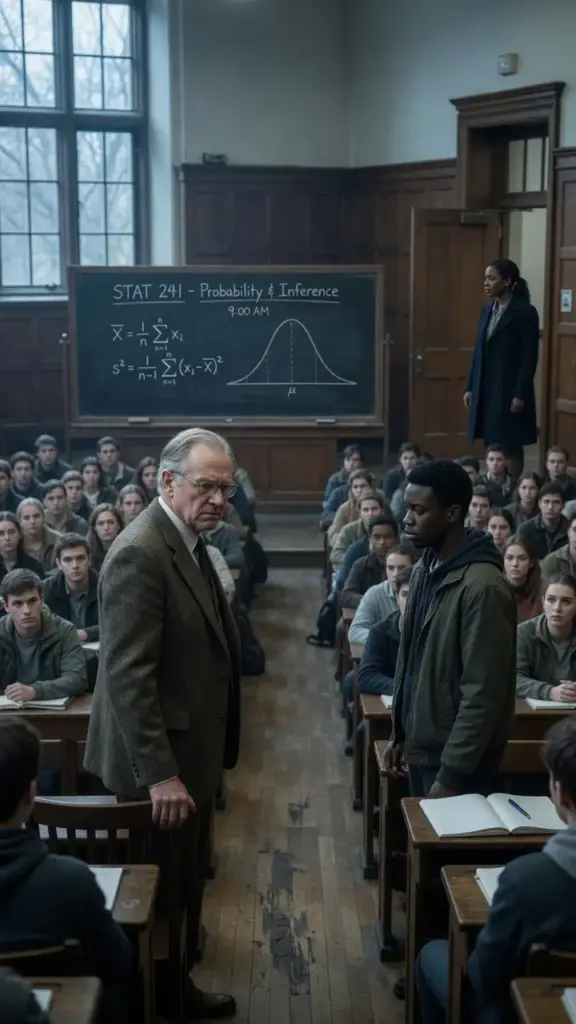
**Who told you that you could sit in the front row?**
“I got here first, Mrs. Hadley.”
“Boy, the only reason you’re here is to fill a quota. Get on the floor. You don’t get a seat you didn’t earn.”
“My GPA is 3.9.”
“Your GPA is charity. Just like your scholarship. Just like every handout your mother begged for while scrubbing toilets.”
“You’ll amount to nothing. You were born nothing. Floor is where nothing belongs.”
200 students watched. Nobody spoke. She didn’t notice the woman standing outside the open door, but that woman heard every word. And she was the one person who could end Mrs. Hadley’s career forever.
The cold hit Owen’s legs before anything else. The tile floor of lecture hall 4B was designed for chair legs and dropped pins, not for a 19-year-old sitting with his back against the wall. He bent his knees at an awkward angle, balanced his notebook on his thigh, and started writing again.
His pencil tip snapped against the page. He didn’t flinch, just reached into his bag, pulled out another one, and kept going. Every letter pressed deep into the paper like he was carving it into stone.
Mrs. Hadley returned to the whiteboard like she’d done nothing more than adjust the thermostat. She drew a bell curve, explained standard deviations, cracked a joke about probability that landed with three hollow laughs, the nervous kind, the kind that buys you one more hour of invisibility in a room where standing out could cost you everything.
A girl in the third row turned around and stared at Owen. Her mouth opened slightly like she wanted to say something. She didn’t. Owen didn’t look up.
His left hand gripped the edge of his notebook until his knuckles went pale. But his right hand kept moving, steady, deliberate. This wasn’t the first time.
Three weeks ago, Hadley assigned group projects and left Owen without a team. “Nobody wants to work with you,” she’d announced to the room. “Perhaps that tells you something about your place here.”
Two weeks before that, she’d graded his research paper a D minus and scrawled in red ink, “Lacks academic rigor. Consider trade school.”
Owen Yates had the highest score on the department entrance diagnostic. He was the first person in his family to step inside a university. His mother, Gloria, worked the day shift at Mercy General Hospital and the night shift cleaning office buildings.
16 hours on her feet so that tuition would never be late again. She called every evening at 9:00. Owen always picked up. Always said the same thing. “Everything’s fine, Mom. Promise.”
It was never fine, but he never told her. Because one complaint from a tenured professor could mean one phone call to the scholarship board. And one lost scholarship meant everything Gloria Yates had sacrificed.
Every double shift, every aching joint, every meal she skipped so he could eat would be for nothing. So, he sat on the floor and he wrote.
40 ft down the corridor, a woman stood motionless outside the open door. No lanyard, no university ID, a plain navy coat, a leather portfolio, and a coffee that had gone cold 20 minutes ago.
Dr. Elaine Crawford had been appointed Dean of the College of Arts and Sciences two weeks earlier. But before the university published her name, she’d made one request. “Give me time on the ground. Let me see what this place looks like when nobody knows who’s watching.”
They gave her two weeks. She arrived that morning listed as a community education consultant. A title so dull nobody would look twice.
She hadn’t expected to find anything in the first hour. She opened her phone, typed the room number, the time, and six words, floor, chair, removed. Amount to nothing.
She looked once more at the boy on the cold tile, spine straight, hand steady, still writing, and walked away without a sound. Day one, room 4B, one professor, one student on the floor, nine days left.
Owen Yates grew up in Ridgefield Courts, four blocks of faded brick apartments where the elevator hadn’t worked since before he was born, and the hallway lights flickered like they were counting down to something. His mother Gloria had lived there for 22 years.
She moved in at 19, pregnant, alone, with a suitcase and $40. Owen’s father left before the birth certificate was signed. No note, no forwarding address, just an empty side of the bed and a gap in the story that Owen learned early not to ask about.
Gloria never sat down. That was the first thing people noticed about her. She worked the morning shift at Mercy General, 12 hours on her feet, changing bedpans, lifting patients twice her size, smiling at families who never learned her name.
When that shift ended, she drove 17 minutes to a commercial cleaning company and spent another 4 hours mopping office floors, wiping conference tables, and emptying trash cans in buildings where people earned in a week what she made in a year.
She did this 6 days a week, sometimes seven. Owen remembered the sound of her keys in the door at 2:00 in the morning, the slow creak of the kitchen chair as she sat down for the first time in 18 hours, the soft hiss of the faucet as she soaked her hands in warm water because her knuckles had cracked again from the cleaning chemicals.
He’d lie in bed pretending to sleep, listening. Every sound she made was a reason to keep going. Owen was the first person in his family to graduate high school with honors, the first to take the SAT, the first to receive a letter from a university that wasn’t a bill or a rejection.
When the partial scholarship came through, tuition covered, room and board on him, Gloria sat at the kitchen table and cried for 40 minutes straight. Not the sad kind, the kind that comes when you’ve been holding your breath for 19 years and someone finally tells you it’s okay to exhale.





