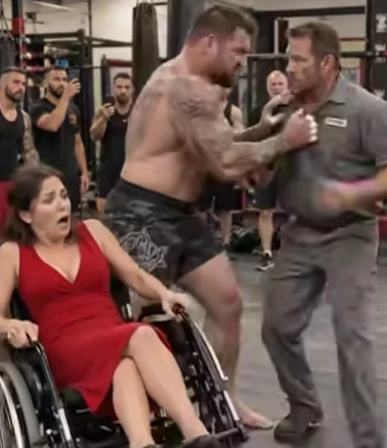
“He controls who gets sparring opportunities. Who gets introduced to promoters. Who gets sponsorship meetings.”
Adrienne nodded.
“That’s why I refused to transfer the contracts.”
Lucas looked at Bennett.
“Everyone’s afraid of him.”
Bennett studied the young man.
“Are you?”
Lucas lowered his eyes.
“Yes.”
Bennett nodded.
“That’s understandable.”
Lucas looked surprised.
“You don’t think I’m weak?”
“No.”
Bennett leaned back.
“Being afraid of someone who can affect your livelihood doesn’t make you weak. It means you understand the situation.”
Lucas stared at him.
Bennett continued.
“The important question is what support you have if you decide to speak.”
Adrienne placed a folder on the table.
“That’s what we’re going to work on.”
For the next two hours, they reviewed the messages, recordings, and contracts Lucas had brought.
Adrienne’s attorney would need to verify the evidence and determine what could be used legally.
But the information suggested Corbin’s behavior was not an isolated incident.
It was a pattern.
And patterns were harder to dismiss.
Two weeks later, the athletic commission opened a formal inquiry into Corbin Vale’s conduct.
Several fighters agreed to provide statements.
The gym’s management suspended Corbin’s access while reviewing the incident.
Sponsors began asking questions.
Corbin’s public image, once carefully built around strength and dominance, began to unravel.
But Bennett wanted no part of the spectacle.
He returned to his work.
He fixed engines.
He helped Tessa with homework.
He continued restoring the 1971 pickup truck.
Then, one Saturday afternoon, Adrienne visited the auto shop.
Bennett was working beneath the truck when he heard her voice.
“Mr. Arkrite?”
He slid out from underneath.
“Adrienne?”
She smiled.
“I hope I’m not interrupting.”
“Not at all.”
She looked around the garage.
“So this is where the famous mechanic works.”
Bennett groaned.
“Please don’t start.”
She laughed.
Then handed him an envelope.
“What’s this?” he asked.
“A proposal.”
He opened it.
Inside was an invitation to help develop a safety and athlete-protection program for young fighters.
Adrienne wanted to create workshops that taught coaches how to recognize intimidation, respond to misconduct, and protect athletes from abuse.
She wanted Bennett involved.
He stared at the document.
“Why me?”
Adrienne looked at him.
“Because you understood something everyone else in that gym forgot.”
“What’s that?”
“That strength means very little if it isn’t used responsibly.”
Bennett looked down at the proposal.
He thought about his military career.
About the people he’d lost.
About the life he’d built afterward.
Then he looked toward the small office where Tessa was drawing pictures while waiting for him to finish work.
“I can’t travel all the time,” he said.
Adrienne nodded.
“You wouldn’t have to.”
“My daughter comes first.”
“She should.”
He studied the proposal again.
Then smiled.
“Maybe we can talk.”
Six months later, the first athlete-protection workshop opened in Las Vegas.
Bennett stood before a group of young fighters, coaches, and parents.
He wore a plain gray shirt.
No medals.
No military decorations.
No dramatic introduction.
Tessa sat in the front row beside Adrienne.
Bennett looked around the room.
“Most people think strength is about what you can do to someone.”
He paused.
“I think it’s more important to ask what you can prevent.”
The room became quiet.
He continued.
“Sometimes protecting someone means speaking up. Sometimes it means getting help. And sometimes it means refusing to let fear decide what happens next.”
He glanced toward his daughter.
She smiled.
Bennett smiled back.
After the workshop, Tessa ran toward him.
“Daddy!”
He lifted her into his arms.
“Hey, sweetheart.”
She looked at the group of athletes leaving the room.
“Did you teach them how to fight?”
Bennett shook his head.
“Not today.”
“What did you teach them?”
He thought for a moment.
“How to make sure people feel safe.”
Tessa nodded seriously.
Then she kissed his cheek.
“That’s better.”
Bennett laughed.
And as he carried her toward the parking lot, he realized something.
For four years, he’d believed his past was something he needed to leave behind completely.
But perhaps the most important parts of that past weren’t the dangerous moments.
They were the lessons he’d learned about responsibility, courage, and protecting others.
He had walked into that MMA gym expecting to repair an air-conditioning unit.
Instead, he’d helped expose a system of intimidation that had frightened young athletes into silence.
He hadn’t become famous because he wanted attention.
He had simply refused to ignore someone who needed help.
And when Tessa asked whether they could stop for ice cream on the way home, Bennett smiled and said yes.
Because despite everything that had happened, the most important part of his life remained exactly where he wanted it.
Beside him.
The End.





