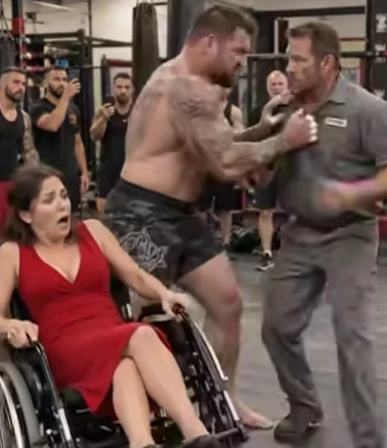
The first man hit the mat with a heavy thud. The second staggered against the cage, clutching his arm, stunned that a mechanic in grease-stained work clothes had stopped him so quickly.
Bennett Arkrite immediately stepped back.
He didn’t raise his fists in celebration. He didn’t smile. He simply placed himself between Adrienne’s wheelchair and the three men.
“Nobody else needs to get hurt,” he said.
Corbin Vale stared at him.
For the first time in years, the heavyweight fighter looked genuinely uncertain.
“Who the hell are you?”
Bennett ignored the question.
He turned slightly toward Adrienne.
“Are you injured, ma’am?”
“My wrist,” she whispered. “And my shoulder.”
Bennett glanced at the red marks forming around her wrist.
Then he looked toward the gym’s front desk.
“Call 911. Tell them a woman has been assaulted and needs medical attention.”
Nobody moved.
Corbin laughed bitterly.
“You think you can walk into my gym, attack my people, and call the police?”
Bennett looked at him.
“Your people attacked me. You assaulted her. There are cameras everywhere.”
Corbin’s expression changed.
His eyes moved toward the security cameras mounted above the training mats.
For a moment, nobody spoke.
Then the gym manager, a nervous man named Peter Lawson, hurried forward.
“Everybody calm down. We can handle this privately.”
Adrienne straightened in her wheelchair.
“No, Peter. We cannot.”
Her voice was shaking, but her words were firm.
“I want the police.”
Peter hesitated.
Corbin turned toward him.
“Don’t you dare.”
Bennett looked at the manager.
“Make the call.”
Something in his voice ended the discussion.
Peter reached for his phone.
Four years earlier, Bennett had returned from his third military deployment carrying injuries that weren’t visible beneath his uniform.
He had served twelve years in the Army, including assignments that demanded patience, discipline, and the ability to make decisions when everything around him was falling apart.
People assumed combat veterans missed the excitement.
Bennett didn’t.
He missed the men he’d served beside.
He missed the certainty of knowing who would stand beside him when things became difficult.
But he didn’t miss violence.
He had seen what it did to families.
To children.
To people who happened to be standing in the wrong place at the wrong moment.
When he left the military, he made himself a promise.
He would build a life where his daughter never had to wonder whether he was coming home.
Tessa was four when he returned.
Her mother had died from complications following an illness two years earlier, leaving Bennett to navigate fatherhood alone.
At first, he struggled.
He knew how to repair military vehicles in terrible conditions.
He knew how to function without sleep.
He knew how to remain calm during emergencies.
But he didn’t know how to braid a little girl’s hair.
He didn’t know which stuffed animal had to sit beside her pillow.
And he certainly didn’t know how to explain why some children had two parents waiting at school pickup while Tessa had only one.
So he learned.
He watched tutorials.
He practiced hairstyles on a mannequin head borrowed from a neighbor.
He attended every school event he could.
And when Tessa asked whether he would ever leave for another deployment, he knelt beside her and said, “Not again, sweetheart. I’m staying.”
He kept that promise.
For four years, he worked as a mechanic, paid his bills, and stayed away from anything that resembled his former life.
Until that Tuesday afternoon.
Police arrived at the MMA gym twelve minutes after the call.
By then, Corbin had recovered his confidence.
He stood near the cage with his arms folded, telling everyone who would listen that Bennett had attacked his training partners without provocation.
When Officer Elena Ruiz entered, Corbin immediately approached her.
“Officer, this guy came in here and assaulted two of my employees.”
Ruiz looked at Bennett.
“Sir, what’s your name?”
“Bennett Arkrite.”
“Can you explain what happened?”
Bennett nodded toward Adrienne.
“That woman was being physically restrained. I asked him to release her. His associates attacked me when I intervened.”
Corbin scoffed.
“That’s a lie.”
Adrienne raised her voice.
“No. It isn’t.”
Everyone turned toward her.
She held up her injured wrist.
“He grabbed me because I refused to sign a contract. Then he shoved my wheelchair hard enough that I nearly fell.”
Ruiz’s expression became serious.
“Do you want to make a formal complaint?”
“Absolutely.”
Corbin stepped forward.
“Adrienne, think carefully about what you’re doing.”
Bennett turned toward him.
“Don’t threaten her again.”
Corbin’s jaw tightened.
But Officer Ruiz was already reaching for her radio.
“Sir, step away from her.”
A second officer began collecting witness statements.
Within minutes, the situation became far more complicated than Corbin had expected.
Three young fighters admitted they had witnessed the confrontation.
One had recorded part of it.
And the gym’s security system had captured the entire incident.
Corbin’s lawyer arrived forty minutes later.
By then, the officers had already separated the parties and begun documenting the allegations.
Bennett gave his statement, provided his contact information, and asked whether Adrienne needed assistance contacting someone she trusted.
She looked at him.
“Actually, yes.”
Adrienne Whitmore had built her sports management company from a single rented office into a multimillion-dollar business.
She represented professional athletes, negotiated sponsorship agreements, and helped young fighters understand contracts that could determine the course of their careers.
She had used a wheelchair since a car accident seven years earlier.
But she had never allowed anyone to mistake her disability for a lack of authority.
Corbin Vale had made that mistake repeatedly.
For months, he’d pressured her to transfer the management rights of three promising fighters to an agency controlled by one of his business partners.
The contracts would have given the new agency substantial control over the athletes’ earnings.
Adrienne refused.
She believed the arrangement was unfair.
Corbin believed his celebrity and financial influence would eventually force her to cooperate.
That afternoon, he had decided intimidation would accomplish what negotiation couldn’t.





