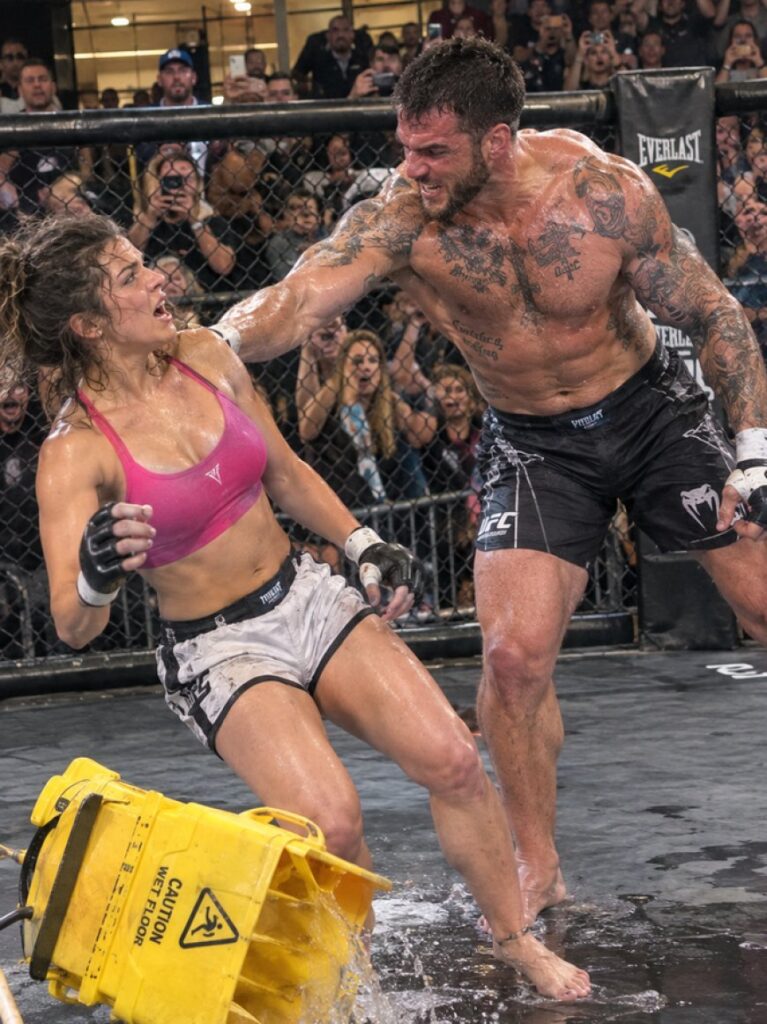
Either way, his character growth wasn’t my responsibility to manage.
I simply nodded once, acknowledging the words, and stepped backward.
Two panicked crew members from the sports network scrambled onto the stage.
They grabbed Bronson under the arms and hauled him awkwardly to his feet, trying to shield him from the roaring crowd.
It was in that chaotic, deafening moment that the crowd near the back began to shift.
A man was walking slowly down the center aisle, moving toward the stage.
He was older than most people in Mil Haven remembered.
His hair was entirely silver, swept back from a face weathered by two decades of hard labor and quiet isolation.
He wore a simple, faded jacket, his posture slightly stooped but undeniably solid.
He moved carefully, deliberately, his worn boots silent against the community center floor.
The crowd parted around him exactly the way they had parted for me minutes earlier.
People stepped aside instinctively, though nobody quite understood why yet.
They just sensed the gravity of the man walking past them.
Opel Jennings, the diner owner, was the first to recognize him.
She stood near the front row, her hands resting on the back of a folding chair.
As the man stepped into the light, Opel’s hand flew to her chest in shock.
Her eyes filled instantly with hot, sudden tears.
“Thomas,” she breathed, the single word cutting through the noise around her.
I turned my head at the sound of the name.
The wooden stage suddenly seemed to tilt beneath my feet.
The roar of the crowd faded into a dull, distant hum in my ears.
Standing right at the edge of the stage, looking up at me, was my father.
He looked noticeably older than the yellowed photograph I kept hidden in my closet.
Deep lines bracketed his mouth, and his shoulders carried a heavy, invisible weight.
But there was absolutely no mistaking him.
He had the exact same steady, patient way of watching a room that I had carried in my own bones my entire life.
I had spent twenty-two years without him, never fully understanding where my own quiet instincts had come from.
Now, the answer was standing right in front of me.
“Dad,” I whispered.
My voice came out incredibly small, completely stripped of the fierce power I had just shown in the fight.
Thomas Ree placed his hands on the edge of the stage.
He climbed the two small wooden steps slowly, careful not to trip.
His dark eyes never left my face for a single second.
He stopped a few feet away from me, his hands trembling slightly at his sides.
“I’m sorry it took me this long,” he said.
His voice was rough, thick with disuse and decades of buried emotion.
“I told myself I was protecting you,” he continued, taking a hesitant step closer.
“I told myself staying away was giving you a chance to build a clean life.”
He swallowed hard, fighting to keep his composure in front of the massive crowd.
“The truth is, I think I was just protecting myself.”
He reached out, his calloused hand hovering in the air between us.
“I was terrified of having to explain what happened. Terrified of seeing the disappointment in your eyes.”
“I’m not disappointed,” I said, my throat tightening painfully.
Hot tears finally broke free, tracing rapid paths down my cheeks.
All the rigid composure I had held onto for three long years completely collapsed.
The walls I had built after Everett died shattered into dust.
“I’m just glad you’re here,” I sobbed.
He stepped forward and pulled me into a fierce, desperate embrace.
Neither of us was willing to end it anytime soon.
I buried my face in his jacket, breathing in the scent of motor oil, old cotton, and something uniquely him.
He wrapped his arms around my shoulders, holding me tighter than he ever had when I was a child.
The entire town watched us from the floor below.
Many of the regulars were wiping their own eyes, the sheer emotional weight of the moment catching everyone off guard.
For twenty-two years, this town had quietly buried his name.
Now, they were standing witness to his resurrection.
“I watched from the back of the room,” my father murmured into my hair, his voice shaking.
He pulled back just enough to look at me properly, his hands gripping my shoulders.
“That combination you threw against him.”
He offered a watery, incredibly proud smile.
“You threw it exactly the way I taught you all those years ago. Maybe even better.”
“Silas taught me again this week,” I sniffled, wiping my eyes with the back of my wrapped hand.
“He told me you two used to work together on it.”
My father turned his head toward the front row.
Silas stood perfectly still near the edge of the stage, his hands resting in his pockets.
A rare, completely unguarded smile had broken across the old janitor’s weathered face.
He looked like a man who had finally set down a burden he had carried for two decades.
“Best twelve years of my life,” my father said to him, his voice thick with gratitude.
He stepped toward the edge of the stage, looking down at his former cornerman.
“Most of them, anyway. I owe you more than I’ve ever properly said out loud, Silas.”
“You could start now,” Silas said softly.
The old man cleared his throat, clearly fighting to keep his own emotions in check.
My father let out a short, rough laugh, wiping quickly at his own eyes.
“I suppose I could.”
I studied my father’s face, hungrily searching it for all the years we had missed.
I looked for all the birthdays, the ordinary Tuesdays, and the quiet evenings that should have belonged to both of us.
“Where have you been all this time?” I asked, my voice barely a whisper.
“Not far, actually,” he replied, turning back to me.





