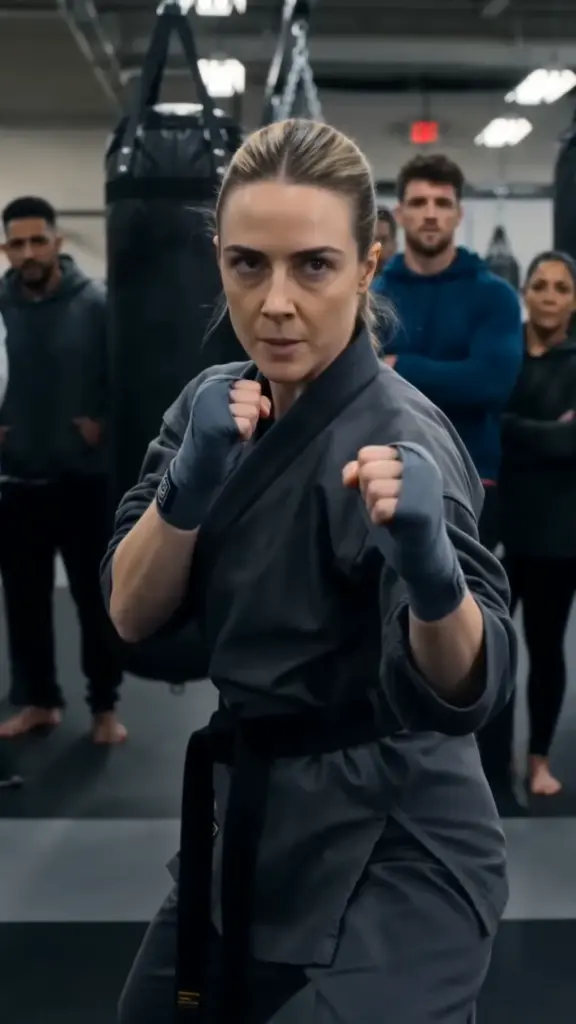
The entire class froze.
Brandon tasted blood.
Not much.
His old instinct arrived immediately.
Pressure.
Dominance.
Make sure the kid understands.
Then he remembered Frank’s sentence.
I don’t trust you with another person’s body.
He took a breath.
The teenager looked terrified.
Brandon removed his glove.
“You okay?”
The kid blinked.
“I hit you.”
“I noticed.”
“I’m sorry.”
“Good.”
Brandon smiled.
“Now let’s fix why it happened.”
Frank watched from across the room.
Mia happened to be there.
She looked at Frank.
“Better.”
Frank smiled.
“Don’t praise him. He’ll become unbearable.”
Brandon heard.
“I can hear you.”
“Good.”
Months passed.
Mia trained regularly with the advanced class.
She was not unbeatable.
That became important.
A collegiate wrestler half her age took her down cleanly.
A boxing coach caught her with a sharp jab.
Brandon eventually scored a controlled sweep against her.
When Mia hit the mat, the whole room went silent.
Then she looked up.
Brandon looked horrified.
Mia started laughing.
“You’re allowed to win.”
The room relaxed.
He extended a hand.
She took it.
“That was good.”
Brandon smiled.
“I’ve been waiting nine months to hear that.”
“Don’t ruin it.”
Frank watched.
The gym had changed.
But not because everyone became nicer.
That would have been unrealistic.
People still argued.
Still got jealous.
Still trained too hard sometimes.
Still said stupid things.
The difference was what happened next.
Silence no longer protected bad behavior as easily.
Frank had created a rule he hated calling a rule:
If you saw a safety problem, status did not matter.
Beginner could stop black belt.
Woman could stop man.
Student could stop coach.
No one lost face for protecting the room.
Some older members resisted.
Two left.
Frank let them.
One accused the academy of becoming soft.
Mia heard.
She asked Frank:
“You worried?”
He shrugged.
“I spent thirty years confusing retention with success.”
“What changed?”
“Age.”
“Really?”
“No. Evelyn’s daughter yelling at me.”
“I never yelled.”
“Your face did.”
Mia smiled.
A year after her first visit, Frank received a letter.
No return address.
Inside was a photocopy of an old evaluation from the military program where Evelyn had been removed.
Someone had recently digitized archived records.
One section had been redacted years earlier.
Now restored.
It included evaluator comments.
Three evaluators had praised Evelyn’s program.
One criticized it.
Louis Mercer.
The official recommendation for removal had come directly from his summary.
Frank read the final line twice.
Instructor Lawson demonstrates technical excellence but lacks the temperament required to command respect among high-performance male personnel.
Frank sat alone in his office for twenty minutes.
Then called Mia.
She arrived the next day.
Read the page.
Said nothing.
Frank waited.
Finally Mia laughed.
It was not a happy laugh.
“Temperament.”
“Yes.”
“My mother had more temperament than any ten people.”
“I know.”
Mia put the document down.
“What do you want to do with this?”
Frank said:
“Correct the history.”
“How?”
“The organization that inherited the training records has an alumni archive.”
Mia looked at him.
“You want them to issue something.”
“Yes.”
“Twenty-two years later.”
“Yes.”
“Mom’s dead.”
“I know.”
“Mercer’s dead.”
“I know.”
“So who is it for?”
Frank stopped.
That was the right question.
Mia continued:
“If you’re doing it because you need someone official to tell you she was wronged, don’t.”
Frank nodded.
“If you’re doing it because her professional record still says she failed, then do it.”
Frank looked at the page.
“That’s exactly why.”
They submitted a correction request.
It took five months.
Several former instructors provided statements.
Frank wrote the hardest one.
He admitted he had witnessed the process.
Admitted he had failed to object publicly.
Admitted that parts of his own academy curriculum were based on Evelyn’s work.
Brandon helped him type the final draft.
“Why me?”
“Because you use punctuation better than I do.”
“That’s insulting.”
“It’s true.”
Eventually the archive amended Evelyn Lawson’s record.
Not with dramatic exoneration.
No medal.
No ceremony.
Simply a formal note:
The prior removal recommendation had relied on evaluator criteria later found inconsistent with documented program standards; subsequent review recognized Lawson’s technical and instructional contributions.
Mia read it once.
Then put it in her mother’s old notebook.
Frank asked:
“That’s it?”
“What were you expecting?”
“I don’t know.”
“Fireworks?”
“Maybe tears.”
Mia looked at him.
“I cried in the car.”
Frank smiled.
“Good.”
“That sounded terrible.”
“I meant—”
“I know.”
Two years passed.
Frank turned seventy.
He retired from day-to-day operations.
Nobody believed him.
He still arrived every morning.
He simply stopped pretending he ran everything.
A new coaching board took over.
Brandon became one of the senior instructors.
Mia accepted a formal advisory role, on one condition:
“I’m not running the place.”
Frank said:
“You are impossible.”
“I learned from my mother.”
“Correct.”
The academy expanded its women’s program.
Not with pink gloves.
Not with marketing slogans.
Just more instructors.
More beginner pathways.
More clear standards.
More opportunities.
One night, Mia walked into the advanced session.
A new woman was standing by the heavy bag.
Twenty-seven.
Nervous.
Black belt from another gym.
Three men were watching her.
One whispered something.
Another laughed.
Mia stopped.
Brandon heard too.
He walked over.
The room noticed.
For one second, Mia wondered which Brandon had arrived.
The old one.
Or the new one.
He looked at the three men.
“What’s funny?”
One shrugged.
“Nothing.”
“Then train.”
They moved.
The woman looked relieved.
Brandon turned to her.
“First day?”
“Yes.”
“Background?”
“Karate. Some judo.”
“Cool.”
He pointed toward the mat.
“You’re with Denise.”
No test.
No joke.
No demand to prove she deserved the belt.
Just placement based on experience.
Mia watched.
Frank was sitting near the wall with coffee.
He looked at her.
She looked at him.
Neither needed to say anything.
Later, after class, Brandon found Mia wrapping up.
“Do you remember what I said the first day?”
“Yes.”
He winced.
“Immediately?”
“Unfortunately.”
“Do you ever forget anything?”
“Useful things? No.”
He leaned against the wall.
“I think about it sometimes.”





