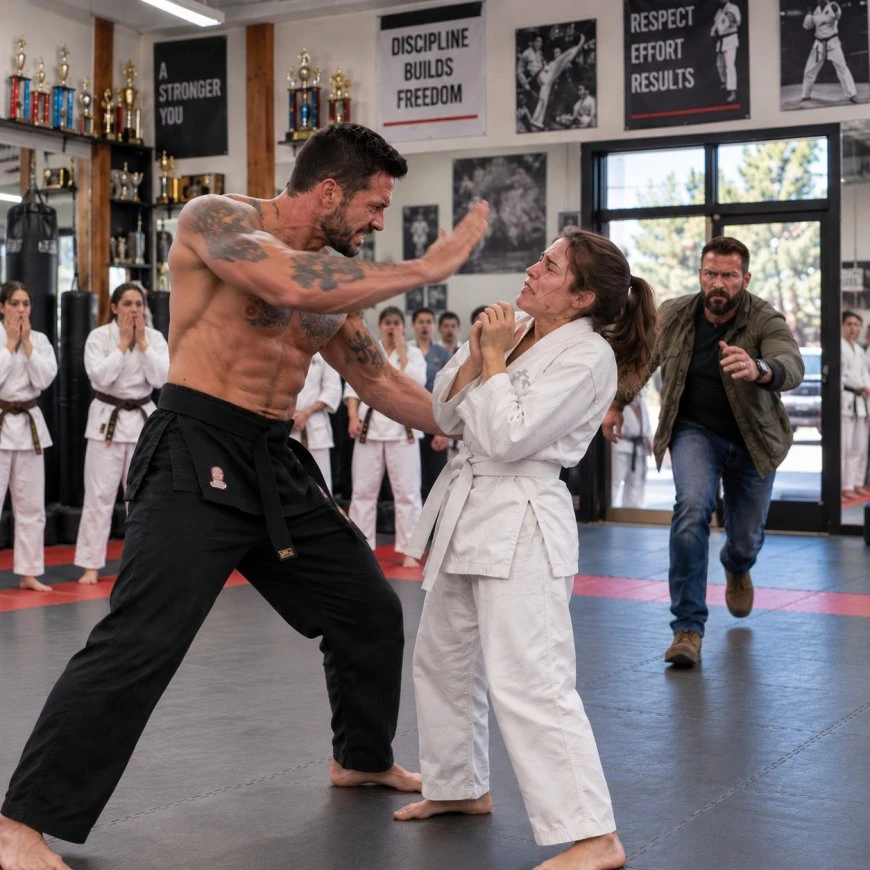
As Riley walked toward the edge of the mat, she stopped right in front of the other two teenage black belts. Instinctively, without a word being spoken, both boys took a half-step backward, their eyes wide, giving her a wide berth. She didn’t look at them. She simply reached down, picked up her neatly folded white gi from her duffel bag, and walked out the double glass doors without looking back.
The drive back to our cramped apartment was quiet. The rain, which had been a constant companion since we moved to this Pacific Northwest town, was coming down harder now, washing the neon storefronts into smeared, blurry streaks of red and blue across the windshield. I kept the heater blasting, the fan roaring loudly in the cab of the beat-up Ford, trying to chase the damp cold away from my aching right ankle. The titanium pin inside my bone throbbed with a dull, rhythmic ache, a souvenir from a roadside bomb that ended my military career and sent me home to a life I barely recognized.
I glanced in the rearview mirror. Riley was sitting in the back, staring out the window, watching the rain race along the glass. She hadn’t said a word since we left the strip mall. Her hands were folded quietly in her lap.
I pulled into a greasy, brightly lit drive-through on the edge of town and bought us two double cheeseburgers and a large order of fries to share. It wasn’t exactly high-performance athlete fuel, but the refrigerator at the apartment was mostly empty, and my VA disability check, combined with the meager wages from my night security job, meant payday wasn’t until Friday.
We ate in the truck in the parking lot of our apartment building, the engine idling to keep the heater going. The rain drummed a heavy, steady beat against the roof of the cab.
“You okay, squirt?” I asked, tossing a French fry into my mouth.
Riley chewed her bite of burger methodically, swallowed, and looked at me. “His footwork was terrible, Dad.”
I let out a loud, barking laugh. It startled me. The sound was unfamiliar, echoing strangely in the cab of the truck. I hadn’t laughed like that in months, probably not since before Sarah died. “Yeah, kid. It really was. He crossed his feet twice before he even threw a punch. If he had tripped, he would have knocked himself out.”
“He was angry,” Riley noted, her voice clinical, devoid of childish emotion. “Anger makes you blind. It makes you heavy.”
“It does,” I agreed soberly, the smile fading from my face as I looked out into the rain-soaked parking lot.
I knew a lot about anger. I carried it in my chest every single day, a heavy, suffocating weight that never entirely left me. I was angry at the drunk driver who had run a red light two years ago and taken my wife from me in a twisting mass of metal and shattered glass. I was angry at the judicial system that gave him a slap on the wrist. I was angry at a government that sent me off to a sandbox to bleed for my country, only to forget about me when I came back broken, leaving me to fight for every meager dime of my disability benefits. I was angry at the damp, freezing weather of this new town, a place we had moved to purely because the rent was cheap enough for us to survive.
But I looked at my daughter. She was so calm, so incredibly disciplined, and I realized with a profound sense of humility that she was managing her grief far better than I was managing mine.
When Sarah died, Riley had stopped speaking for almost three months. She withdrew into a dark, silent shell, the vibrant, laughing little girl I knew seemingly gone forever. Desperate, I had taken her to a dusty, converted warehouse dojo in Texas run by an old, grizzled judoka. I didn’t know what else to do. I just needed her to be around people, to have an outlet.
That dojo saved her life. It gave her a framework for her pain. It taught her how to compartmentalize the utter chaos of a world that could steal your mother on a Tuesday afternoon into manageable, three-minute rounds. It taught her that while you cannot control what happens to you, you can control your breathing, your balance, and your response.
I couldn’t let that die just because this new town was full of frauds and strip-mall businessmen posing as warriors.
That night, after Riley was asleep in her small, sparsely furnished bedroom, I sat at the tiny kitchen table. The apartment smelled faintly of cheap bleach and old carpeting. I cracked open a cheap domestic beer and opened my laptop, the screen casting a pale blue glow across the cramped kitchen.
I skipped Google entirely. The flashy gyms with SEO-optimized websites, the places that promised “confidence building” and “black belt guarantees,” were out. Instead, I dug deep. I logged into a few local community forums, scrolled through amateur boxing group pages, and searched for names that consistently popped up in the comments of local grappling tournament results—the places that didn’t run ads because they didn’t need to.
Around two in the morning, my eyes burning and my ankle throbbing a dull rhythm, I found it.
It was a grainy, poorly lit photo of a cinderblock building located down near the industrial rail yards, an area of town mostly occupied by mechanics, supply warehouses, and rusted chain-link fences. There was no website. There was no class schedule posted online. Just an address, a phone number, and a name painted on a piece of plywood above a garage door: Sullivan’s Boxing and Grappling.
The next afternoon, the endless rain finally broke, leaving the air heavy, thick, and smelling of wet asphalt and diesel exhaust. I drove the Ford past rows of corrugated metal warehouses, navigating potholed streets that shook my bad ankle with every bump.





