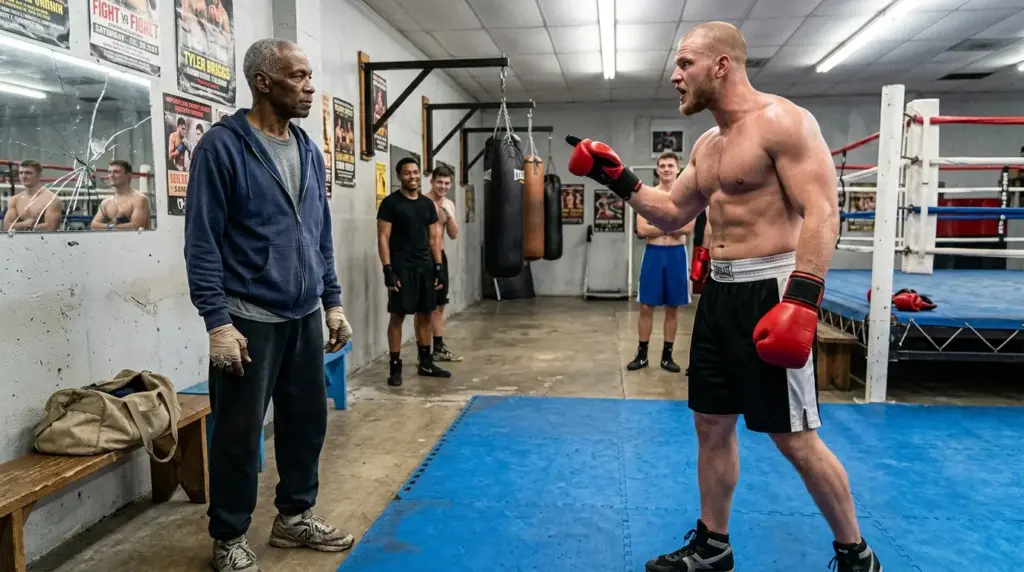
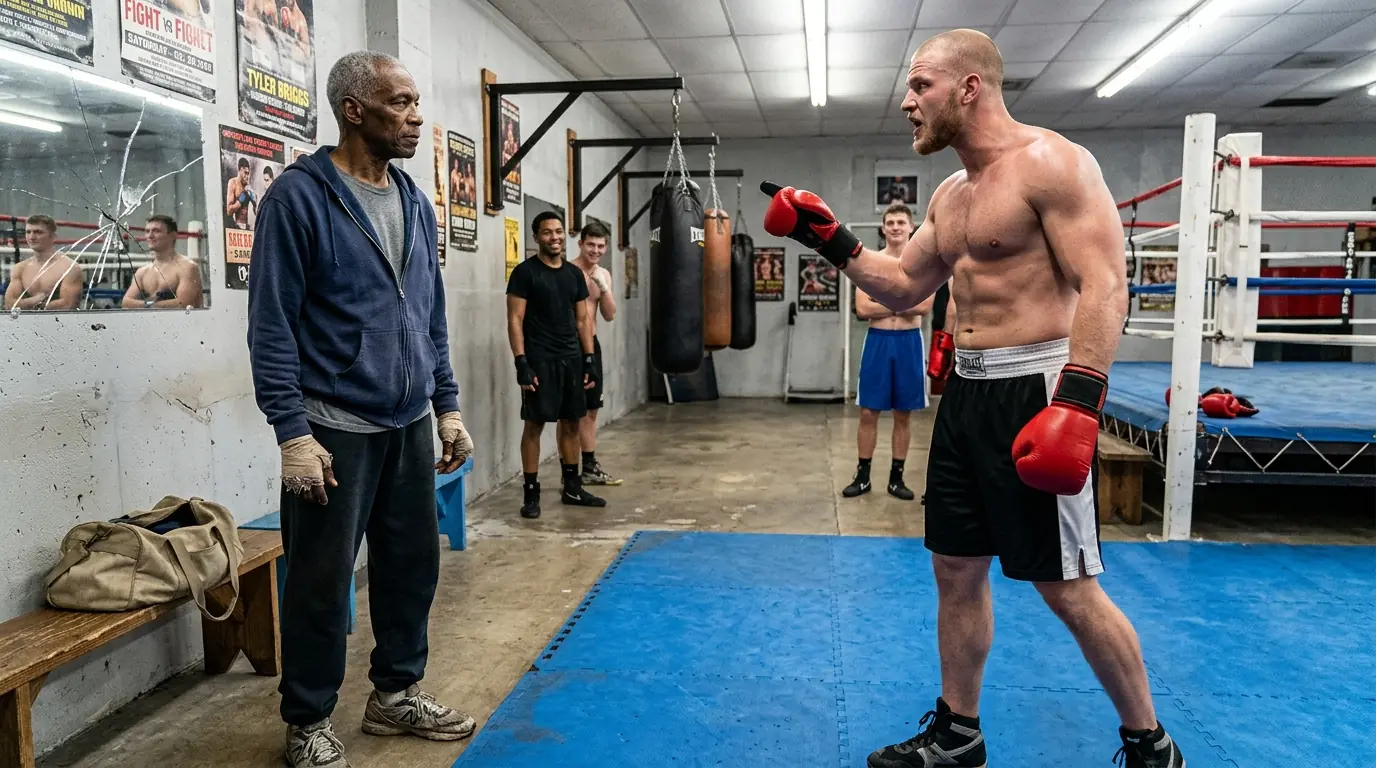
The Bully Told the Old Man to “Go Home” — Then He Saw the Fighting Stance
“Go home, old man,” Tyler Briggs said. “This place is for fighters.”
The words carried across the gym louder than the music.
Heavy bags swung slowly from chains. Gloves slapped against pads near the far wall. The smell of sweat, rubber mats, and cheap disinfectant hung in the air beneath the buzzing lights.
Everyone heard him.
Everyone looked.
Then, one by one, most of them looked away.
That was how bullying survived in places that claimed to build courage.
People saw enough to know it was wrong, then found something else to adjust.
A glove strap.
A water bottle.
A phone screen.
A shoelace that did not need tying.
The old man stood near the entrance with a small canvas gym bag in one hand and a folded membership form in the other.
His name was Samuel Whitaker.
He was seventy-two years old.
Thin, but not fragile.
Gray-haired, but not bent.
He wore plain navy sweatpants, a faded white T-shirt under an old zip-up jacket, and walking shoes that looked more suited for a grocery store than a boxing gym.
His hands were large, knuckled, and veined.
His face was narrow, with deep lines around the eyes and mouth, the kind carved not by age alone but by long years of holding more inside than the world ever asked about.
Samuel did not answer at first.
He only looked at Tyler.
Not offended.
Not frightened.
Just looking.
That made Tyler smirk.
Tyler Briggs was twenty-four years old, six foot two, heavily muscled, with a shaved head, a short blond beard, and the restless energy of a man who needed an audience to feel real. He was the loudest fighter at Harbor Street Boxing Club, though not the best.
He had won several amateur bouts.
Enough to think he was dangerous.
Enough to make newer members nervous.
Enough to make the coaches tolerate him because he brought attention, ticket sales, and noise.
Noise, in a gym like that, often got mistaken for value.
Tyler stepped closer to the old man.
“You lost?” he asked. “Senior center’s three blocks down.”
A few young men near the ring laughed.
Samuel folded the membership form slowly.
“I’m here for the evening class.”
That made the laughter louder.
Tyler turned toward the room, spreading his arms.
“He’s here for class.”
He looked back at Samuel.
“What class? Chair boxing?”
Samuel’s expression did not change.
“I called this morning. They said beginner conditioning starts at six.”
Tyler glanced toward the office.
Coach Ray Donovan, the gym owner, stood behind the front desk with a towel over one shoulder and a phone in his hand. He had heard every word. He could have stepped in.
He did not.
Ray was fifty-five, thick around the middle now, but still broad through the shoulders. Twenty years earlier, he had trained serious fighters. Now he ran a gym that survived on monthly memberships, youth classes, and social media clips.
Tyler was good for business.
That was the excuse Ray used when Tyler mocked beginners, went too hard in sparring, or humiliated people who did not know how to defend themselves yet.
“He’s just intense,” Ray would say.
“Kid’s got a fighter’s mentality.”
“He’ll grow out of it.”
But Tyler had not grown out of it.
He had grown into it.
Samuel looked toward Ray.
“I paid online.”
Ray cleared his throat.
“Yeah, Mr. Whitaker. You’re on the list.”
Tyler laughed.
“You serious, Coach? You’re letting him on the floor?”
Ray forced a weak smile.
“Everybody starts somewhere.”
Tyler looked Samuel up and down again.
“Some people should’ve started fifty years ago.”
Samuel placed his gym bag on the bench.
He unzipped it and removed a pair of old hand wraps.
They were clean, but faded from use.
Not new.
Not decorative.
He began wrapping his left hand.
Slowly.
Carefully.
The room watched now.
Something in the old man’s hands made people quieter.
Not because they understood.
Because the movement did not match the joke.
Samuel wrapped like someone who had done it thousands of times. Around the wrist. Across the palm. Through the fingers. Back across the knuckles. Smooth, economical, without looking down more than necessary.
Tyler noticed too.
His smirk held, but his eyes narrowed.
“You watch a YouTube tutorial before coming in?”
Samuel finished the left hand and started the right.
“My father taught me.”
“What, back in the Civil War?”
More laughter.
Samuel tugged the wrap tight.
“My father said a man should not speak more than his skill can carry.”
The laughter thinned.
Tyler’s smile hardened.
“What’s that supposed to mean?”
Samuel looked up.
“It means you talk a lot.”
The room changed.
Just a little.
Enough for Tyler to feel it.
His face flushed.
“You got jokes?”
“No.”
Samuel tucked the end of the wrap neatly under his wrist.
“I have arthritis.”
That got a real laugh from someone near the heavy bags.
Tyler turned sharply.
The laugh died.
Then he looked back at Samuel, stepping closer until only a few feet separated them.
“Listen, old man. I don’t know what kind of tough-guy memory you’re trying to relive, but this gym isn’t for people like you. You get in the way, somebody has to watch you, somebody has to slow down for you, and eventually you get hurt.”
Samuel zipped his bag.
“I understand the risk.”
“No,” Tyler said. “You don’t.”
He leaned in.
“You people come in here thinking boxing is therapy. Thinking you can hit a bag a few times and feel young again. But this is a fighter’s gym.”
Samuel looked past him at the ring.
At the bags.
At the mirrors.
At the young men watching.
At the coach saying nothing.
Then his gaze returned to Tyler.
“Is it?”
The question was quiet.
But it landed harder than an insult.
Tyler stepped back.
“Fine,” he said. “You want to learn? I’ll teach you.”





