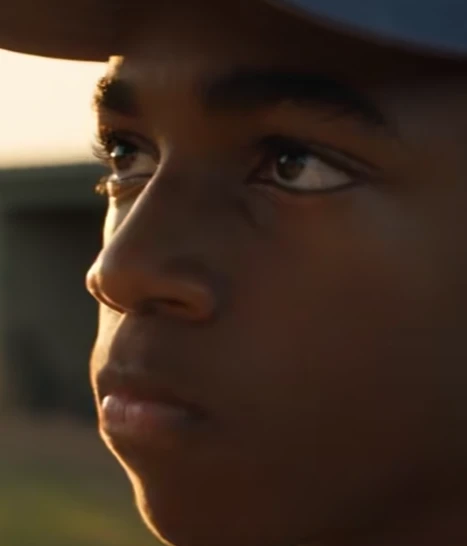
They remembered the dust rising from the dirt.
They remembered the stunned expressions near the dugout.
They remembered how the team’s most confident player had suddenly found himself sitting on the ground.
But the fall was not the most important part of the story.
Tyler’s greatest defeat had not been losing his balance.
It had been allowing his pride to control him.
And Marcus’s greatest victory had not been remaining on his feet.
It had been refusing to let someone else’s arrogance turn him into a person he didn’t want to become.
The incident exposed two different ideas of strength.
Tyler initially believed strength meant control over other people.
Marcus understood that strength could also mean control over oneself.
One boy tried to command respect through intimidation.
The other demonstrated self-respect through restraint.
And when the confrontation ended, it was the quieter boy who had shown the greater discipline.
That lesson extended beyond baseball.
In classrooms, workplaces, sports teams, and everyday life, people often mistake aggression for confidence.
They assume that the loudest person is the strongest.
That the most celebrated individual deserves unquestioned authority.
That someone who refuses to fight must be afraid.
But restraint is not necessarily weakness.
Walking away is not always surrender.
And refusing to respond to an insult does not mean accepting disrespect.
Sometimes it means understanding that a confrontation offers nothing worth gaining.
Marcus had come to Westfield to play baseball.
He had not arrived to challenge Tyler’s status.
He had not tried to embarrass him.
He had not demanded recognition.
He simply wanted an opportunity to play the sport he loved.
And when Tyler tried to turn that opportunity into a battle for dominance, Marcus refused to participate.
That decision changed more than one afternoon.
It changed the way his teammates saw him.
It changed the way Tyler understood leadership.
And it changed the culture of a team that had spent too long confusing talent with character.
The Boy Who Stayed Standing
Years later, the players might forget the exact score of that ninth-inning victory.
They might forget which pitcher started the game.
They might forget how many hits Tyler recorded that season.
But they would remember the afternoon near home plate.
The setting sun.
The dusty field.
The two players standing face-to-face.
The shove.
The sudden fall.
And the quiet boy who remained standing without raising a fist.
Because the most remarkable thing about Marcus Reed was never his ability to embarrass someone stronger.
It was his refusal to become cruel when he had the opportunity.
He could have laughed at Tyler.
He could have mocked him in front of the team.
He could have used the incident to build his own reputation.
Instead, he remained calm.
And when Tyler eventually apologized, Marcus accepted it without demanding humiliation in return.
That was the difference between winning a confrontation and understanding why it never needed to happen.
The baseball field had begun as a place where one boy tried to prove he was better than another.
It ended as a place where both learned something about themselves.
Tyler learned that talent could earn attention, but character earned trust.
Marcus learned that patience could sometimes accomplish what anger never would.
And the teammates watching learned that respect did not have to come from fear.
On that Friday evening, Tyler Brooks had stepped toward a quiet new player believing the outcome was already decided.
He had the reputation.
He had the confidence.
He had the attention of the entire team.
But seconds later, he was sitting in the dirt, staring up at the boy he had underestimated.
Marcus Reed hadn’t celebrated.
He hadn’t threatened him.
He hadn’t even smiled.
He had simply stood there, holding his worn baseball glove, waiting for the confrontation to end.
And that was the moment everyone on the field began to understand that the strongest person isn’t always the one who can knock somebody down. Sometimes, it’s the one who knows he doesn’t have to.





