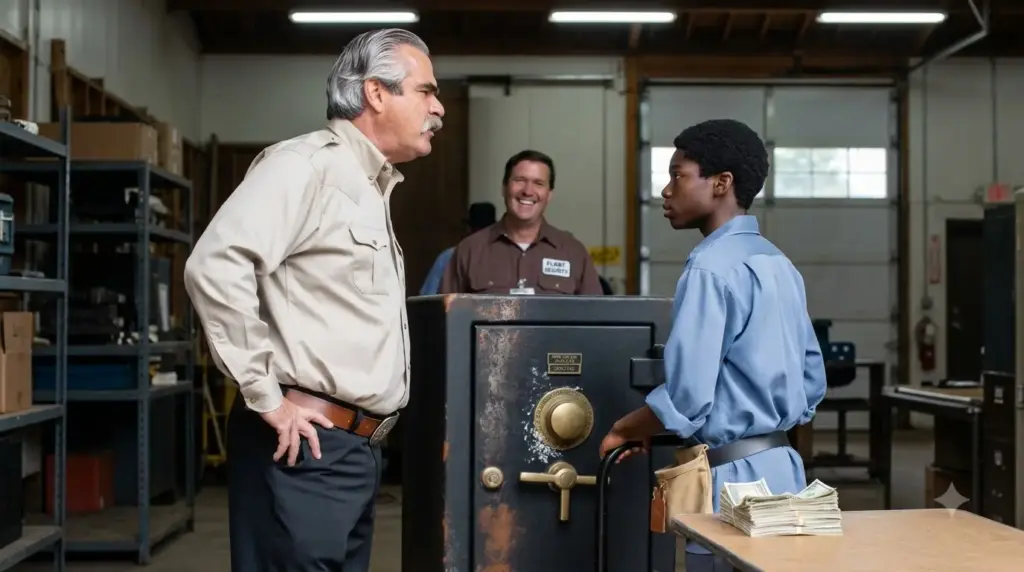
But it was a thinner laugh than the day before.
Something in the way Arthur walked had taken the certainty out of it.
Arthur climbed the courthouse steps until he stood level with the commissioners.
He set the feed sack down.
Then he opened the dark cloth on the wide stone rail where everyone could see.
He did not say a word at first.
He simply laid out, one piece at a time, what the fire had failed to destroy.
The banded cash.
The folded bonds.
The browned envelope with Harold Beaumont’s careful hand across the front.
And last of all, set apart from the rest, the worn locksmith’s tools with the initials scratched into the brass.
The square had gone very quiet by the time Arthur straightened.
“Mr. Beaumont left a letter,” Arthur said.
His voice carried through the stillness better than any shout could have.
“He wrote it himself. He signed it. He locked it in his safe so the men he didn’t trust couldn’t get rid of it before the law could read it.”
Dale Coburn did not smile now.
Arthur continued.
“He left everything he had to this town. To a library and a school for any child in this county, no matter who their people were.”
He looked at the two commissioners as he said it.
One had gone the color of paper.
“He named the men he figured would try to bury it. I expect the law will want to read those names for itself.”
Then Arthur set his hand on the worn tools.
“These belong to the man Mr. Beaumont trusted to lock that letter away. The man who went into that hotel the night it burned trying to carry the truth back out.”
His throat tightened.
But his voice did not break.
“For sixteen years, this town has said Samuel Callaway went into the Beaumont to steal. He didn’t. He went in because a man needed a lock kept honest, and he was the one trusted to do it.”
Arthur lifted his chin.
“He was my father. And he died in there keeping a promise that some of the people standing in this square made sure nobody ever found out about.”
No one laughed.
No one said anything at all.
Then Walt Hendricks broke the silence.
The old locksmith had come from his shop on Mercer Street with the rest of the town.
He stood at the edge of the crowd for a long moment.
Then he moved forward.Slow.
Old.
Heavy with sixteen years of the thing he had carried.
He reached the foot of the courthouse steps and looked up at Arthur.
Then he turned toward the commissioners.
Toward Dale Coburn.
Whatever Walt had been carrying all those years, he set it down at last.
“The boy’s telling it true,” Walt said.
His voice was rough.
Not loud.
But the square was so quiet it did not need to be.
“Sam Callaway worked beside me for nine years. There wasn’t an honester man in this county, and there wasn’t a better set of hands. Harold Beaumont came to me when he wanted that letter locked away where these gentlemen couldn’t reach it. I sent him to Sam because Sam was the one I trusted. Sam was the one who could do it so it stayed done.”
Walt looked at Arthur.
Something gave way in the old face that had been shut tight for sixteen years.
“I knew,” Walt said.
His voice broke.
“I knew what they said about him was a lie. And I held my tongue because I was afraid of these same men. I have been ashamed of it every day since.”
He looked up at the boy.
“I should have told you, son. I’m sorry I let you grow up hearing it.”
The thing Harlan County had believed for sixteen years came apart right there in the square.
In the space of two men speaking.
There was no putting it back together.
What happened to Dale Coburn happened slower than the laughter had.
But it was surer.
The letter and the names in it went where Arthur said they should go.
To the law.
The law in those years was not always quick to listen to a Black boy in a Southern town.
But a signed will in a dead man’s hand, locked in his own safe, naming the very man who had spent sixteen years getting rich off land that should have gone to a library, was not a thing that could be laughed away.
Over the months that followed, the truth came out.
Coburn had bought the Beaumont land and hotel ground for almost nothing in the confusion after the fire.
He had bought it from a county that had no right to sell it.
Because Harold Beaumont had already given it away in a letter those officials pretended did not exist.
The fortune Dale Coburn built on Mercer Street had its first stone laid on a buried will and a slandered dead man.
Coburn fought it the way men like him fight.
With lawyers.
With bluster.
With noise about his good name.
But the names in Harold Beaumont’s hand could not be unsaid.
The worn tools with the scratched initials could not be unseen.
And one by one, the people of Harlan County who had been afraid of Dale Coburn for thirty years discovered they were not afraid of him anymore.
The white Lincoln went first.
Sold to cover what the courts said he owed.
Then the storefronts.
Then the old land.
By the time the trust was settled and the property returned to the purpose Harold Beaumont had written down, Dale Coburn had nothing left in Harlan County but a name nobody said kindly.
He left the way such men leave.
Quietly.
Early in the day.
With no crowd to see him off.
The last anyone in town saw of him, he had stopped his loaded car at the corner of Mercer Street.





