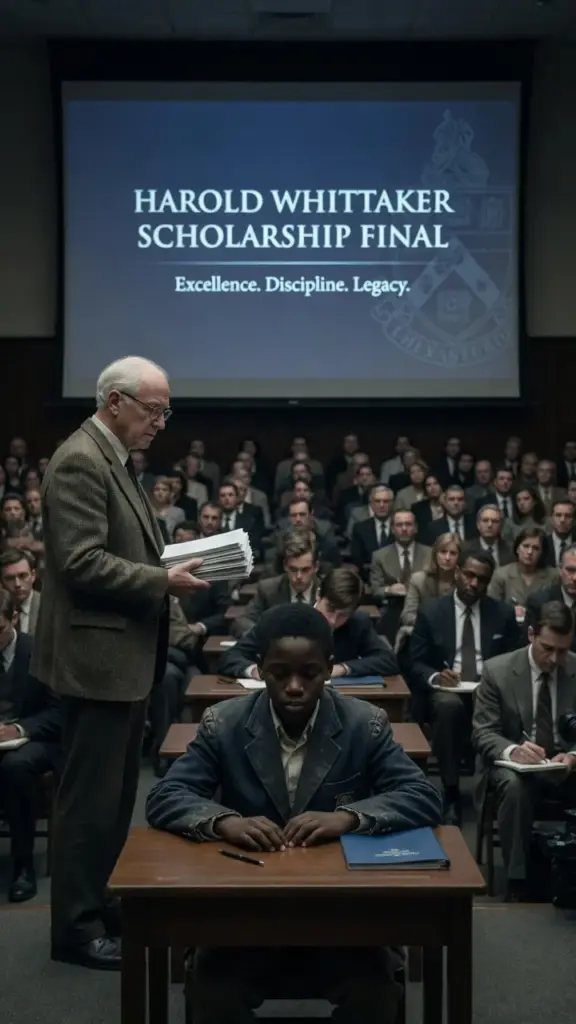
What does a 10-year-old child say when a 62-year-old professor has just moved the goalposts again in front of the whole world?
A 20-minute recess was called. Wesley was led into a small private study room next to the auditorium. Vivian was allowed in. So was Headmaster Bradford. Whittaker, by foundation rule, was not.
But he stood in the hallway outside talking quietly to two donors in tuxedos, gesturing with his hands, smiling.
Inside the study room, the boy sat down in a chair that was too big for him. His feet did not reach the floor.
The crisis was not the math. The crisis was the framing. If Wesley said no to the oral retest, the headline tomorrow would be Black finalist refuses retest, withdraws from scholarship. The truth would die in a footnote. He would become the boy who couldn’t take pressure. The scholarship would go to someone else. Whittaker would keep his job. The system would absorb the moment and move on, the way it always had.
If he said yes, he was letting Whittaker move the goalposts in real time. He was agreeing to be examined orally in front of 300 people on a topic Whittaker would choose in conditions Whittaker controlled.
Vivian did not tell him what to do. She set the cornbread container on the small table. She opened it. She broke off a piece and held it out to him.
Eat, baby. You haven’t had anything since 5:00.
He took the piece. He held it without eating it.
Mom, what if I lose?
She looked at him for a long second. Wesley, I was proud of you before you walked into that room. I will be proud of you after you walk out. Nothing they do in there changes that. You came in here on your own two feet. You leave here on your own two feet. The rest of it? The panel, the scholarship, that man in the hallway, that’s their business. Not yours.
He bit the cornbread. He didn’t say anything.
There was a knock on the door. Dr. Ashford stepped in. Bradford gave them a moment and stepped out. She closed the door. She knelt down so she was at the boy’s eye level, which not many adults had done for him in his life.
Wesley, you and I both know what just happened out there. The trustees know. The reporter knows. The MIT observers know. But none of them will say it out loud unless you give them a reason they can’t ignore. Do you understand?
He nodded.
He’s going to ask you something he thinks you can’t answer. That’s why he made this happen.
I know.
When people are scared, Wesley, they reach for the tool they trust the most. The thing they’re best at. The thing they wrote their name on. Do you understand what I’m asking?
The boy looked up at her. His eyes were dry. He had stopped chewing.
Yes, ma’am.
What is he best at?
Tensor decomposition. Hilbert space operators. 1998.
Dr. Ashford did not smile. She just nodded once. Like a doctor confirming a diagnosis.
She stood up. She walked out.
Wesley sat there for one more second. Then he turned to his mother.
Mom, I read his paper when I was eight. I read it again two nights ago. He’s going to ask me something from his own paper. He doesn’t know I’ve read it.
Vivian Caldwell, who drove a city bus for a living and had not slept more than four hours a night in a decade, looked at her 10-year-old son. She took his hand.
Then go finish what you came here to do. On your own two feet.
He stood up. He took her hand. He walked out of the study room with her beside him. Not behind him, not in front of him, but next to him.
The hallway watched them pass. Whittaker, in the corner with his donors, saw them coming and turned his back deliberately and laughed at something one of the men had said. He did not look at the boy walking past him.
He should have.
What was he about to ask Wesley in front of 300 people on the biggest stage of his career? And what did he not know?
At 9:43, the public hall was fuller than it had been when the exam started. Word had traveled. Two more reporters had arrived. Faculty from other departments had walked over from neighboring buildings to see what was happening. People were standing in the aisles. Some Northbridge upper school students sat cross-legged on the floor at the foot of the stage.
Whittaker walked up to the podium. The microphone clicked on. He had recovered his composure. He was on home ground now. The lectern, the projector, the hall full of adults. This was where men like him won.
To resolve any irregularity, he said, his voice smooth and confident. Master Caldwell will solve a single problem of my choosing on the board in front of the panel. 20 minutes. We begin now.
Wesley walked up to the front. He stopped before stepping onto the stage. He turned to the podium.
Sir, I’ll do it. But I’d like one condition. If I solve your problem in the time you give me, you grade my original written exam live, on screen, page by page, in front of this hall.
The audience went very quiet.
Whittaker could not refuse. To refuse would look exactly like what it was, a man hiding something. He smiled the way a man smiles when he is swallowing a coin, and he said, Agreed.
He turned to the whiteboard. He wrote a problem in large, deliberate letters. It was a tensor decomposition, senior-level math, real hard, and to anyone who knew the field, unmistakably the central application from a particular 1998 paper.





