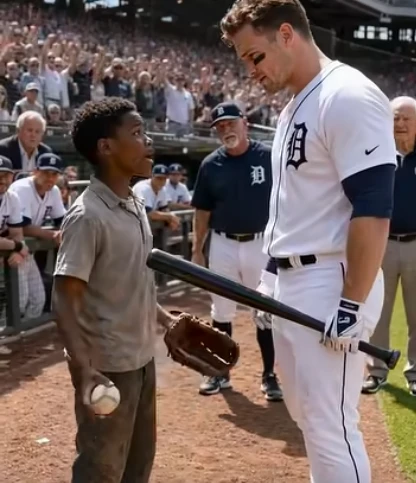
The stadium began to buzz.
Phones came up.
The local camera crew turned.
Derek stepped into the batter’s box and tapped the plate with his bat.
“One pitch,” he said.
The crowd leaned forward.
“If you can get the ball past me, I’ll give you ten thousand dollars.”
People gasped.
Ten thousand dollars.
To most of the people in the lower seats, it sounded like entertainment.
To Eli, it sounded like rent.
It sounded like his mother’s car repair.
It sounded like the dental bill she kept folded behind the toaster.
It sounded like a real glove he could buy without feeling like he was betraying the old one.
Eli’s fingers tightened around the cracked leather.
A coach stepped forward from the first-base side.
Her name was Maria Santos, director of the youth clinic.
She was short, strong, and had the voice of someone used to making teenage boys run laps when they forgot respect.
“Derek, leave the kid alone.”
Derek did not take his eyes off Eli.
“No. He wanted to throw.”
Maria’s jaw tightened.
“He returned a ball.”
“He threw at me like he had something to prove.”
Eli looked down.
“I didn’t.”
Derek raised his voice again.
“Then prove you didn’t.”
The crowd noise grew.
Some kids cheered because they thought they were seeing a dream.
Some adults smiled because they thought it was harmless.
A few people looked uncomfortable but said nothing.
That was how humiliation often survived.
By convincing witnesses it was only a joke.
Maria walked to Eli.
“You don’t have to do this.”
Eli looked at the mound.
He had watched it all morning from the edge of the field.
Smooth dirt.
White rubber.
Clean slope.
A place he had dreamed about stepping on since he was old enough to understand what a pitcher was.
Then he looked at Derek Vaughn.
Smiling.
Waiting.
Holding ten thousand dollars like bait.
Eli whispered,
“My dad said never back away from a mound.”
Behind home plate, an old scout suddenly stood up.
His name was Raymond Cole.
Seventy-two years old.
Former college coach.
Former regional scout.
A man with silver hair, a worn leather notebook, and the quiet reputation of someone who remembered players long after baseball forgot them.
He had come to Harrison Field that day because Maria asked him to watch some of the local kids during the morning clinic.
He had not come to watch Derek Vaughn.
Raymond had watched enough of Derek Vaughn for one lifetime.
But when Eli spoke those words, Raymond’s hand tightened around the rail.
Never back away from a mound.
He had heard that sentence before.
Years ago.
From a pitcher everyone called too stubborn until they called him gone.
Derek frowned toward the boy.
“What did you say?”
Eli did not answer.
He slowly walked toward the pitcher’s mound.
No uniform.
No cleats.
No applause.
Just a quiet Black kid with a glove everyone had laughed at.
Derek smiled from the batter’s box.
“Make it quick, bucket boy.”
The words rippled through the crowd.
Some laughed.
Some winced.
Maria’s face went cold.
“Derek,” she warned.
But Eli was already on the mound.
He placed one foot against the rubber.
Raised the ball.
And before he threw, Derek finally noticed the initials burned into the side of the glove.
M.C.
His smile disappeared.
The stadium did not know why.
But Derek knew.
Because that glove belonged to Malcolm Carter.
A pitcher he had spent years trying to forget.
The change in Derek’s face lasted only a second, but Raymond Cole saw it.
So did Maria Santos.
So did one camera operator, who zoomed in because men like Derek Vaughn were not supposed to look afraid.
Eli looked in toward the catcher.
There was no real catcher assigned for this.
A minor league backup named Jordan Hayes had crouched behind the plate, laughing at first, then not laughing after seeing Derek’s face change.
Jordan held up his glove.
“Just throw it, kid.”
Eli nodded.
His father had taught him one pitch that mattered more than all the others.
Not the fastest.
Not the flashiest.
The one Malcolm Carter called the Quiet Door.
“It looks open,” Malcolm used to say, crouching behind a milk crate in the alley. “Then it closes.”
Eli took a breath.
Derek stepped out of the box.
“Wait.”
The crowd groaned.
Derek pointed toward Eli’s glove.
“Where did you get that?”
Eli looked down at the old leather.
“My dad.”
Derek swallowed.
“What’s his name?”
Eli held the ball tighter.
“Malcolm Carter.”
The name moved through the field strangely.
Most people did not know it.
But the ones who did went still.
Raymond Cole stepped closer to the backstop.
Derek looked toward him and saw recognition there.
For the first time all afternoon, he did not look like the man who owned the stadium.
He looked like a man who had found an old door unlocked.
Maria Santos spoke from the grass near the mound.
“Derek, we can stop this now.”
Derek’s pride returned faster than his judgment.
“No,” he said. “He wanted the mound.”
Eli looked at him.
“No, sir. You put me here.”
That line reached the front rows.
Several phones turned toward Derek.
His jaw tightened.
“Throw the ball.”
Eli set his feet.
Derek tapped the plate once.
Not smiling now.
Just angry.
Eli lifted his leg.
For half a heartbeat, the stadium held its breath.
Then the pitch left his hand.
It came out smooth.
Too smooth.
It looked low and ordinary at first, the kind of pitch a superstar would crush into the bleachers just to punish a story for getting too interesting.
Derek started his swing.
Then the ball moved.
Not a curve.
Not a slider.
A late, sharp, impossible little cut that slipped under the barrel as if it had changed its mind halfway home.
Derek swung over it.
Jordan Hayes caught it clean.
The sound of the ball hitting leather cracked through Harrison Field.
For one second, nobody moved.





