Keller pointed toward Elijah.
“He has no right to be here.”
Elijah’s expression remained calm.
“I’ve had keys to this building longer than you have.”
A few students lowered their phones.
Dr. Ward guided Elijah toward the front table.
He placed the notebook beneath the reading lamp and carefully opened it.
The leather cover was cracked. Several pages had loosened from the binding, and the handwriting changed in darkness from black to blue to faded brown.
Dates appeared in the upper corners.
The earliest was June 1987.
Dr. Ward compared a page in the notebook with Isaiah’s work.
Then she turned to Keller.
“Professor, would you like to explain why his work has your name on it?”
Keller’s face became pale.
“I have never seen that notebook.”
Elijah looked at him.
“You read the first ninety-four pages in my apartment.”
The lecture hall erupted in whispers.
Keller turned toward the audience.
“This is an outrageous accusation.”
Elijah removed a folded photograph from the notebook.
It showed two young men standing beside a small kitchen table. One was Elijah at thirty-four. The other was Arthur Keller, then a graduate student at Hawthorne.
Between them lay the open notebook.
Dr. Ward held up the photograph.
Keller shook his head.
“A photograph proves we knew each other. Nothing more.”
“Then we’ll discuss the dated pages,” she said.
Keller looked toward the cameras.
“Stop the stream.”
A university technician glanced at Dr. Ward.
She shook her head.
“No.”
“This is a confidential personnel matter.”
“It became a public academic matter when you challenged Isaiah’s authorship in front of this audience.”
“I did not challenge his authorship.”
“You demanded his notes.”
“Because an unknown high school student reproduced a method connected to my published research.”
Elijah’s voice remained quiet.
“Connected to your research?”
Keller turned toward him.
“You showed me an incomplete idea thirty-nine years ago. I developed it into a rigorous method.”
“You told me it was worthless.”
“Because what you showed me was not a proof.”
“It became valuable after you changed the title page.”
Dr. Ward closed the notebook gently.
“This lecture is suspended. Faculty and invited witnesses will remain. Students may leave, but all recordings must be preserved.”
No one moved.
The students who had laughed at Isaiah were now watching Keller.
Isaiah stood beside the board, uncertain whether he was allowed to step away.
Elijah approached him.
“You did well.”
“My hand was shaking.”
“So does mine.”
“What if there’s an error?”
“Then we find it. That’s what mathematicians do.”
Isaiah looked toward Keller.
“He recognized the transformation.”
“Yes.”
“Why didn’t you tell me he was the one?”
“Because I wanted your reasoning to remain yours. If you walked in carrying my anger, they would only see the accusation. I needed them to see the mathematics first.”
Dr. Ward asked Isaiah and Elijah to accompany her to the department conference room.
Professor Keller followed with the university’s general counsel, two senior faculty members, and Dr. Price.
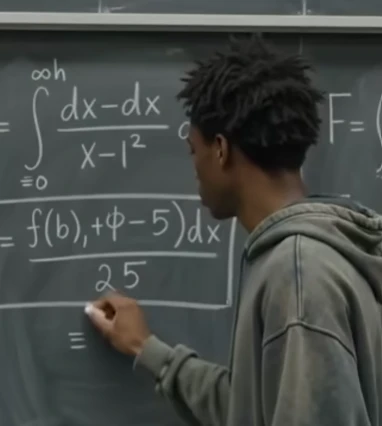
Before leaving, Isaiah looked at the board.
The boxed number remained where he had written it.
Three years earlier, Isaiah had first met Elijah in the basement of Hawthorne’s science library.
Isaiah was fifteen and attending a free summer program for public-school students. The program brochure promised access to university laboratories and professors, but most sessions were taught by graduate assistants. Participants were reminded to remain inside designated areas.
During the second week, Isaiah left his group to find a working water fountain.
He became lost in a service corridor and discovered Elijah sitting at a workbench during his lunch break.
A maintenance request form lay beside him.
So did a page filled with equations.
Isaiah stared longer than politeness allowed.
Elijah noticed.
“Something wrong?”
“That symbol on the third line should be negative.”
Elijah looked down.
“Why?”
“Because you reflected the function.”
Elijah studied him.
“What school do you attend?”
“Eastview.”
“Who teaches you recursive functions at Eastview?”
“No one. I found a book.”
“Where?”
“A library sale.”
Elijah handed him the pencil.
“Show me.”
Isaiah corrected the sign.
Elijah then pointed to another line.
“What about this?”
They spent the remainder of Elijah’s lunch break arguing over the transformation.
The next day, Isaiah returned.
By the end of the summer program, they had developed a routine. Isaiah came to the basement after class. Elijah gave him problems no textbook had assigned, and Isaiah attempted them on discarded maintenance forms.
Elijah never praised an answer merely because it was correct.
He asked why it was correct.
When Isaiah relied on intuition, Elijah made him prove it. When he copied a familiar method, Elijah asked whether the method’s assumptions actually applied. When Isaiah became frustrated, Elijah reminded him that confusion was not evidence of failure.
It was evidence that he had reached the place where learning began.
Months passed before Isaiah learned anything about Elijah’s past.
One afternoon, he noticed a Hawthorne student identification card inside the leather notebook.
The photograph showed Elijah as a young man.
“Were you a student here?”
“For a while.”
“What happened?”
Elijah closed the notebook.
“Life.”
Isaiah did not press him.
The fuller answer came a year later.
Elijah had grown up in South Georgia, the son of a mechanic and a nursing aide. His high school did not offer calculus, so he taught himself from borrowed textbooks. At twenty-six, after military service and several years of night classes, he applied to Hawthorne as a nontraditional student.
His entrance examination scores were among the highest in the university’s history.
Yet ability did not make him welcome.
In 1985, Elijah was one of only three Black students in Hawthorne’s graduate mathematics program. He was older than most of his classmates, married, and supporting an infant daughter. He worked evenings repairing laboratory equipment and cleaned offices on weekends.
Some professors assumed he was maintenance staff even before he took the job.
Others praised him as “surprisingly articulate.”





