Isaiah frowned.
“So the edge is talking?”
Naomi smiled.
“That’s my boy.”
Then she underlined a term three times.
“The edge is always talking.”
That yellow notebook disappeared the same year Naomi Reed disappeared from Westbridge.
Not vanished from the earth.
Not missing in the police sense.
Worse, in some ways.
Academically erased.
When Isaiah was thirteen, his mother came home one night with a cardboard box from her university office.
She set it on the kitchen floor.
She stood over it for a long time without removing her coat.
Isaiah looked inside.
Books.
Papers.
A framed photo of him from fifth-grade graduation.
A cracked mug that said WOMEN IN MATH.
“Are you moving offices?” he asked.
Naomi touched the rim of the box.
“No, baby.”
That was all she said.
Later, Isaiah heard voices in the kitchen.
His mother and his grandmother.
Low.
Angry.
Afraid.
Words came through the door in pieces.
Whitman.
Paper.
Attribution.
Committee.
Don’t sign.
He said no one would believe me.
Isaiah remembered that last sentence because his grandmother answered loud enough for him to hear.
“Then make them believe you.”
But Naomi did not make them believe her.
Or could not.
Within months, her Westbridge email stopped working.
Her name disappeared from the department website.
Her paper was rejected.
Her research file was inaccessible.
Professor Harold Whitman became the public face of the Calloway program.
Naomi took a job teaching community college at night and tutoring high school students during the day.
She never stopped doing math.
But she stopped speaking about Westbridge unless Isaiah asked.
And when he asked too directly, her eyes moved away.
By the time Isaiah was sixteen, she was sick.
Not suddenly.
Not dramatically.
A heart condition made worse by stress, doctors said carefully, as if stress were a weather pattern instead of something people created.
She died in early spring.
Rain struck the apartment windows the whole night.
Isaiah was fifteen days from turning seventeen.
At the funeral, Professor Whitman sent flowers.
White lilies.
No note.
Isaiah’s grandmother threw them in the trash behind the church.
“Some people mourn the evidence,” she said.
Isaiah did not understand then.
He was beginning to now.
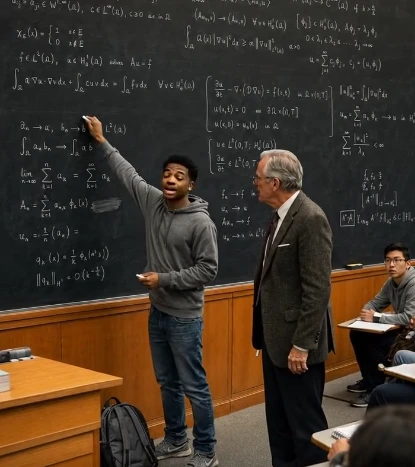
He stood at the front of Professor Whitman’s lecture hall, chalk in hand, staring at the equation his mother had taught him in fragments over years.
The Calloway Equation.
Only Whitman had not written it correctly.
Or rather, he had written it the way he always did.
The way that made the problem impossible.
Isaiah erased the negative sign in the boundary transformation.
Then he wrote:
Let the boundary term carry orientation, not opposition.
He heard someone inhale sharply behind him.
It was the teaching assistant, Daniel Cho.
Isaiah kept writing.
He introduced the substitution his mother called the hinge.
Not a full solution by itself.
A way of folding the boundary term into the interior equation without destroying the limit condition.
Then he wrote the stabilizing identity.
Not all of it.
Enough to show the path.
The room had gone completely still.
Professor Whitman stepped closer.
“That transformation is invalid.”
Isaiah stopped writing.
“No, sir. It’s invalid if the boundary sign is fixed before the limit is taken. But if the orientation is preserved until after the convergence step, the cancellation works.”
Whitman’s face lost color.
A student in the front row whispered,
“That makes sense.”
Whitman turned sharply.
“Quiet.”
Isaiah wrote another line.
Then circled the term.
“This is where the old derivation breaks.”
Whitman’s voice hardened.
“Mr. Reed, that is not a standard approach.”
“My mother said standard approaches are how old mistakes stay employed.”
A sound moved through the room.
Half shock.
Half laughter swallowed before it escaped.
Whitman looked at Isaiah as if the boy had slapped him.
“Your mother,” he said slowly.
Isaiah turned.
“Yes.”
“What was her name?”
The question was dishonest.
Isaiah knew it.
Whitman knew exactly who his mother was.
But men like Harold Whitman often used pretending not to remember as a way to remind people how little they thought someone mattered.
Isaiah held his gaze.
“Dr. Naomi Reed.”
The name hit the room harder than the math.
Not everyone knew it.
But enough did.
Daniel Cho, the teaching assistant, looked at Professor Whitman.
One of the graduate students in the back whispered,
“Reed? From the archived Calloway notes?”
Whitman’s jaw tightened.
“This is inappropriate.”
Isaiah pointed at the board.
“The equation?”
“This spectacle.”
“You handed me the chalk.”
A few students looked down quickly.
Whitman turned toward the class.
“We are finished for today.”
Nobody moved.
He clapped his hands once.
“Class dismissed.”
Chairs scraped.
Backpacks zipped.
Students began to leave, but slowly, unwilling to abandon the scene entirely.
Several took photos of the board before Whitman could erase it.
Daniel Cho took three.
Professor Whitman noticed.
“Mr. Cho.”
Daniel lowered his phone but did not delete anything.
Isaiah stepped away from the board.
His heart was beating too fast now.
He had not meant to say his mother’s name.
Not like that.
Not in that room.
He had come to Westbridge on a partial scholarship and two campus jobs because his grandmother said, “Your mother wanted you to walk under that tower.”
He had planned to study quietly.
Get through.
Learn.
Leave.
He had not planned to challenge the most powerful professor in the department in front of two hundred students.
Whitman approached him as the room emptied.
“You have no idea what you are touching.”
Isaiah slipped the chalk into the tray.
“I think I do.”
“No. You found some notes, repeated something you don’t understand, and embarrassed yourself.”
Isaiah looked at the board.
“Then why are you scared?”
Whitman’s eyes hardened.
For one second, the polished professor vanished and something smaller, older, uglier showed through.
“You are here because this university is generous,” Whitman said quietly. “Do not confuse admission with belonging.”
The words were soft enough that only Isaiah and Daniel Cho, still pretending to gather papers nearby, heard them.





