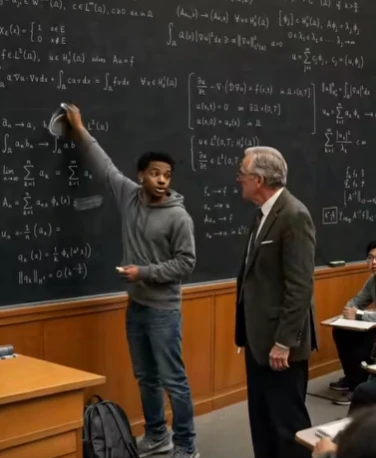
Miriam Vale sat in front.
Daniel Cho stood near the wall.
And somewhere, in every line of the yellow notebook, his mother was still speaking.
Isaiah said,
“You can digitize it. But the original stays with my family until my grandmother says otherwise.”
A small smile crossed Ruth’s face.
President Pierce nodded.
“Of course.”
Then Isaiah added,
“And the scholarship shouldn’t be named like she was only a victim.”
The president waited.
Isaiah’s voice steadied.
“Name it for the method. The Naomi Reed Boundary Fellowship. Because she found a way through.”
For the first time that day, applause rose.
Not wild.
Not cheap.
Deep.
Sustained.
Ruth began crying.
Miriam wiped her eyes without pretending otherwise.
Isaiah sat down, and his grandmother took his hand.
“You did good, baby,” she whispered.
“No,” he whispered back. “She did.”
Ruth squeezed his hand.
“Both can be true.”
The mathematical review took months.
That mattered to Isaiah.
He did not want his mother turned into a symbol without the work being respected.
Naomi Reed deserved more than pity.
She deserved checking.
Line by line.
Assumption by assumption.
Proof by proof.
The external panel included scholars from four universities.
Some parts of Naomi’s original proof were incomplete.
Some needed modern notation.
Some limits required conditions she had only sketched.
But the core method held.
The boundary orientation approach was valid.
Not only valid.
Powerful.
With Daniel Cho and Miriam Vale advising, Isaiah helped prepare an annotated edition of Naomi’s paper.
He did not pretend to be more than he was.
He was nineteen.
Brilliant, yes.
But still learning.
He made mistakes.
Daniel caught them.
Miriam corrected him with terrifying kindness.
Ruth brought food to late-night work sessions and warned them that no theorem was worth skipping dinner for.
The final paper listed Naomi Reed as sole author of the original manuscript.
The historical commentary listed Miriam Vale, Daniel Cho, and Isaiah Reed as editors.
When the paper appeared online, Isaiah opened the page and stared at his mother’s name until the letters blurred.
Dr. Naomi E. Reed.
There.
Not hidden.
Not archived under dispute.
There.
Professor Harold Whitman’s legacy changed too.
His old lecture notes were reviewed.
Several were corrected.
A formal reprimand was added to his faculty record.
His named seminar was renamed.
Some people said it was too harsh for a man who had given forty years to Westbridge.
Miriam Vale answered that in one faculty meeting.
“He gave forty years to Westbridge. Naomi Reed lost the forty she should have had. Do not ask me to mourn his plaque.”
No one argued after that.
Isaiah remained at Westbridge.
That surprised some people.
A reporter asked him why.
He looked across the campus lawn at the clock tower.
“Because my mother told me I belonged here before the university remembered.”
He changed majors from engineering mathematics to pure mathematics after his sophomore year.
Ruth said she saw it coming.
“You were never going to be happy making equations behave for machines,” she said. “You like when they misbehave for everybody.”
Isaiah laughed.
“That’s not a major.”
“It should be.”
He still wore gray hoodies.
Still worked in the library.
Still carried the worn backpack until the zipper finally died during finals week.
Daniel Cho bought him a new one.
Isaiah tried to refuse.
Daniel said,
“Consider it department infrastructure.”
Miriam said,
“Take the bag before he tries to explain generosity as grant support.”
Isaiah took the bag.
On the first anniversary of the lecture, Westbridge held the inaugural Naomi Reed Boundary Lecture.
Not in the old hall.
In the main auditorium.
Ruth sat in the front row.
Isaiah sat beside her.
The speaker was Dr. Lena Ortiz, one of the external reviewers, who began by putting Naomi’s original yellow notebook page on the screen.
“This,” she said, “is the line where a problem stopped being impossible.”
The screen showed the same place Isaiah had noticed.
The sign.
The edge.
The place everyone else had accepted because Professor Whitman had written it that way for years.
Dr. Ortiz turned to the audience.
“Mathematics is often described as pure, but mathematicians are human. We bring pride, fear, bias, ambition, blindness, and courage to the board with us. A proof can be correct and still be buried. An error can be repeated until it sounds like tradition. That is why we do not worship authority. We check the work.”
Isaiah looked down.
Ruth whispered,
“That one’s going on my refrigerator.”
After the lecture, students gathered around Isaiah.
Some asked about the method.
Some asked about his mother.
One Black girl, maybe sixteen, visiting with a high school math club, waited until the others moved away.
Then she said,
“Did you know you were right when you erased it?”
Isaiah thought about the question.
“No.”
She looked surprised.
“Really?”
“I knew my mother was right.”
The girl nodded slowly.
Like that answer gave her something.
Maybe permission.
Maybe courage.
Maybe both.
That evening, Isaiah walked alone to the old lecture hall.
It was empty.
The lights were dim.
The blackboards were clean.
He stood in the middle aisle where he had sat that day.
Then he walked down to the front.
There was chalk in the tray.
He picked up one piece and wrote, very small, in the lower corner of the board:
The edge is always talking.
He stared at it for a while.
Then he erased it.
Not because it did not matter.
Because he no longer needed to hide messages in corners.
His mother’s work was in the archive now.
In classrooms.
In lectures.
In citations.
In students who would learn the method without knowing how hard someone had fought for it to be seen.
Years later, people at Westbridge University would still tell the story of the quiet Black student who asked for the chalk.
Some told it like a legend.
The impossible equation.
The crowded lecture hall.
Professor Harold Whitman holding out the chalk like a dare.
Isaiah Reed erasing one symbol.





