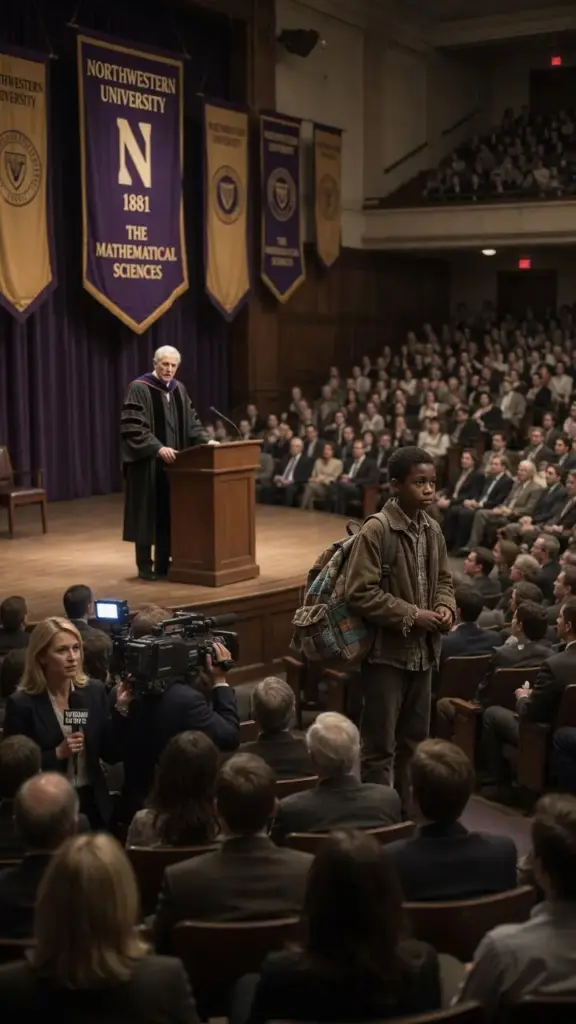
“Mr. Wells, spectators are not allowed in the competitor’s area. Return to your seat.”
Cameron shot Yseph one last look. Pure hatred.
Then he walked away.
Yseph’s hands were trembling, but he didn’t let it show.
Ten minutes until the final round.
The finalists were escorted to the main auditorium. The audience had grown. Word had spread. Local news had called in extra cameras. Six hundred seats were full. People stood in the aisles. More watched online. The live stream counter showed fifty thousand viewers.
Yseph walked past the crowd. He heard whispers.
“That’s him, the library kid.”
“I heard he taught himself calculus at nine.”
“No way. That’s impossible.”
“Look at him. He looks so young.”
“He doesn’t stand a chance against Elizabeth. She’s been training for years.”
Yseph kept walking, eyes forward, chin up.
He took his place at the competitor’s table, front row, center stage.
The judges sat behind a long wooden desk. Dr. Stanton, Dr. Ashford, two other professors, and Harrington in the middle, the head judge.
He was smiling. Not a kind smile, not a welcoming smile. The smile of a man who knew something no one else knew.
A large screen behind the judges flickered to life.
The words appeared.
“Final round. Problem selected by Dr. Edmund Harrington.”
The audience murmured.
Elizabeth looked confident. Preston looked nervous. Victoria looked sick.
Yseph looked at Harrington.
Harrington looked back.
And in that moment, Yseph understood. Whatever was about to happen, it wasn’t going to be fair.
At home, on a borrowed tablet, Mrs. Deline Bradley watched the live stream. Her hands gripped her rosary. Her lips moved in silent prayer.
“Show them, baby,” she whispered. “Show them what God put in your mind.”
The screen changed. The final problem appeared, and everyone in the auditorium gasped.
The equation filled the entire screen. Dense, complex, terrifying.
But it wasn’t just any equation.
At the bottom of the screen in small letters were the words, “The Harrington partition problem. Unsolved. Fifty years.”
The audience erupted.
“Is he serious?”
“That’s his own problem.”
“No one has ever solved that.”
“This is insane.”
Dr. Ashford stood up. Her voice cut through the noise.
“Edmund, what is this?”
Harrington spread his hands, innocent, reasonable.
“This year, we raise the bar. Our young scholars claim to be exceptional. Let’s see how exceptional they truly are.”
“This problem has defeated professional mathematicians for five decades. You’re asking children to attempt it?”
“I’m asking them to try.” Harrington smiled. “Isn’t that what education is about? Reaching for the impossible.”
Dr. Stanton shook his head slowly.
“This isn’t a test. This is an execution.”
“Then let them withdraw.” Harrington gestured at the finalists. “Anyone who feels overwhelmed is free to leave. No shame, no penalty.”
He looked directly at Yseph.
“Some of us know our limits. Others need to learn them.”
The message was clear. This problem was chosen for one reason. To destroy Yseph publicly.
Preston Clark stood up immediately. His face was pale.
“I withdraw.”
He walked off the stage. His tutor followed, already making excuses to his parents.
Victoria Nash lasted ten seconds longer. Then she withdrew too.
That left Elizabeth Thornton and Yseph Bradley.
Elizabeth stared at the screen. Her confidence had cracked. Her father gestured frantically from the audience, but she couldn’t read his signals.
She looked at Harrington, then at the problem, then at her shaking hands.
“I—” she swallowed. “I’ll try.”
But her voice said she had already given up.
Yseph hadn’t moved. He stared at the equation. The Harrington partition problem. Fifty years unsolved. The life’s work of a man who hated him.
Every mathematician who had attempted this problem had failed. Professors, researchers, genius minds from every corner of the world.
And now it was placed in front of a twelve-year-old boy from public housing.
A trap. An impossible trap.
The logical move was to withdraw, preserve his dignity, walk away before the humiliation.
But Yseph thought about his grandmother, her medical bills, the fifty dollars she had sacrificed, the pride in her voice when she told him to show them.
He thought about every person who had told him he didn’t belong. Every door that had been closed in his face. Every time someone had looked at his skin and decided he was worthless.
He picked up his chalk.
“I’ll try, too.”
Harrington’s smile widened.
“Then, let’s begin.”
The clock started. Sixty minutes.
Yseph started from the beginning. Not the beginning of the problem, the beginning of mathematics itself.
He wrote the number one, then two, then three.
The audience frowned. What was he doing? This was a graduate level partition problem. Why was he writing numbers a child could count?
But Yseph wasn’t counting. He was building.
“The problem asks about partitions of any integer,” he said quietly, almost to himself. “Everyone tries to prove it for all numbers at once. But what if we start with the smallest cases first?”
He drew a simple diagram, three dots arranged in a triangle.
“For one, there’s only one partition, the number itself.”
He added more dots, connected them with lines.
“For two, there are two partitions, two itself, or one plus one.”
“For three, there are three partitions. Three, two plus one, or one plus one plus one.”
His chalk moved faster now.
“But look at the pattern.”
He circled specific connections in his diagram.
“Each partition contains smaller partitions inside it, like mirrors reflecting mirrors. The structure is recursive, self-similar.”
Dr. Stanton sat up straighter. His eyes widened.
“My god,” he whispered. “He’s mapping it visually.”
Yseph continued building. His diagrams grew more complex, but they remained clear. Each layer nested inside the previous one. Triangles within triangles. Patterns within patterns.
Just like the fractal on the student’s t-shirt.
Ten minutes left.
“The reason no one solved this,” Yseph said, “is because they treated it as an algebraic problem. They tried to force it into equations. But it’s not algebraic. It’s geometric.”





