“No,” Dr. Moore agreed. “Which is why we’ve brought additional evidence.”
She presented James Parker’s 1995 complaint.
Then the independent evaluations of Isaiah’s mathematical work.
All three mathematicians had concluded that Isaiah demonstrated genuine advanced mathematical ability.
His performance did not support the allegation that he was incapable of understanding the proof he had written.
Finally, Dr. Moore submitted Dr. Sullivan’s statement.
The dean read it carefully.
Hartwell’s expression changed.
“That’s a false account.”
The dean looked up.
“Professor Hartwell, you will have an opportunity to respond to these allegations through a separate investigation.”
Then she turned toward Isaiah.
“The academic integrity complaint against you is dismissed.”
Isaiah exhaled.
But he didn’t smile.
Not yet.
He had spent weeks defending himself.
His father had spent years trying to defend his own reputation.
And Isaiah understood that dismissing the complaint against him was only the beginning.
He stood once more.
“I want the university to examine what happened to James Parker.”
The dean nodded.
“That review will be opened.”
Isaiah placed one of his father’s notebooks on the table.
“He deserved to have his work recognized.”
Over the following months, investigators reviewed decades of research records and former students’ accounts.
They examined publication histories, archived correspondence, and the disputed mathematical work.
The investigation ultimately found serious research misconduct involving Hartwell.
Other former students came forward with complaints about misattributed work and abuses of academic authority.
The university revoked Hartwell’s tenure and removed him from his position.
Relevant publications were flagged for review.
Awards and institutional honors associated with the misconduct were reconsidered.
Most importantly, James Parker’s original contribution was formally recognized.
For Isaiah, that acknowledgment meant more than seeing Hartwell punished.
His father had spent the final years of his life carrying the burden of an accusation he insisted was false.
Now the university was acknowledging the evidence supporting his claim.
Isaiah’s mother framed the announcement.
She placed it beside an old photograph of James.
For a long time, she stood in front of both.
Then she called Isaiah into the room.
“Your father would have been proud of you.”
Isaiah looked at the photograph.
“I wish he’d been here.”
Linda took his hand.
“So do I.”
A year later, Isaiah returned to the same lecture hall where Hartwell had humiliated him.
But this time, he wasn’t sitting in the back row.
He was standing at the front as a teaching assistant.
He had continued his studies, worked with Dr. Moore, and begun developing research of his own.
On the chalkboard behind him was a number theory problem.
The classroom was quiet.
Students were working.
Near the back sat a young student who rarely volunteered answers.
Isaiah had noticed him during the first week.
The student was talented.
But hesitant.
When class ended, Isaiah approached.
“Your last problem set was excellent.”
The student looked surprised.
“Really?”
“Really.”
“I thought maybe I was doing it wrong because my solution didn’t look like the example.”
Isaiah smiled.
“Different doesn’t automatically mean wrong. Show me how you got there.”
The student opened his notebook.
They spent several minutes discussing the solution.
Then Isaiah handed him a copy of an old research paper.
James Parker’s name appeared prominently on the cover.
“Someone important to me wrote this,” Isaiah said.
The student studied it.
“Is he famous?”
Isaiah looked toward the chalkboard.
“He should have been.”
Then he smiled.
“Now more people are getting to know his work.”
The student thanked him and left.
Isaiah remained in the classroom for a moment.
He remembered Hartwell’s mocking voice.
The laughter.
The accusation.
The feeling of standing at a chalkboard while someone powerful expected him to fail.
But the room no longer belonged to that memory.
It was now a place where he could help other students discover what they were capable of.
And where James Parker’s mathematics could finally be studied under its rightful name.
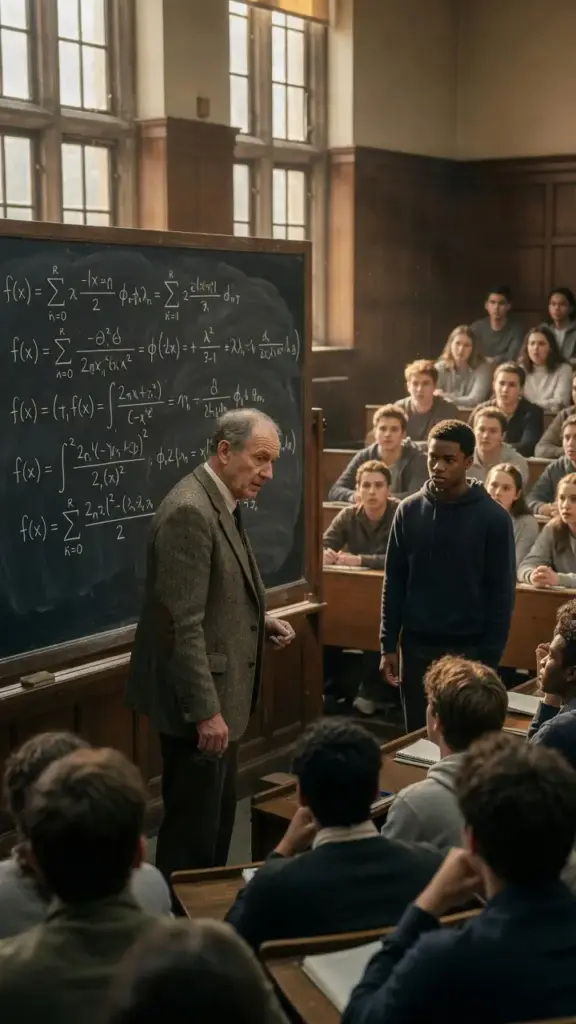
Professor Hartwell had tried to use an impossible equation to prove that Isaiah Parker didn’t belong in his classroom. Instead, Isaiah’s solution exposed the history behind Hartwell’s greatest academic achievement. Twenty-four years after James Parker lost credit for his research, his son helped bring the truth into the open—not by destroying another person’s future, but by defending the work his father had left behind.
Disclaimer: This is a fictional dramatic adaptation of the supplied story. The university, characters, mathematical breakthrough, and disciplinary proceedings are elements of the narrative, not verified historical events.





