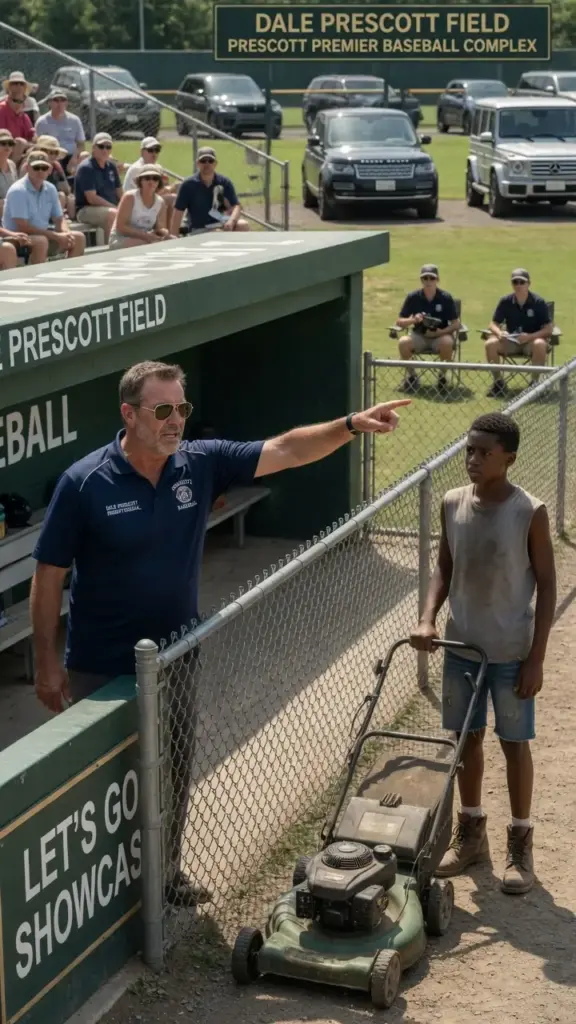
“Look, Tyler, right? We should talk about getting you into our program. I can see you’ve got real ability, and with the right coaching environment”
He was reaching, trying to claim what he’d just mocked, trying to rewrite 10 minutes of cruelty into a discovery story where he was the one holding the pen.
Ray stepped between them, not with a speech, not with volume. He just positioned himself beside Tyler, close enough to mean something, casual enough to not cause a scene, and looked at the scout.
Not at Prescott. He addressed the scout directly, as if the manager wasn’t standing 3 ft away.
“I can vouch for this kid. I’ve watched him throw against a cinder block wall behind his grandmother’s duplex for 2 years, every single evening, rain or shine.
I drive past it on my way to practice. I’ve seen what his arm can do since he was 12 years old.”
He paused. Something moved across his face.
The kind of expression that comes from saying out loud what you should have said a long time ago. “I should have said something sooner.”
His voice cracked, just barely, but enough. Enough for everyone standing in that circle to hear 2 years of guilt breaking the surface.
Ray had known. Every single evening for 2 years he’d driven past that duplex on his way to Ridgewood.
He’d slowed down at the stop sign on the corner and watched through his windshield as Tyler threw a tennis ball against a cinder block wall with mechanics that were cleaner, sharper, and more natural than anything the $2,800 program had ever produced.
He’d watched the kid’s arm slot improve month by month. He’d watched the curveball develop.
He’d watched the changeup appear one summer evening like a magic trick Tyler taught himself. And he had said nothing.
Not one word, because Prescott ran the show. Because the program had rules about who belonged and who didn’t.
Because the fence was always closed, and Ray was never the one who held the key. He’d driven past that wall 200 times, and 200 times he’d kept his mouth shut, until today.
Today, the silence cost more than the speech. Prescott stood there, mouth half open, nothing in it.
He looked at Ray, his quiet, obedient assistant for three full seasons, and realized for the first time that the loyalty he’d mistaken for agreement had actually been guilt.
And the guilt had just run out. The scout squeezed Tyler’s shoulder.
“We’ll be in touch this week. Bring your arm. We’ll handle everything else.”
The field emptied slow, the way places do when something happens that people need to carry with them before they can leave. Parents folded chairs and collapsed canopies and loaded coolers into SUVs, but the conversations were different, quieter, more careful.
Every group of adults walking toward the parking lot had some version of the same sentence. “Did you see that kid?”
Tyler stood by the equipment shed. The adrenaline was fading.
His hands were starting to shake, not from fear, but from the kind of release that comes after holding yourself together for longer than anyone should have to.
He looked down at the borrowed glove on his left hand, Ray’s glove. He pulled it off slowly, held it in both hands, and walked over.
“Here.” “Thank you.”
Ray looked at the glove, then at Tyler. He didn’t take it.
He put his hand on top of it and pushed it back. “Keep it. It’s yours now.”
Tyler didn’t have words for that. He held the glove against his chest.
The leather was warm from the sun and the innings. It smelled like neatsfoot oil and red clay and years of somebody else’s catches, broken in by a thousand practice reps, softened by sweat and time.
It was the first real baseball glove Tyler Shaw had ever owned, not borrowed, not temporary, his. He pressed it against his ribs and felt the warmth of it through his T-shirt.
His eyes stung. He blinked once.
That was all he allowed himself. Ray pulled out his phone.
“You need to call somebody?” Tyler dialed his grandmother’s number.
She picked up on the first ring, not the second, not the third, the first, because she’d been sitting by the phone since he left that morning.
She didn’t know what was happening at Ridgewood. She just knew her grandson was there, and she was waiting.
She was always waiting. Even when she didn’t know what she was waiting for.
“Grandma, I pitched today, on a real field, a real mound, against real batters.” Silence on the other end.
Not confused silence, not distracted silence. The kind of silence that listens with its whole body, the kind that holds space for something big to land.
“Three batters. I struck out all three.” More silence.
Then soft, steady, certain, like she was reading from something she’d written in her heart years ago. “I know, baby.
I’ve been knowing. That wall told me everything I needed to hear.”
Tyler closed his eyes, let the words land where they needed to. The complex was nearly empty now.
The last SUV pulled out of the lot with a crunch of gravel and a travel ball decal catching the afternoon light. Prescott sat in his golf cart at the far edge of the parking lot, engine off, hands on the steering wheel.
He wasn’t going anywhere. He was looking at the mound, the rubber, the footprints in the clay, work boot prints, not cleat marks, the exact spot where a 14-year-old had undone three seasons of his authority in 10 minutes and nine pitches.
The live stream was still circulating. He didn’t know that yet.
He would by tonight. He didn’t drive away, just sat.
Tyler handed the phone back, tucked the glove under his arm, walked to his bicycle. The card sat in his pocket.
Its edges were already soft from sweat and Georgia heat. Same road home, same bicycle, same pedals, but different.





