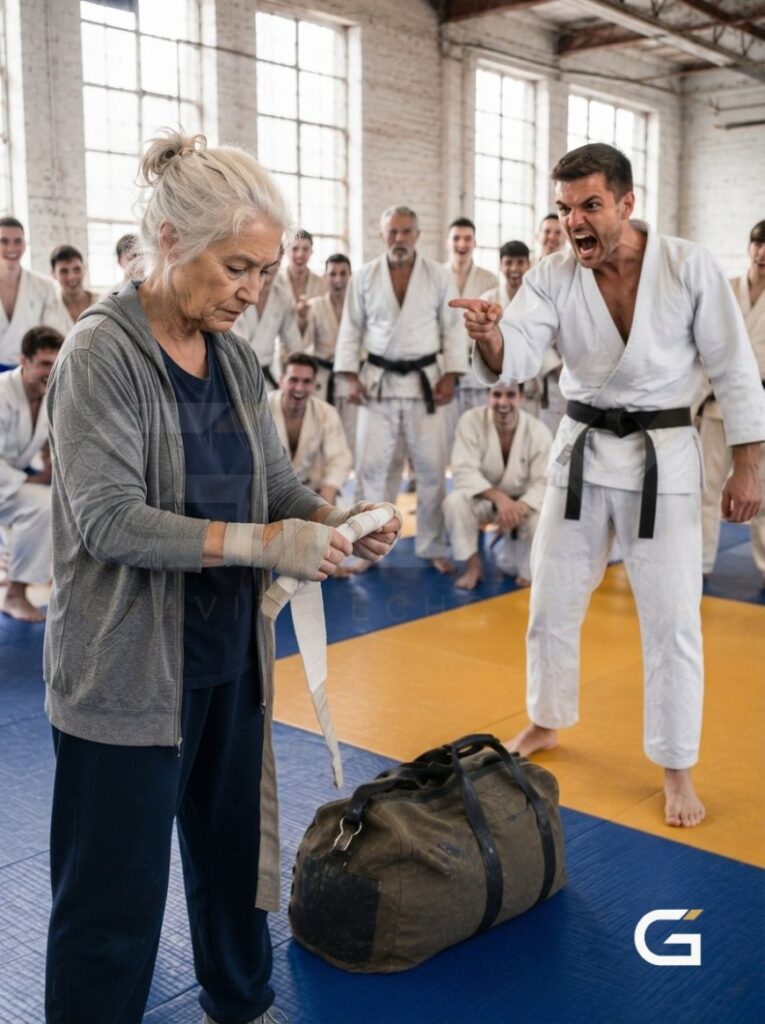
And across the empty gym, our eyes met—two women who had both spent twenty years pretending to be someone else, finally standing in the same room.
She took a single step forward onto the mat.
“You’re Nadia,” she said. It wasn’t a question.
“And you’re the one who took the ledger,” I replied.
Her smile didn’t change. But something behind it did.
“Somebody had to,” she said.
Then she reached into her bag, and pulled out a folder.
It was black. It was bordered. And it was addressed to me.
The folder was the color of a bruise at midnight, and my name was written across the front in handwriting I almost recognized.
Nobody moved. Above us the overhead lights kept up their low, steady drone, and behind the gym’s back wall a compressor kicked on and rattled itself quiet again.
Marcus stepped past me and put one shoulder between me and the girl, the way he used to move through doorways.
“Hands where I can see them,” he said.
She didn’t take offense. She set the folder flat on the mat and lifted both palms, and even that small movement was clean — no wasted elbow, no shift of weight she couldn’t reverse.
“You’re not going to shoot me in a children’s gym,” she said.
“I’ve done worse in worse places.”
“I know. That’s why I came to you instead of them.”
Deja’s voice cut across the floor from the front counter.
“I’m going to need somebody to tell me what’s happening in my building,” she said. “Right now. In words.”
“Deja,” I said, “take Tyler into the back.”
“I’m not a kid,” Tyler said. He was already standing, hands loose, watching the girl the way he watched the far corner of the mat when he knew a throw was coming.
“No,” I said. “You’re a regional champion with a torn meniscus and no idea what you’re looking at. Go in the back.”
He went. That surprised me more than anything else that had happened all evening.
The girl waited until the door clicked shut. Then she crouched, slid the folder across the mat, and let it stop a foot from my shoes.
“He said you’d want it opened in private,” she said. “He said you’d check the seams first.”
I checked the seams. I couldn’t help it. Twenty years of gardening had not erased the habit of running a thumb along an edge, feeling for a second layer, a hollow, a lie.
“Who is he?” I asked.
“Jonah.”
The name hit Marcus before it hit me. I heard him breathe out through his nose, heard the small shift of his heel on the mat.
“He’s dead,” the girl said. “Three weeks ago. They got him in a parking garage in Bakersfield. He knew it was coming. He spent the last month teaching me how to disappear and then he made me promise to find you instead.”
“How did he find *me*?” I said.
“Same way he found everyone. He never stopped keeping the list.”
I knelt down on the mat and opened the folder.
Inside was a single spiral notebook, no cover, water-stained at the corners, the wire rusted almost black. The pages were dense with a small, careful hand — columns, dates, initials, sums of money and flights and rooms and names.
And clipped to the first page, a photograph. Nine people standing in a row against a corrugated wall. Seven of them I could name. One I could not. The ninth had been cut out with a razor blade and taped back in upside down.
Marcus came and stood over my shoulder. He was quiet for a long time.
“It’s real,” he said finally.
“It’s real.”
“That’s twenty years of my life in a spiral notebook from a drugstore.”
“That’s twenty years of everybody’s life.” I turned the page. “Including the names of people who signed the authorizations.”
“You’re going to General Ramsey.”
It wasn’t a question, but I answered it anyway.
“Yes.”
“You know she’ll have people.”
“I know.”
“You know she might be one of the people who wants this gone.”
“I know that too.”
The girl stood up. She was watching me the way a student watches a teacher they’ve been told to trust and aren’t sure they should.
“He told me something else,” she said. “He said not to let you go alone. He said you’d try.”
“He was right.”
“Then I’m coming.”
Marcus turned to her. “How old are you?”
“Twenty-two.”
“You’ve been trained eight years.”
“Ten.”
“Then you’re not coming,” Marcus said. “You’re a civilian with good posture.”
The girl didn’t flinch. She just looked at him, and something in her face went very still and very old.
“He raised me,” she said. “He fed me, he taught me, and then he died in a parking garage so I could hand you that notebook. You don’t get to tell me I’m a civilian.”
Marcus opened his mouth. I put a hand on his arm.
“She’s right,” I said.
“This isn’t a field exercise, Nadia.”
“No. It’s worse. Which is why we need her.”
I looked at the girl. “What’s your name?”
“Sasha.”
“Sasha, do you have a car?”
“Yes.”
“Good. Marcus drives like a man who learned in a government motor pool.”
Marcus made a sound that was almost a laugh. It was the first one I’d heard from him, and it didn’t last.





