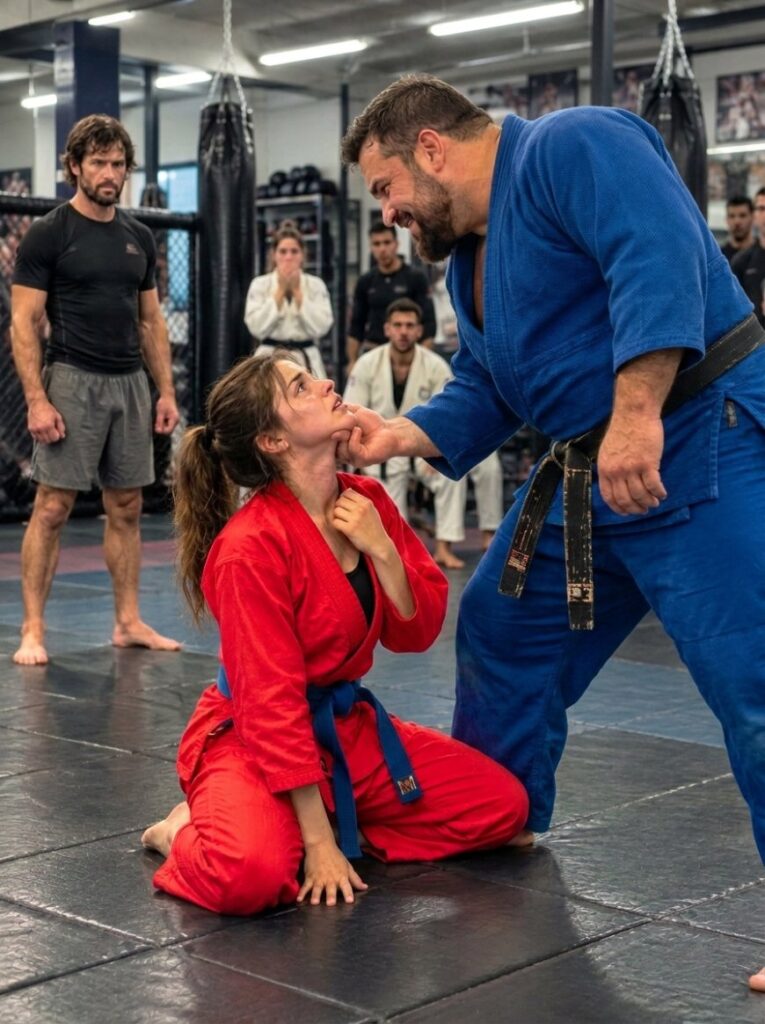
No one sized me up. No one looked at me like I was prey.
Marcus Reeves met me at the front desk. He was a tall, wiry man in his late fifties, with kind eyes and a quiet confidence that reminded me of Cole.
“Sarah,” he said, shaking my hand. “I’ve been looking forward to meeting you.”
“Thank you for having me,” I said, my voice steadier than I expected.
“Before we start, I want you to know something. This gym runs on three rules. No ego. No bullying. No exceptions. If anyone violates those rules, they’re out. No discussion. No second chances.”
He looked at me directly.
“You’re safe here. I promise.”
I nodded, blinking back tears.
The first few months were hard. My body had forgotten how to trust itself. Every time someone moved toward me, I flinched. Every time I felt a hand on my arm, my throat closed up.
But I kept showing up.
I showed up when I was scared. I showed up when I was tired. I showed up when every instinct told me to run.
And slowly, painfully, I started to heal.
The first time I tapped a higher belt, I didn’t even realize what had happened until Marcus called the round.
“Nice work, Sarah,” he said, grinning. “You’ve got good instincts.”
I stared at my hands like they belonged to someone else.
“I… I didn’t mean to…”
“That’s the point,” he said. “The best moves are the ones you don’t have to think about.”
I walked home that night with a lightness in my chest I hadn’t felt in years.
I called Cole.
“You’d be proud of me,” I said.
“I already am.”
I laughed. “I submitted a blue belt today. Clean technique. He didn’t even see it coming.”
“That’s my girl.”
We talked for another hour, about nothing and everything. The deployment he couldn’t talk about. The new gym that finally felt like home. The apartment I was thinking about redecorating.
Before he hung up, he said something that stayed with me.
“You know what the hardest thing in the world is, Sarah?”
“What?”
“Letting go of who you were supposed to be and accepting who you actually are.”
I sat on my couch for a long time after that call, thinking about his words.
I wasn’t the person I thought I’d be when I first walked into Apex Grappling. I wasn’t invincible. I wasn’t unbreakable.
But I was still here. And sometimes, that’s enough.
Six months after that night at Apex, I stood on the podium at my first tournament.
I’d won bronze in the women’s division — nothing special, nothing that would make headlines.
But as I held that medal in my hands, I thought about how far I’d come.
I thought about the night I woke up on the mat, coughing and gasping, surrounded by silence.
I thought about the two words that had changed everything.
She tapped.
And I thought about my brother, standing in the doorway of my apartment, promising me that he’d always show up.
He was overseas again — some place that didn’t have a name — but he’d called the night before, just to wish me luck.
“Win or lose,” he’d said, “you’re already the toughest person I know.”
I’d laughed. “You’ve literally been deployed to active zones.”
“Yeah,” he’d said. “But I had training. You had to learn it on your own.”
I didn’t win gold that day. But as I stepped off the podium and walked back to my teammates, I realized something.
I wasn’t afraid anymore.
Not of the mat. Not of the people on it. Not of the memories that still crept up on me in the quiet moments.
Because I knew, with absolute certainty, that I wasn’t alone.
And that made all the difference.
That night, as I lay in bed, staring at the ceiling, my phone buzzed with a text from Cole.
“Proud of you. Always. — C”
I smiled and typed back.
“I know. That’s why I keep going.”
I put the phone down and closed my eyes.
The memories still came sometimes. The phantom pressure on my throat. The gray spots at the edges of my vision.
But they were quieter now. Less frequent. Less real.
Because I’d learned something that Derek and Greg and every silent bystander in that gym had tried to take from me.
I was not what they said I was. I was not what they did to me. I was not the fear in my chest or the tremble in my hands.
I was Sarah. And I was still standing.
Two years later, I received a letter. It was from a woman named Elena, a 22-year-old living up north. She’d been hurt at her own gym. She’d tapped, and no one had helped her. She said she found my story online and wanted to thank me for sharing it. She said she was thinking about quitting.
I wrote her back. I told her about Cole. I told her about Marcus. I told her about the bronze medal. I told her that healing was possible.
And I told her the two words that had given me back my voice: She tapped. Those two words aren’t just about a hold. They’re about having the courage to say when you’ve had enough. And that courage — that voice — is something no one can ever take from you.
I folded the letter to Elena and sealed it in an envelope. The paper was thin, almost translucent, and my pen had left indentation marks on the second page where I’d pressed too hard.
I walked to the mailbox at the corner of my street, the afternoon sun warm on my shoulders. The metal flap creaked when I opened it.
A few days later, a reply arrived. Her handwriting was small and careful, the kind you use when you’re not sure anyone will read it.





