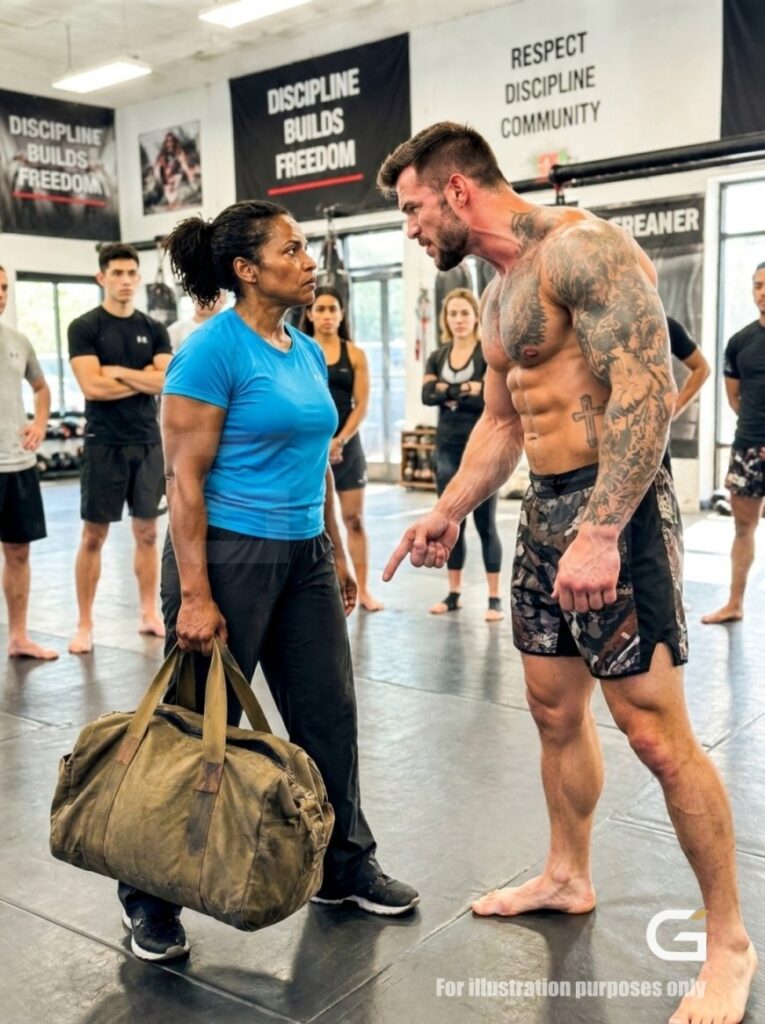
I continued: “You can train hard. You can compete. You can push each other. But nobody owes you pain, exhaustion, humiliation, or a round just because you have a higher belt.”
Ryan stood in the back. He listened.
Three years passed.
Jasmine earned her blue belt. Then left for college. Marcus stopped competing and became head wrestling instructor. Devin won a major national masters event when he aged into the division.
Ryan eventually became Granite Hill’s head competition coach. He was still intense. Still hated losing. Still sometimes needed Daniel to remind him not every training room was a podium.
But the old challenge culture disappeared.
One afternoon, a quiet middle-aged man came in to watch his daughter. Ryan noticed him studying the class.
Afterward, one of the academy’s young black belts approached.
“You train?”
“A little.”
“What?”
“Wrestling.”
“Want a round?”
The man smiled. “No, thanks.”
The young black belt started: “Come on, just—”
Ryan called from the desk. “He said no.”
The black belt stopped. “Right. Sorry.”
The visitor smiled. “No problem.”
He left ten minutes later.
Nobody discovered he was secretly a champion. Nobody got tapped. Nobody was humiliated.
There was no viral story.
I watched the whole thing. I walked over to Ryan.
“That was better.”
Ryan smiled. “You finally complimented me.”
“Don’t get excited.”
Years later, Granite Hill held its twentieth-anniversary celebration.
Old students returned. Photos covered the lobby. Daniel brought out the original notebooks I had delivered years earlier.
Somebody found the security footage of the three short rounds.
Ryan immediately said: “No.”
Everyone else said: “Yes.”
They watched. Nineteen seconds. Thirty-one. Forty-one. The room laughed.
Ryan looked at me. “You still think you could do that?”
I was fifty-one now. I looked toward Marcus. Then Devin. Then Ryan.
All three had improved.
I smiled. “Absolutely not.”
Marcus laughed. “Thank you.”
Ryan looked disappointed. “Nothing?”
“You’re younger. You train more. You learned. That’s supposed to happen.”
A young student asked: “So were you better than all three of them back then?”
I thought carefully. “For those three exchanges? Yes. Overall?”
I shook my head. “That question creates more confusion than information.”
Ryan nodded.
The student frowned. “But you tapped all three.”
“Yes.”
“That means you won.”
I smiled. “Three rounds. Three moments. That’s all.”
Ryan stepped beside me. “The taps weren’t the embarrassing part anyway.”
The student looked at him. “What was?”
Ryan pointed toward me. “We made her get on the mat because we didn’t like being corrected. That aged worse than losing.”
I laughed. “Much worse.”
Daniel walked toward the old framed sentence near the entrance.
YOUR RANK SHOULD MAKE OTHER PEOPLE SAFER TRAINING WITH YOU.
He tapped the glass. “That stayed.”
I looked at him. “Better than my knees.”
Everyone laughed.
People loved telling the dramatic version. The dojo’s top three fighters surrounded a quiet woman. They smirked. “Choose one.” She looked at all three. Then pointed. “All three.”
One by one, they stepped onto the mat. One by one, they tapped. Then everyone discovered she was a former national-level judoka, longtime black belt, respected coach, and one of the people who had helped build the academy years earlier.
Perfect reveal. Perfect reversal.
But I always thought people ended the story in the wrong place.
My résumé explained why I could recognize the mistakes. It explained the timing. The balance. The patience. It made the taps less mysterious.
But none of those achievements created my right to speak.
Emily’s wrist mattered before anyone knew I had coaching experience. My first no mattered before anyone knew my belt.
And if I had stepped onto the mat and lost all three rounds in fifteen seconds, Ryan, Marcus, and Devin still would have been wrong to believe respect had to be earned through performance.
Years later, one of my students asked: “Coach, if you could go back to that day, would you still point at all three?”
I thought about it. Then smiled. “No.”
The student looked disappointed. “Really?”
“I’d probably just go home.”
“Why?”
“Because I was forty-three. I had nothing to prove.”
The student laughed.
I continued: “That’s the part I learned later. The three men had needed the rounds. I had not. And eventually, they learned something better than how to avoid my reversals. They learned not to turn every unfamiliar person into a challenge. Not to confuse rank with authority over another person’s boundaries. Not to assume the quietest person in the room knew the least.”
The first day, they told me to choose one. I pointed at all three.
Years later, if someone asked what I was proudest of from that afternoon, I never mentioned the taps.
I pointed instead to the culture that came afterward. A beginner could say no without being mocked. An injured student could ask for less pressure without apologizing. A visitor could stand against the wall and simply watch.
No test. No proving ground. No demand to earn the right to belong.
Three black belts had once believed the mat would settle the question of who deserved respect.
I showed them something harder to learn.
Respect was supposed to be there before anybody stepped onto it.





