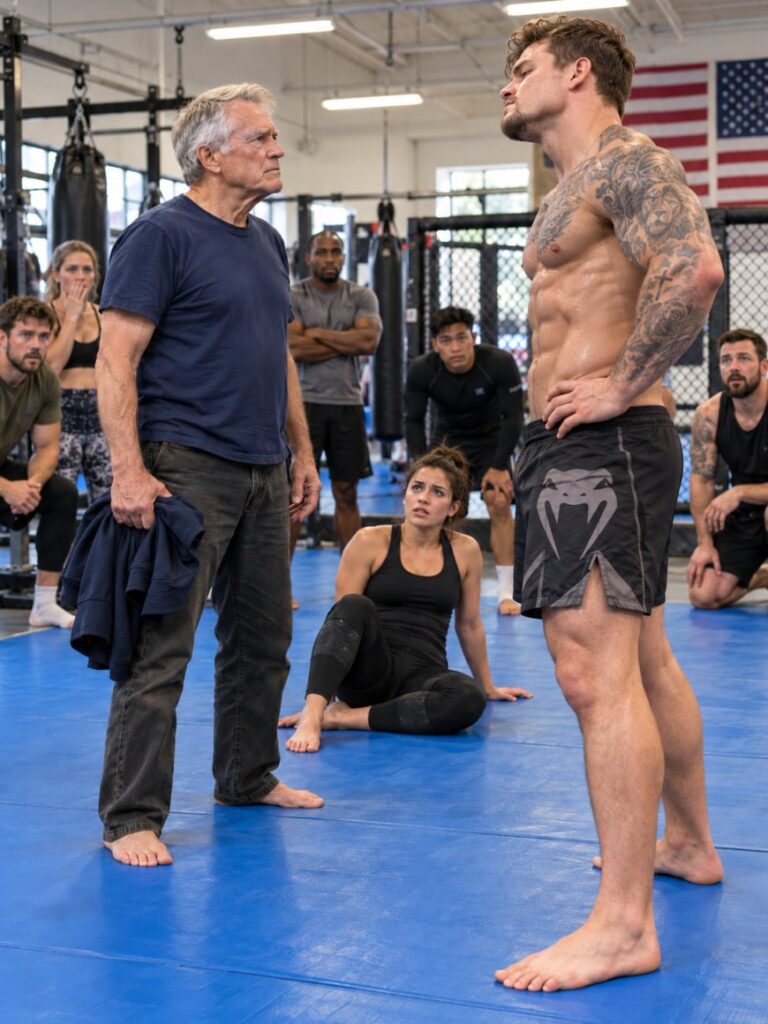
“And now?”
“Now I’m trying to do better.”
I understood.
“That’s all anyone can do.”
He smiled.
“Yes.”
Lily appeared at my side.
“Hi.”
Arthur looked at her.
“You must be Lily.”
“How do you know my name?”
“Your mother talked about you.”
Lily looked at me.
“She did?”
“A lot.”
Lily smiled.
“Thank you for helping her,” she said.
Arthur looked at her for a moment. Then he nodded.
“Thank you for being brave enough to watch,” he said. “That’s harder than you know.”
Lily didn’t respond. But something in her face changed.
We stood there for a moment, the three of us, watching the class practice on the mat. Beginners tapping. Partners releasing. The simplest rule in the world, repeated over and over until it became instinct.
“That’s the whole thing,” Arthur said quietly.
“What?”
“That.” He pointed at the mat. “That’s the whole art. Learning to trust. Learning to listen. Learning to let go.”
I watched a young girl — maybe fifteen, maybe sixteen — tap her partner’s arm. The partner released immediately. They smiled at each other. Then they reset and started again.
“Do you think Tyler will ever really understand?” I asked.
Arthur considered.
“Maybe not completely. But he’s trying. That’s more than most people ever do.”
“Is it enough?”
He looked at me.
“That’s not the question.”
“What is?”
“The question is whether you’re okay.”
I thought about it. My throat. My daughter. My life since that night.
“I am.”
He nodded.
“Then that’s enough.”
—
I heard three years later that Arthur Bennett had died.
Martin called me early in the morning. His voice was thick.
“He went in his sleep. His son was there.”
“Matthew?”
“Yes.”
I sat down. I hadn’t seen Arthur since the reopening. Hadn’t talked to him. Hadn’t thought about him much, honestly — life had moved on, and the memory of that night had faded into something softer, something I could carry without it hurting.
But now.
“What can I do?”
“Nothing. Just—” Martin paused. “I thought you should know.”
“Thank you.”
“His son wants you to come. To the memorial.”
I was surprised.
“Why?”
“He said his father mentioned you. More than once.”
“Okay.”
“I’ll send you the details.”
“Okay.”
We hung up.
I sat at my kitchen table — the same table where I had sat when Tyler called, when the world was still spinning — and I let myself feel it.
Not grief, exactly. Arthur had lived a long life. Had done good work. Had helped more people than I would ever know.
But something like gratitude. Deep and quiet and impossible to fully express.
I went to the memorial. So did Lily. So did Martin. So did dozens of people I had never met — refs, coaches, students, family members. People whose lives had been shaped by a man who had learned when to let go and spent decades teaching others.
Tyler wasn’t there. I found out later he had sent flowers. No note.
After the service, Matthew came up to me.
“You’re Rachel.”
“Yes.”
“He talked about you.”
“What did he say?”
Matthew smiled.
“He said you reminded him of why he kept doing the work. Why it mattered.” He looked at me. “He said you had something. Something that made him want to be better.”
I didn’t know what to say.
“I don’t even know what that means.”
“He did.” Matthew laughed. “That was the thing about my dad. He saw things in people that they couldn’t see in themselves.”
I thought about that. About Arthur standing up. About Arthur folding his jacket. About the thirty seconds that had changed everything.
“He saw something in Tyler too,” I said.
“Yes.” Matthew’s face was thoughtful. “He said Tyler wasn’t lost. Just late.”
Late.
I liked that.
Not lost. Just late.
—
Ten years later, I had my own dojo.
Not a big one. A small studio in a strip mall, next to a bakery and a nail salon. I taught judo. I taught self-defense. I taught the same lesson I had learned the hard way: tapping means stop.
Lily helped sometimes. She was twenty-three now, working as a physical therapist, engaged to be married. She still trained. She still tapped. She still made me proud.
One day, a man came in. He was maybe forty. Thick arms. A competitive look in his eyes.
“I want to train,” he said. “Hear good things about you.”
“Any experience?”
“Some.” He smiled. “Did a little MMA.”
“Okay.”
We talked. I took his information. Then I handed him the rules.
“Read these. Sign them. Bring them back.”
He scanned it. His eyes stopped on the last line.
“No explanation required. What does that mean?”
“Exactly what it says. If you say no, the answer is no. If you tap, the match stops. If a referee says stop, you stop. No questions. No debates.”
He laughed.
“Seems a little—”
“Strict?”
“Yeah.”
I looked at him. I remembered Tyler Kane. I remembered Arthur Bennett. I remembered my daughter’s face on that terrible night.
“I’ll tell you a story,” I said.
And I did.
When I finished, the man was quiet.
“I’ve heard about that,” he said. “The video.”
“That’s me.”
He stared at me.
“That’s you?”
“Yes.”
“I didn’t—” He shook his head. “I didn’t know.”
“No reason you should.” I held out the paper. “Now you know.”
He signed it.
“Welcome to the gym,” I said.
He trained well. He was respectful. He was careful. He tapped when he needed to and released when someone else tapped. He followed the rules.
Maybe he would have anyway. Maybe the story didn’t make a difference.
But maybe it did.
And that was why I kept telling it.
Not because I wanted to be a symbol. Not because I wanted revenge. But because stories were how we learned. Stories were how we remembered Arthur. Stories were how we taught the next generation that when someone says stop, you stop.





