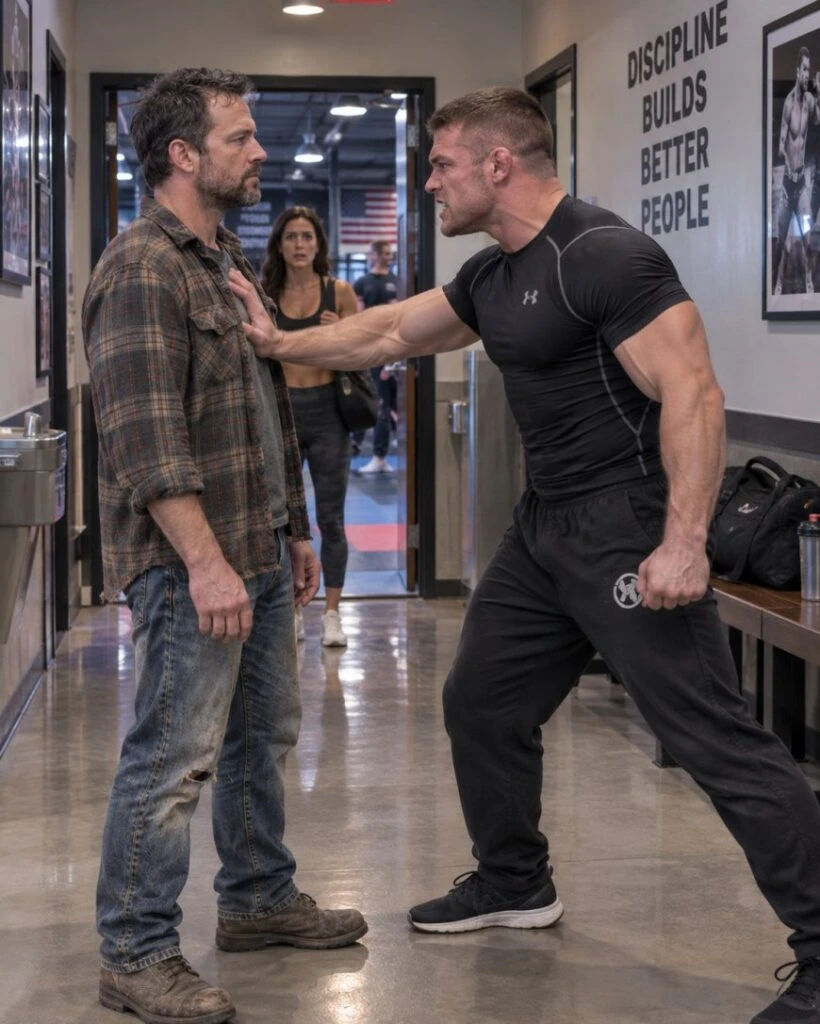
PART 2
The fluorescent lights of Apex Grappling still buzzed in my ears as I pulled out of the strip mall parking lot. My hands were steady on the wheel. They always were after the storm passed. The adrenaline that would have most men shaking for an hour had been trained out of me years ago, replaced by a cold, hollow calm that settled into my bones like an old friend I never wanted to see again.
I drove past the discount liquor store. Past the dying laundromat. Past the rows of closed businesses with their faded signs and cracked windows. The streets were empty at this hour, just me and the amber glow of traffic lights blinking through intersections where nobody else bothered to stop.
My phone buzzed in the cupholder. I didn’t look at it. I already knew who it was. Sarah would be calling. Or texting. Or doing whatever she did when the reality of a situation finally crashed through that hardened mask she’d been wearing for the past year. She’d want answers. She’d want explanations. She’d want me to help her understand what she’d just witnessed.
I didn’t owe her that. I didn’t owe her anything anymore.
The motel sign flickered ahead — Vacancy, it said in faded red neon. I pulled into the same spot I’d been parking in for two weeks, killed the engine, and sat there in the dark for a long moment. The room was exactly as I’d left it. Cheap mattress. Sticky carpet. A television bolted to the dresser that only got three channels, all of them fuzzy.
I sat on the edge of the bed and looked at my hands again. Liam’s blood was still under my fingernails. Not much — just a thin dark line where his face had met the mat. I flexed my fingers. No pain. No swelling. I’d pulled every punch. I’d controlled every movement. Even at the end, when I had his throat under my forearm and his life in my hands, I’d held back.
That was the difference between me and men like Liam. He fought for ego. He fought for the rush. He fought because he’d never been in a real fight, a fight where losing meant dying in the mud while your buddies dragged your body to cover.
I fought because I had to. And I stopped when the threat was neutralized. That was the discipline they’d drilled into me. That was the line I’d sworn never to cross again.
My phone buzzed again. Then again. I finally picked it up.
Sarah: What the hell was that
Sarah: Jack answer me
Sarah: Where did you learn to do that
Sarah: I’m serious
Sarah: Liam is in the hospital
I set the phone face down on the nightstand. The bathroom mirror was cracked in the corner, and I avoided looking at it while I washed my hands. The water ran pink for a few seconds before it cleared. I dried my hands on the stiff motel towel and walked back into the room.
I didn’t sleep that night. I lay on top of the covers with my boots still on and stared at the ceiling, listening to the distant hum of the interstate. In my head, I was still on that mat. Still watching Liam’s overhand punch cut through empty air. Still feeling the crack of his shin against my tibia. Still hearing that high, thin wail when his shoulder separated.
I’d told myself for three years that I could leave that part of me behind. That the man who woke up at 0300 in a shipping container in Fallujah was a different person, a stranger I’d buried under khakis and spreadsheets and property tax complaints. But watching Liam grovel on his own blue mats, I’d realized the truth.
That man wasn’t buried. He was just waiting.
The sun came up gray and cold through the thin motel curtains. I made coffee in the tiny two-cup machine, drank it standing by the window, and watched the parking lot fill with truckers and salesmen and other people passing through. My phone had eleven missed calls. Three from Sarah. Two from a number I didn’t recognize. Six from another number I didn’t recognize.
I called the last one back.
“Mr. Harper?” The voice on the other end was young, female, professional. “This is Dr. Reyes at Mercy General. Your wife Sarah asked us to contact you. Your name was listed as her emergency contact.”
“I’m not her emergency contact anymore,” I said.
There was a pause. “Sir, your wife was brought in last night for a severe anxiety attack. She’s stable, but she’s asking for you.”
I closed my eyes. The coffee was bitter in my mouth. “Is she in danger?”
“No, sir. But she’s very distressed.”
“I’ll be there in twenty minutes.”
I didn’t know why I said it. I didn’t owe Sarah anything. But the man I used to be — the one who raised his right hand and swore an oath to protect people — he was still in there somewhere. And he didn’t walk away from someone in distress, even if that someone had spent the last year treating him like a piece of furniture.
Mercy General was a sprawling complex of brick and glass on the edge of downtown. I parked in the visitor lot and walked through the automatic doors into the sterile lobby. The smell hit me first — antiseptic, hand sanitizer, that faint undertone of fear that always lingers in hospitals. I’d spent enough time in medical tents to know it well.
Sarah was in a room on the third floor. When I walked in, she was sitting up in bed with her knees pulled to her chest. Her face was blotchy from crying. Her hair was a mess. She looked smaller than I remembered, somehow diminished, as if the past twenty-four hours had stripped away the armor she’d been wearing for so long.





