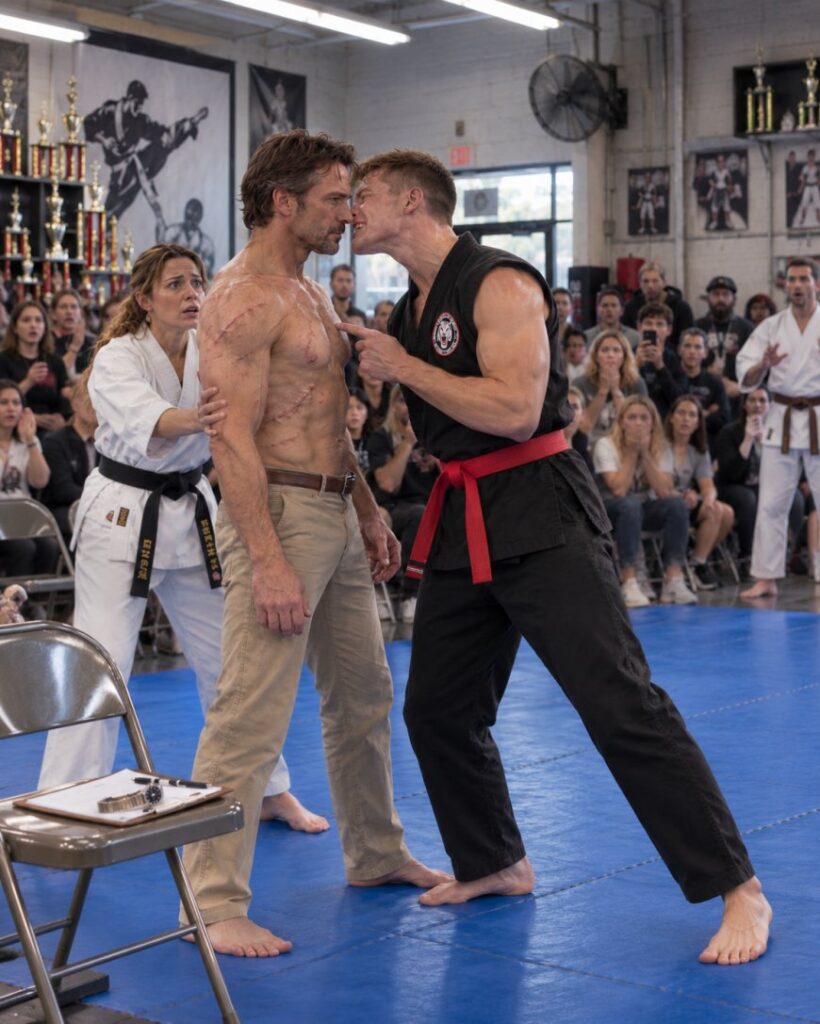
But for the rest of the hour, those seven teenagers trained with a focus and intensity I had never seen from them before. They weren’t trying to look cool. They were trying to understand the physics of their own bodies.
Over the next three weeks, the gym transformed. The noise level dropped significantly. The chaotic, ego-driven sparring sessions were replaced by quiet, grueling positional drills. We were bleeding money, but the culture of the room was shifting. The smell of cheap body spray was replaced by the honest, sharp scent of hard work and canvas.
A few parents complained about the change in pace. A few more kids trickled away. But slowly, something else began to happen. The parents who stayed started talking. They talked to their friends. They talked about a gym where discipline actually meant something, where their children were learning resilience instead of choreography.
One evening, an older man walked through the doors. He was in his fifties with thick forearms and a slight limp. He walked up to the front desk, looking past me to watch Sarah drilling a headlock escape with Peter.
“I heard a rumor,” the man said, his voice gravelly. “I heard the loudmouth kid who used to run this place got humbled by the accountant. And I heard you guys are actually teaching grappling now.”
I looked up from my screen. I analyzed his posture. His cauliflower right ear, the calluses on his knuckles. He wasn’t looking for a fitness class.
“We teach fundamentals,” I replied carefully. “My wife is the head instructor. I just handle the billing.”
The man smiled, pulling a worn leather wallet from his back pocket.
“I used to wrestle Greco-Roman back in the Navy. Need a place to get a sweat going without dealing with a bunch of hotshots. Where do I sign?”
I slid a registration clipboard across the glass counter. It was just one sign-up. It wouldn’t cover the rent deficit. It wouldn’t magically fix the broken air conditioning or the leaking roof. The math was still against us.
But as I watched the man fill out the forms, I realized something important. We weren’t a daycare anymore. We weren’t a fantasy camp. The cash cow was dead, but the foundation was finally solid. And a solid foundation is the only thing that survives the storm.
The transition from summer to autumn brought a bitter chill to the strip mall, but for the first time in years, the cold felt welcome. The broken air conditioner didn’t matter anymore. The heavy industrial fans were pushed into the storage closet, replaced by the natural sharp draft that leaked through the weather stripping of the glass double doors. We were lean. We were hungry. And most importantly, we were quiet.
The mass exodus of Connor’s fan club had left our bank account severely depleted, but it also removed the rot from the floorboards. The thirty students we retained were the ones who actually wanted to learn. They didn’t care about Instagram clips or showing off for their friends. They cared about balance, leverage, and the honest, unglamorous mechanics of survival.
Arthur, the Navy veteran with the cauliflowered ear, became a regular. He didn’t just train—he brought an entirely different kind of energy to the adult classes. He brought a grueling, blue-collar work ethic that immediately rubbed off on the accountants and middle managers who had previously treated the gym like a Friday night social club.
Within a month, Arthur had recruited three other guys from his local VFW post. Thick-necked, quiet men who didn’t mind getting sweat in their eyes and canvas burns on their elbows. Our demographic shifted rapidly. We stopped advertising to parents looking for after-school babysitting. We started marketing to people who wanted to understand the brutal realities of physical confrontation.
Sarah transformed alongside the gym. The perpetual exhaustion that used to hang over her vanished, replaced by a sharp, focused intensity. She wasn’t managing egos anymore. She was forging martial artists.
I watched her one Tuesday evening demonstrating a trip on Arthur. He outweighed her by sixty pounds, but she didn’t use an ounce of muscle. She used angles. She disrupted his base, trapped his posting arm, and sent him crashing to the mat with a heavy, satisfying thud. Arthur laughed—a genuine, booming sound—and immediately asked her to walk him through the footwork again.
She was in her element. She was her father’s daughter, running a school that finally lived up to the name printed on the sign outside.
News about Connor trickled back to us eventually. The martial arts community in a mid-size city is a very small, gossipy circle. He had lasted exactly three weeks at the kickboxing gym across town. The head coach there didn’t care about regional point-fighting trophies or how many teenagers thought he was cool. He put Connor in the ring for hard sparring with a local amateur boxer who didn’t respect spinning hook kicks.
Connor got his nose severely broken in the first round. He quit the next day, claiming the gym culture was too toxic. He was currently working at a supplement store in the mall, selling overpriced protein powder and telling anyone who would listen about his days as an undefeated champion.
Reality is a harsh teacher, and it doesn’t grade on a curve.
As for me, I remained the accountant. I kept my desk in the lobby. I wore my beige slacks and my button-down shirts. I processed the billing, swept the floors, and calculated our margins. By November, the spreadsheet finally stopped bleeding red. We weren’t wealthy, but we were solvent. The lease was paid. The lights stayed on.
But things were different now. The invisible barrier between the front desk and the canvas mats had permanently dissolved. Every Friday night, after the junior classes were finished and the sun went down, we held an open mat session for the advanced adults. It was invite only. It was quiet.





