I folded the letter and put it in the drawer with the others. Then I went to the kitchen and started making dinner.
Milo came in from the living room, where he’d been working on a new model — a fighter jet this time, with moving parts and a detailed cockpit.
“Dad,” he said. “Can I ask you something?”
“Always.”
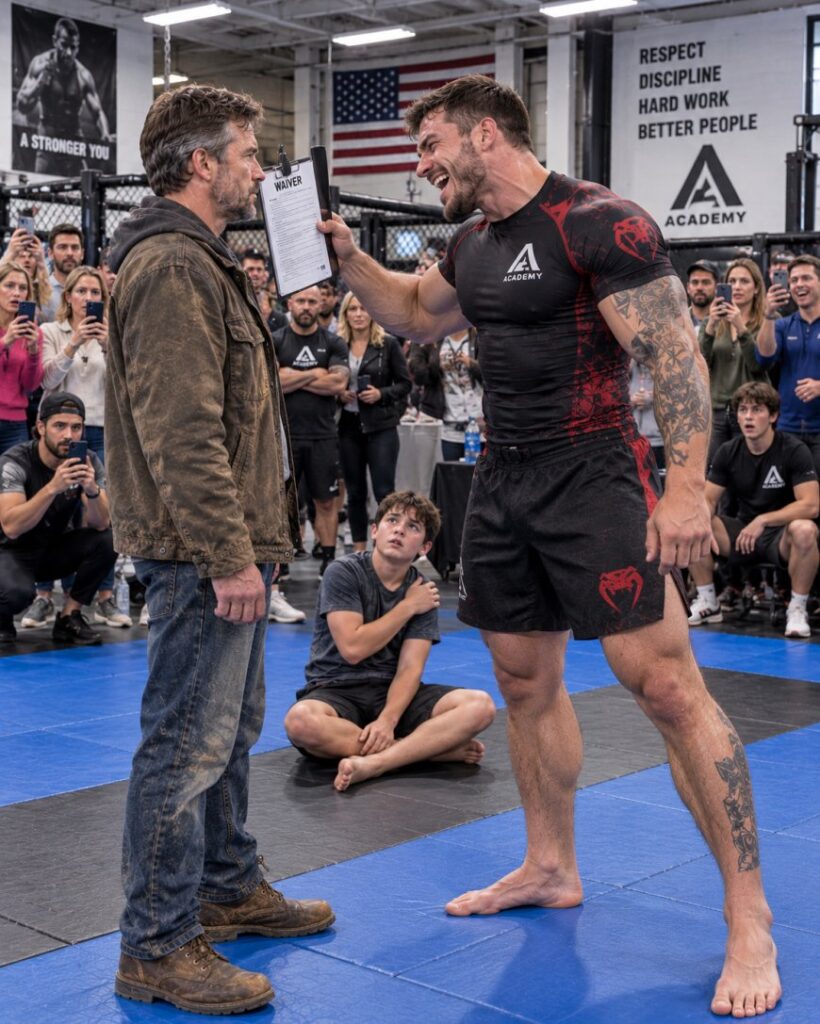
He hesitated. Then he said, “The night at Bryce’s gym. When you were fighting him. You could have hurt him. You could have done a lot worse than you did.”
“I could have.”
“Why didn’t you?”
I set down the knife I’d been using to chop onions and turned to face him. He was standing in the doorway, his arms crossed, his expression serious. He looked older than twelve. He looked like someone who was trying to understand something important.
“Because I made a promise to your mother,” I said. “Before she died, she asked me to make sure you grew up knowing more about kindness than combat. And I couldn’t keep that promise if I let myself become the kind of man who hurts people just because he can.”
“But you could have. You were stronger than him.”
“Strength isn’t about what you can do. It’s about what you choose to do. And I chose to stop him without hurting him more than I had to. That was the right choice. Not because I had to. Because I wanted to.”
He was quiet for a moment, thinking. Then he nodded slowly.
“Okay,” he said. “I think I understand.”
“Good.”
He turned to go back to his model, then stopped and looked at me again.
“Dad?”
“Yeah?”
“I’m glad you’re my father.”
He said it simply, without embarrassment, the way he’d say he liked a particular kind of cereal or preferred one video game over another. But the words landed deep, the way words from your child always do.
“I’m glad you’re my son,” I said.
He smiled — a real smile, the kind that reached his eyes — and disappeared back into the living room.
I stood there for a moment, in the kitchen, surrounded by the smell of onions and the sound of Milo’s model-making in the other room. The house was warm. The lights were on. Outside, the December wind was blowing, but inside, everything was still.
I thought about Claire. About the promise I’d made her. About the years I’d spent trying to keep it.
I thought about Marcus, and how close I’d come to breaking it. About the darkness I’d spent four years trying to bury. About the choice I’d made in that alley.
I thought about Milo, and the man he was becoming. The boy who’d stood up to his bullies without throwing a punch. The boy who’d asked me why I hadn’t hurt Bryce more. The boy who was learning, slowly and surely, that strength and kindness weren’t opposites — that they were, in fact, the same thing.
I turned back to the onions. My eyes were watering, but it wasn’t from the onions.
That night, after Milo was asleep, I sat on the back porch with a cup of tea and looked up at the stars. The air was cold and clear, the kind of cold that makes you feel alive. I thought about everything that had happened. The fight at Bryce’s gym. The confrontation with Marcus. The years I’d spent trying to build a life out of the wreckage of the old one.
I thought about the promise I’d made to Claire, and the promise I’d made to myself.
I’d kept them both. Not perfectly. Not without mistakes. But I’d kept them.
And that, I realized, was enough.
THE END
This content may be created by AI for entertainment purposes. Any resemblance to real persons, events, or places is coincidental.





