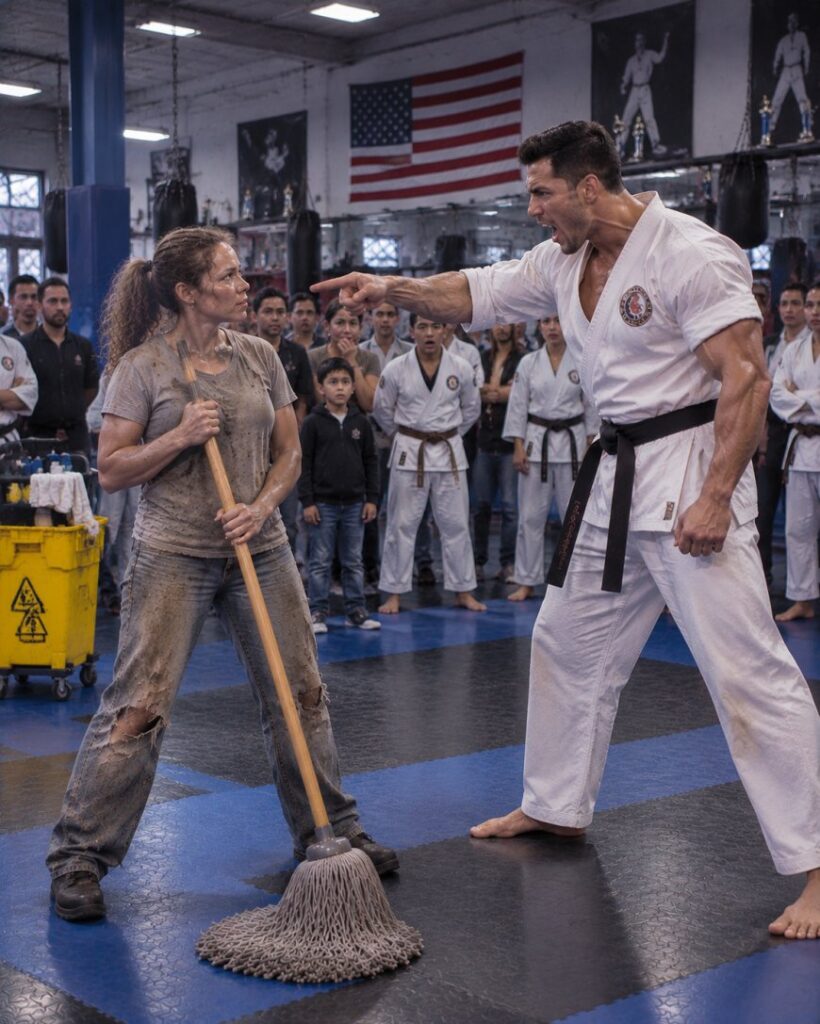
Five minutes in, Ryan was breathing hard while I looked like I’d barely started warming up. Sweat darkened his gi while my shirt remained dry. His movements were becoming wider, more telegraphed as fatigue and frustration took their toll.
The crowd’s energy was shifting, too. Parents who’d expected to see Ryan dominate were now watching with growing amazement as the cleaning lady systematically dismantled his offense without seeming to exert any effort.
“She’s making him look silly,” Sarah Kim whispered to another mother.
“Where did she learn to move like that?” came the reply.
Ryan heard the whispers and his face reddened. He’d promised these people a demonstration of proper martial arts hierarchy. Instead, he was being embarrassed by someone who wasn’t even fighting back.
“Enough!” Ryan roared, abandoning technique for pure aggression.
He rushed forward with a wild haymaker, putting all his power behind a punch designed to end the match. I had been waiting for this moment.
As Ryan committed fully to his attack, I stepped off the line of his punch and captured his extended arm. My movement was so fast, so precise that most spectators missed the technique entirely. One moment, Ryan was throwing his biggest punch. The next, he was airborne, rotating through space in a perfect arc before landing hard on his back with me controlling his arm in a textbook Juji Gatame armbar.
The room erupted in gasps and scattered applause. But instead of applying pressure to force a submission, I held the position for just a moment — long enough for everyone to see how completely I controlled him. Then I released his arm and stood up.
Ryan lay on his back, staring at the ceiling, his chest heaving.
Around the room, parents and students processed what they’d just witnessed. That throw had been beautiful, technical, the kind of technique that took years to perfect.
Marcus Chen was on his feet now, his face pale with recognition. He knew that throw. He’d seen it in competition footage performed by Paralympic champions and Olympic medalists.
“Jesus Christ,” he breathed. “Who is she?”
Ryan rolled to his side, then pushed himself up to his knees. His gi was disheveled, his hair messed, his breathing labored. But it was his expression that had changed most dramatically — the arrogant confidence replaced by confusion and growing fear.
“What the hell was that?” he gasped.
I extended my hand to help him up. The gesture was respectful, even gentle. But when Ryan looked into my eyes, he saw something that made him shiver. I wasn’t even trying yet, and somehow everyone in the room knew it.
Ryan stared at my outstretched hand for a long moment before slapping it away and scrambling to his feet on his own. His face was flushed with embarrassment and growing desperation.
“Lucky shot!” he panted, adjusting his gi with shaking hands. “You caught me off guard.”
But everyone in the room had seen the truth. That hadn’t been luck. That had been the kind of technical perfection that came from thousands of hours of practice, from muscle memory so deep it operated beyond conscious thought.
David Park stepped closer to the edge of the mat, his referee’s instincts alert. The dynamic had shifted completely. Ryan’s breathing was ragged, his movements increasingly frantic, while I remained centered and calm.
“Ryan,” David called out, his voice carrying a warning. “Remember where you are.”
But Ryan was past hearing warnings. The whispers from the crowd, the way parents were looking at him now — not with respect, but with something approaching pity. It was eating at him. His entire identity was built on being the expert, the authority figure. Without that, who was he?
He came at me again, this time abandoning any pretense of technique. Wild swings, desperate grappling attempts, the kind of sloppy brawling that had no place in a martial arts school.
I absorbed it all with minimal effort. I redirected his punches, stepped away from his kicks, and when he tried to tackle me, I simply wasn’t where he expected me to be.
The crowd watched in growing discomfort as Ryan’s attacks became more reckless, more dangerous. This wasn’t martial arts anymore. This was a man having a breakdown in public.
“This is embarrassing,” someone whispered.
“Someone should stop this,” came another voice.
But I understood something the spectators didn’t. Ryan needed to reach the bottom before he could find his way back up. So I gave him space to fall, space to exhaust himself against my defense.
Eight minutes into the match, Ryan threw a wild right hook that would have seriously injured me if it had connected. But it didn’t connect. I moved just enough to let it pass by my ear, and the momentum of his miss sent Ryan stumbling forward.
That’s when something inside him snapped.
“Fight me!” he screamed, spinning around to face me. “Stop hiding. Stop running. Fight me like a man.”
The words hung in the air like poison. Around the room, parents exchanged shocked glances. Students shifted uncomfortably. Even Aiden, who couldn’t hear the shouted words, could read the ugly emotion on Ryan’s face.
Ryan raised his fist again, but this time there was something different in his eyes. Something that made David start forward from the edge of the mat.
I saw it, too. The moment when frustration crossed the line into genuine violence, when technique gave way to the desire to hurt.
I moved — not away this time, but toward him.
As Ryan’s fist came down in a wild, uncontrolled strike aimed at my head, I stepped inside his guard and caught his wrist. My other hand came up and pressed gently against his chest, and I held him there for a moment that stretched like eternity.
We were frozen in that position. Ryan’s fist trapped inches from my face, my hand resting over his heart.





