It was not justice.
But it was a step.
That night, Divine called me.
“Did you hear?” she asked.
“I heard.”
“How do you feel?”
I thought about it.
“Like I can breathe,” I said.
“Good.”
“Mom.”
“Yes?”
“Did Grandpa Robert ever talk about the Macon training center?”
Divine was quiet for a moment.
“Not in words,” she said.
“What do you mean?”
“He used to get letters from coaches all over Georgia.”
“He never told me.”
“He never told anyone.”
“Why?”
“Because he didn’t do it for the thanks.”
I looked at Robert’s photograph on my corkboard.
“He did it because talent without access is talent wasted,” I said.
Divine’s voice softened.
“You found the letter.”
“I found the letter.”
“Then you know everything he would have wanted you to know.”
I did not cry.
Not then.
But I came close.
The following Saturday, I competed at the regional open grappling tournament outside Atlanta.
I had registered before everything began.
Before the lawsuit.
Before the board hearing.
Before my name became a debate.
I almost withdrew twice.
I did not.
The venue was a converted warehouse with bad lighting and high ceilings.
The mats were old but clean.
The air smelled like sweat and chalk and nerves.
Latimore was in the bleachers.
Avery was beside her with a crooked sign that said ZOE in letters too big for the poster board.
Divine sat in the third row in her good shoes and good coat.
Takahashi stood near the back with his arms folded.
When I walked to the warm-up area, he nodded once.
I nodded back.
My first match lasted four minutes.
I won by points.
My second match lasted six minutes.
I won by submission.
The semifinal went the full time.
The girl from Savannah was technically excellent.
She was also genuinely difficult.
I won on points.
The final lasted seven minutes.
It ended with a submission.
Twenty-four and zero.
Still undefeated.
Afterward, I sat on a bench at the edge of the warm-up area.
My gym bag was between my feet.
My body was quiet with the exhaustion that only comes after everything available has been spent.
I reached into the front pocket of my bag.
Robert’s photograph was there.
Worn at the edges now.
Soft at the corners.
Robert Oakerson, 1987.
Arms raised.
Chest out.
Grinning like someone had just told him the best news of his life.
Not performing.
Just certain.
I looked at it for a long time.
Across the warehouse, Avery was forcing her way through the crowd.
The sign was still in her hand.
She was already talking before she reached me.
Divine followed at her own pace.
Latimore stayed back, giving me the moment.
I looked at the photograph one more time.
“I know, Grandpa,” I whispered.
“I know.”
Then I tucked it back into my bag.
The story had begun with someone deciding I was nothing.
A new girl.
A scholarship student.
A Black girl with worn shoes and no powerful family standing behind her.
It had continued through lies and threats and legal pressure and administrative cowardice and donor money disguised as university policy.
But it ended where Robert had always taught me every real fight must end.
Not with noise.
Not with revenge.
Not even with victory as the world understands it.
It ended with me standing.
Standing on the mat.
Standing in the hearing room.
Standing beside my mother.
Standing beneath my grandfather’s name.
Standing not because I had never been afraid, but because fear had never been allowed to make me small.
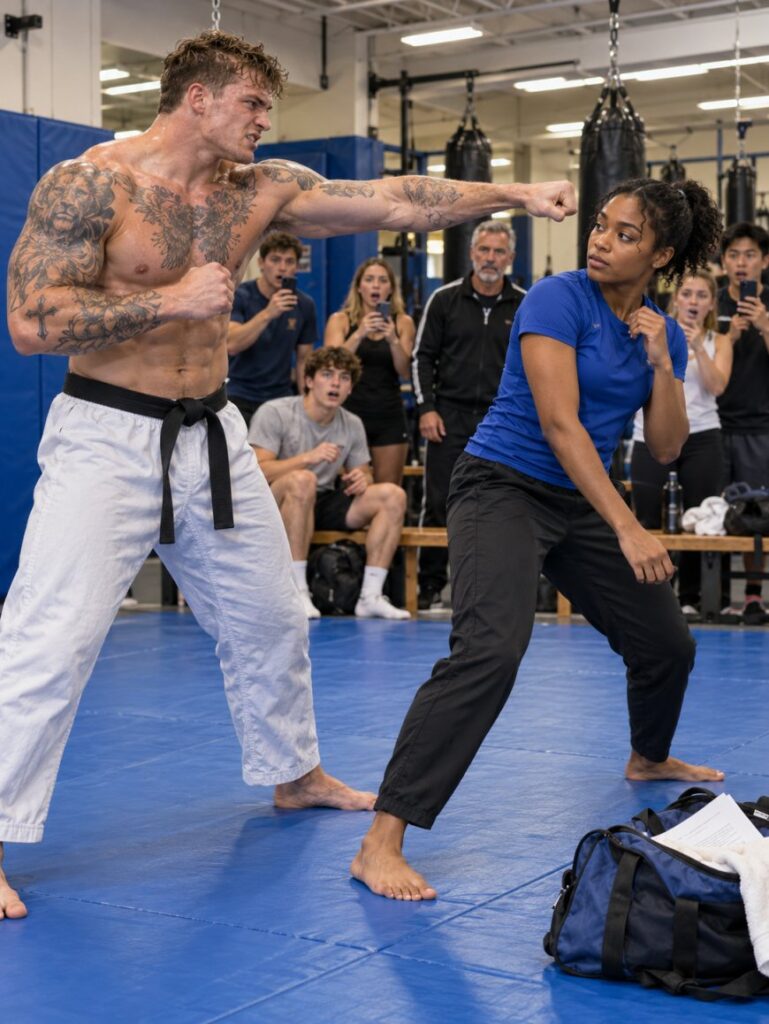
Brody Walter thought he was inviting an easy target onto the mat.
He thought he was choosing someone isolated enough to embarrass and poor enough to punish.
He thought power belonged to the person with the biggest name, the richest father, and the loudest audience.
He was wrong.
Power was in the girl who stayed calm when the room turned against her.
In the roommate who documented everything before fear forced her quiet.
In the student journalist who published truth when the official paper refused.
In the instructor who came back after fear almost closed his mouth.
In the woman who had survived years of institutional machinery and still found one legal way to say, this happened before.
In Vera Latimore, who knew exactly how power worked because she had watched it long enough to learn where its seams were.
And in Robert Oakerson, who had spent his life building quiet networks for young athletes who had talent but no access, never knowing that one day his granddaughter would need the road he had laid.
The eleven-second match made people look.
But it was everything after the match that showed them what mattered.
Because bullies rarely lose when they fall.
They lose when the room finally stops helping them stand.
I never asked to become the center of a story.
I only wanted to study and train and keep the promise my scholarship represented.
But when the machinery came for me, I learned what my grandfather had been teaching me all along.
You win long before the fight begins.
You win in the discipline.
In the records kept.
In the truth protected.
In the refusal to accept a quiet settlement that leaves the next person alone.
And when the moment finally comes, when everyone is watching and someone powerful expects you to fold, you do not need to shout.
You do not need to perform.
You do not need to prove you are dangerous.
You simply step forward.
Breathe.
And stand.
Disclaimer: This story is entirely fictional and created for entertainment purposes only. It does not represent any organization or individual, nor does it encourage inappropriate behavior. The content was generated with AI assistance.





