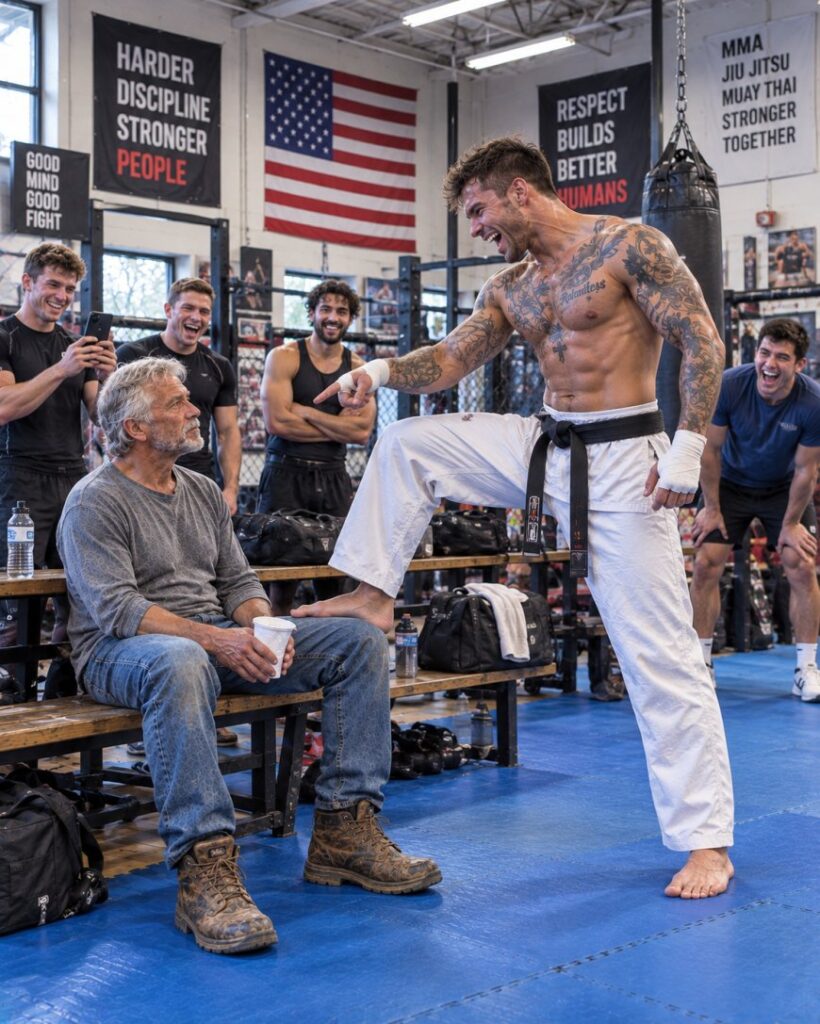
Thorn nodded. “I need to understand.”
Gregory didn’t ask what he needed to understand. He just nodded and watched as Thorn climbed back into his truck and drove away.
The address was a small house on a quiet street on the edge of town. The yard was neat but simple—a few flower beds, a patch of grass, a battered wooden rocking chair on the front porch. An old blue Ford F-150 sat in the driveway, rust creeping along the wheel wells. It didn’t look like the home of a killer. It looked like the home of a grandfather.
Thorn parked on the street and sat in his truck for a long time, staring at the house. The morning was crisp and cool, the air carrying the early bitter promise of autumn. He could see the old man sitting on the porch in the rocking chair, a mug of something steaming in his hands, his gaze fixed on a pair of blue jays fighting over a peanut in the front yard.
He looked peaceful. Content. Like a man who had nothing to prove and nowhere to be.
Thorn took a deep breath, climbed out of his truck, and walked up the short concrete walkway. His shoes made soft sounds on the pavement, and the old man looked up, his eyes tracking Thorn’s approach with the same calm, steady gaze that had dismantled him three days earlier.
Thorn stopped at the edge of the walkway. He didn’t say anything. He just stood there, his hands shoved deep into his pockets, his shoulders slumped, his face a mess of bruises and splints and shame.
The old man didn’t say anything either. He just continued to rock, the wooden runners of the chair squeaking faintly against the floorboards. The blue jays flew away, and the yard was silent except for the creaking of the chair and the distant hum of a lawnmower somewhere in the neighborhood.
“Greg gave me your address,” Thorn said finally. His voice was thick and nasal due to the splint. He sounded nervous. He sounded like a kid.
“I assumed,” the old man replied, his voice gravelly and calm.
Thorn shifted his weight from one foot to the other. He looked around the modest yard, taking in the neat flower beds, the peeling white paint on the window trim, the absolute quiet of the neighborhood. It didn’t look like the home of a killer. It looked like the home of a grandfather.
“I came to apologize,” Thorn blurted out, the words rushing out of him as if he were afraid he would lose the nerve to say them. “I was out of line. I was disrespectful. You were just sitting there and I—I acted like a punk.”
The old man stopped rocking. He rested the mug on his knee and looked at Thorn.
“Yes, you did.”
Thorn flinched slightly at the blunt agreement. He’d expected the older man to wave it off, to say, “No hard feelings,” or “Water under the bridge.” That was how these things usually went. But the old man wasn’t offering any easy absolution.
“My nose is fractured in two places,” Thorn offered, gesturing vaguely to his face.
“I know,” the old man said. “I felt it break.”
Thorn swallowed hard. He took a hesitant step forward, stopping at the bottom of the wooden porch stairs.
“I don’t understand.”
“What don’t you understand?”
“How you did it,” Thorn said, his voice dropping, shedding the last remnants of his pride. “I’m faster than you. I’m stronger than you. I train four hours a day. I have a black belt in Brazilian Jiu-Jitsu and a golden gloves background. You didn’t even put your hands up. You just—you just walked through me.”
The old man sighed, a long, weary exhalation that seemed to carry the weight of decades. He set the mug down on a small wooden side table.
“You’re a sports car, Thorn,” he said quietly. “You’re built for a track. You have rules. You have referees. You have a canvas that offers perfect traction, and you have opponents who agree to fight you under a very specific set of conditions.”
He leaned forward, resting his elbows on his knees.
“I’m a bulldozer. I was built to clear rubble. I don’t care about the rules of the track, because I was trained for places where there is no track. When you stepped to me, you were calculating distance, timing, and point combinations. I was calculating the fastest geometric route to render your central nervous system completely inoperable.”
Thorn stared at him. The bruised flesh around his eyes was twitching slightly.
“You weren’t even mad when you had me pinned. When you were going to break my arm, you looked bored.”
“Anger is a liability,” the old man stated, his tone flat and educational. “Anger floods your brain with chemicals that ruin your fine motor skills. Anger makes you swing wide. It makes you predictable. You fight out of anger and ego. You want to prove you’re the baddest man in the room. That requires an audience.”
He pointed a thick calloused finger at Thorn’s chest.
“When you fight for survival, you don’t care who is watching. You don’t want to be there. The violence isn’t a performance. It’s a terrifying, necessary chore, like taking out the garbage. You don’t get angry at the garbage. You just remove it.”
Thorn absorbed the words. They hit harder than the headbutt had. His entire identity had been wrapped up in being the apex predator, the untouchable fighter, but the old man had just fundamentally deconstructed his reality.
“Why didn’t you snap my arm?” Thorn asked, his voice barely a whisper.
“Because you yielded,” the old man said simply. “And because I am trying very hard to be a civilized man. Breaking a kid’s arm over a bruised ego is bad for the soul. I’ve broken enough things in my life.”





