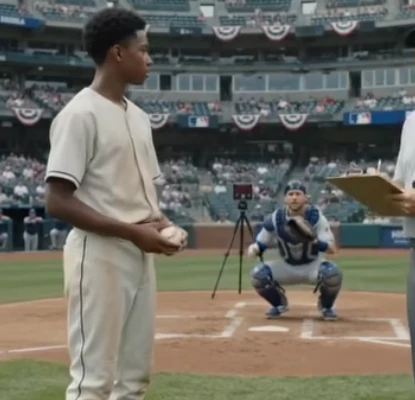
That phrase changed Terrence’s life more than the radar number.
Need follow.
For the first time, people whose jobs depended on noticing talent had decided Terrence was worth seeing again.
Monica arrived at 6:24 wearing navy work pants and white nursing shoes.
She looked around the nearly empty field.
Then saw her son sitting beside Ryan Mitchell near the dugout.
Terrence stood.
Monica walked toward him.
“Why are these men still here?”
Terrence smiled.
“I pitched.”
“I gathered that.”
“How did it go?”
He looked at Ryan.
Ryan answered:
“Pretty good.”
Monica recognized understatement immediately.
“How pretty good?”
Harold approached.
“Ms. Cole.”
He explained the numbers.
Monica listened.
Then asked:
“What does any of that actually mean?”
Harold liked her instantly.
“It means your son has a pitch professional organizations consider unusual enough to keep evaluating.”
“Does that mean somebody is offering him money?”
“Not tonight.”
“Scholarship?”
“Not from us.”
“So what does he have right now?”
Harold nodded.
Correct question.
“Attention.”
Monica looked at Terrence.
Then back at Harold.
“Attention doesn’t pay tuition.”
“No.”
“Can attention disappear?”
“Very quickly.”
“Then what should he do?”
Cal Dugan answered from behind Harold.
“Throw again when we ask.”
Monica looked at him.
“Were you the one who laughed?”
Terrence’s eyes widened.
“Mom.”
Ryan coughed into his glove.
Cal froze.
“How did you know?”
Terrence whispered:
“I might’ve mentioned it.”
Monica stared at Cal.
Cal did something nobody expected.
He nodded.
“Yes, ma’am.”
“You laughed at my son?”
“I did.”
“Before he pitched?”
“Yes.”
“Why?”
Cal could have defended himself.
He could have said Terrence was staff.
Not registered.
Unknown.
No verified velocity.
All true.
Instead:
“Because I decided what he was before I checked.”
Monica looked at him for another second.
Then:
“That seems like a bad habit for a scout.”
Ryan turned away because he was smiling too hard.
Harold openly laughed.
Cal nodded.
“Yes, ma’am.”
Three days later, Terrence received an invitation to a private regional workout.
Fee:
Zero.
Travel covered.
Two weeks later, three colleges contacted Jefferson High.
One offered a partial scholarship.
A junior college offered full tuition and books.
Another Division I program wanted to see him pitch in person before deciding.
Terrence did not immediately sign anything.
Monica made him read every document.
Twice.
Coach Webb helped.
So did an adviser provided through a legitimate player-development organization that charged them nothing.
Ryan Mitchell texted occasionally.
Mostly jokes.
Sometimes advice.
Throw strikes before trying to impress radar guns.
Or:
Your slider still owes baseball an apology.
Terrence saved that one.
At the regional workout, the fastball averaged 94.3.
High 95.7.
Movement profile remained unusual.
Command was better.
Slider still inconsistent.
Changeup improved.
A biomechanics coach explained the fastball in words Terrence had never heard before.
His low three-quarter release and particular two-seam orientation created asymmetric airflow off the seams.
The ball’s actual spin suggested one direction.
Its wake contributed additional movement.
Seam-shifted wake.
Terrence listened carefully.
Then asked:
“So I shouldn’t change the grip?”
The coach laughed.
“No.”
“Absolutely not.”
Terrence looked relieved.
“Good.”
“I spent two years finding it.”
That sentence moved through scouting reports too.
Not because it proved genius.
Because it proved feel.
Terrence had discovered through repetition what expensive equipment later measured.
That mattered.
The showcase organization faced uncomfortable questions after a short video of Terrence’s first pitch spread online.
Not from Terrence.
Ryan’s college teammate had filmed part of the bullpen from the stands.
The clip showed Terrence in a staff uniform.
Cal’s voice could be heard faintly before the throw:
“We’re evaluating pitchers, not stadium help.”
Then the pitch.
The glove pop.
Ryan removing his mitt.
The radar being turned on.
Within two days, the clip had millions of views.
People argued about race.
Money.
Baseball’s showcase system.
Access.
Some accused every scout there of racism.
Terrence did not like that.
Some men had dismissed him.
Others had not even known what was happening.
He told a local reporter:
“I’m Black. I was also wearing a ball-boy shirt and taped shoes.”
“People can decide for themselves what they saw.”
“What I know is they didn’t ask if I could pitch until Ryan did.”
That answer disappointed people who wanted a simpler argument.
Terrence did not care.
He had lived the moment.
They had watched twelve seconds.
The showcase director later announced that future events would reserve two evaluation slots for local high-school players nominated by public-school coaches who could not afford registration.
It was not a revolution.
Two slots.
Small.
But real.
Monica said:
“Should’ve been there already.”
Terrence agreed.
Cal Dugan returned to Jefferson High three weeks later.
The field looked even worse than he expected.
One bullpen mound.
Uneven grass.
A rusty batting cage.
He found Terrence dragging the infield tarp after afternoon rain.
Cal laughed.
“You always working?”
Terrence shrugged.
“Somebody has to.”
Cal watched him throw a bullpen after the field dried.
No crowd.
No dramatic radar moment.
Terrence topped at 94.
Missed badly twice.
Hung a slider that Coach Webb pretended to hit over an imaginary fence.
Cal wrote everything.
Afterward, he sat beside Terrence on the dugout bench.
“You know your first pitch didn’t make you a prospect.”
Terrence looked at him.
“I know.”
“It made us look.”
“I know.”
“What you do after that matters more.”
“I know.”
Cal smiled.
“You say ‘I know’ a lot.”
“My mom says that too.”
Then Terrence asked:
“Can I ask you something?”
“Sure.”
“If Ryan hadn’t said let me throw one, would you ever have asked?”
Cal looked toward the empty field.
“No.”
Terrence appreciated the answer.
“Why?”
Cal took time.
“Because scouting isn’t just finding talent.”
“It’s filtering.”
“Thousands of names.”
“Thousands of games.”
“Limited time.”
“You learn shortcuts.”
“Age.”
“Level.”
“Body.”
“Velocity.”
“Competition.”
“Role.”
He pointed toward Terrence.
“You were wearing a staff shirt.”
“So I filtered you out.”
Terrence asked:
“Before seeing me.”
“Yes.”
“Isn’t that dangerous?”
Cal nodded.
“Very.”
Then:
“Shortcuts help you work faster.”
“They also make you miss things.”





