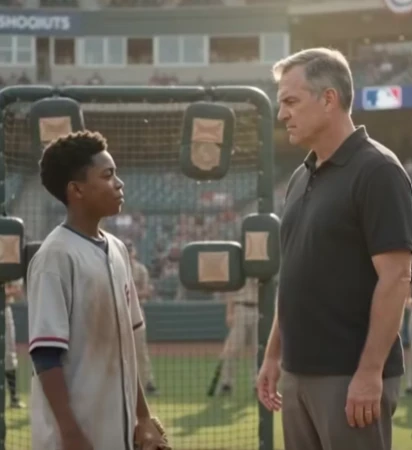
He crossed the warning track and walked onto the grass.
Around his neck hung an old leather pouch that most people assumed contained medication or reading glasses.
Arthur stopped in front of Isaiah.
“You said they have been attempting the wrong challenge.”
“Yes, sir.”
“Explain.”
Isaiah pointed toward the targets.
“The lower-left plate leans back and right.”
“The upper-left leans slightly down.”
“The upper-right turns inward.”
“The lower-right is supposed to angle up.”
“Supposed to?”
“The bottom-right plate is mounted backward.”
A murmur moved through the stands.
Warren shook his head.
“The targets were restored by professional stadium engineers.”
“They restored them to look square.”
Isaiah said it without disrespect.
That made Warren angrier.
Arthur stared toward home plate.
“How can you tell from here?”
“The bolt pattern.”
“What about it?”
“The top bolts on the other three sit closer together.”
“The lower-right has the wide pair on top.”
Arthur’s grip tightened around his cane.
He knew the old apparatus.
He had stood behind it when it was first built.
“You believe the plates are meant to redirect the ball,” he said.
“Yes.”
“Not stop it.”
“Yes.”
Warren laughed once.
“Four targets with one pitch?”
Isaiah looked at him.
“That is the challenge.”
“That is physically impossible.”
“No, sir.”
“You have never thrown from a major-league mound.”
“The mound doesn’t change the angles.”
“Have you even thrown ninety miles per hour?”
“No.”
More laughter came from the dugout.
Isaiah continued.
“It doesn’t need ninety.”
“What does it need?”
“Spin.”
Arthur opened the leather pouch.
Inside was a baseball sealed in a clear protective case.
The leather had darkened with age.
The red stitches were faded brown.
A small ink mark remained near the horseshoe seam.
M.M.
Several older scouts stood.
They recognized it.
The ball had appeared in photographs of the original Harlan challenge.
Arthur had carried it to showcases for decades but had never removed it in public.
Warren stared.
“You brought the Vance ball?”
“It was never mine,” Arthur said.
He opened the case.
Then he placed the baseball in Isaiah’s hand.
Isaiah’s fingers settled across the seams.
His index finger rested diagonally over the narrow stitch line.
His middle finger crossed the horseshoe.
His thumb pressed off-center beneath the ball.
Arthur stopped breathing for a moment.
He had seen that grip once.
Only once.
Fifty years earlier, under the same grandstand.
“You didn’t invent that,” Arthur said.
“No, sir.”
“Who taught you?”
Isaiah looked toward the first target.
“My grandfather.”
Arthur’s voice dropped.
“Tell me his name before you throw.”
“Malachi Monroe.”
The name moved through Arthur like a physical blow.
His cane slipped against the dirt.
Isaiah caught his elbow before he fell.
Arthur stared at the boy’s face.
The high cheekbones.
The narrow eyes.
The small scar above the left eyebrow.
He had seen those features beneath a faded Birmingham Bears cap in 1976.
“Malachi is alive?”
“Yes, sir.”
“Where?”
“St. Catherine’s Rehabilitation Center.”
“What happened?”
“Stroke last winter.”
Arthur looked at the old initials on the baseball.
“M.M.”
Warren stepped closer.
“What is this?”
Arthur did not answer him.
He looked only at Isaiah.
“Did Malachi tell you what happened here?”
“Some of it.”
“How much?”
“He said he completed the challenge.”
Warren laughed sharply.
“No one completed it.”
Arthur turned toward him.
“Your father made certain the record said that.”
The stadium went silent.
Warren removed his sunglasses.
“My father created this showcase.”
“Your father inherited it.”
“He chaired the original scouting committee.”
“He also erased a seventeen-year-old pitcher because the boy embarrassed his chosen prospect.”
Warren looked toward the scouts.
“This is not the place for an old personal argument.”
Arthur lifted the ball.
“This is exactly the place.”
Fifty Years Earlier
In July 1976, Harlan Field was not a showcase stadium.
It was a minor-league park with peeling green seats and a scoreboard that failed whenever it rained.
The four-target frame had been built by Dr. Edwin Harlan, a former physics professor who loved baseball more than professional baseball loved him.
Harlan believed pitchers were evaluated too heavily by speed.
He designed a test for spin, observation, and adaptability.
The targets were angled steel paddles mounted around the strike zone.
A pitcher had to throw one baseball into the lower-left plate.
With the correct velocity, angle, and spin, the ball would ricochet to the upper-left plate, cross to the upper-right, and drop into the lower-right.
Four consecutive impacts.
One pitch.
The challenge was not meant to identify the strongest arm.
It was meant to identify the pitcher who looked long enough to understand the machine.
The first official invitational included twelve elite prospects.
One was Warren Pike’s father’s favorite player, a highly promoted right-hander named Daniel Creed.
Creed threw ninety-four.
He hit the first target over and over.
The ball always fell into the net.
No one understood why Harlan refused to call the attempts close.
Malachi Monroe worked at the stadium.
He swept aisles.
Painted foul poles.
Carried equipment.
His father maintained the field.
Malachi was seventeen, Black, left-handed, and too poor to attend the private camps where scouts found most prospects.
He pitched for a church team on Sundays.
Arthur Vance was thirty-one then.
He was the youngest scout in the park and the lowest-ranked.
Late on the second afternoon, he found Malachi standing behind home plate, studying the target frame.
“You see something?” Arthur asked.
Malachi pointed toward the lower-left plate.
“It sends the ball up if it reaches the outside edge.”
Arthur had spent two days watching famous pitchers miss the purpose.
“What happens after that?”
“It needs to arrive with cut spin.”
“Why?”
“So the first plate changes the direction, but the spin keeps pulling it toward the second.”
Arthur looked at him.
“You pitch?”
“A little.”
“How hard?”
“Hard enough.”
Arthur found Dr. Harlan and asked whether the stadium worker could try.
Harlan agreed immediately.
Gideon Pike did not.
Gideon was Warren’s father and the most powerful scout at the invitational.





