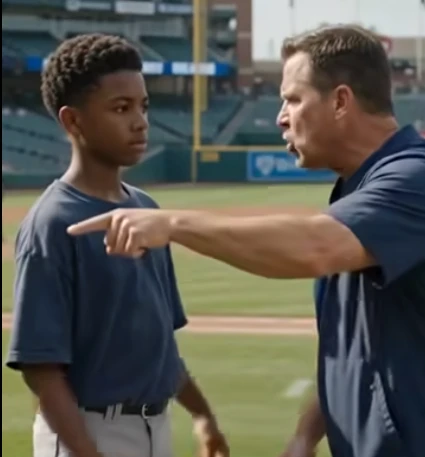
“Leonard.”
“Humor me.”
“This is ridiculous.”
“Then one pitch will prove it.”
Brent looked around.
Every scout had stopped writing.
Every coach was watching.
He finally waved toward Eli.
“Fine.”
Eli moved.
Marcus watched.
“Two more feet.”
Brent turned toward him.
“You’re pushing it.”
Leonard said:
“Two more.”
Eli moved.
Trevor stepped into the box again.
Cole crouched.
He intentionally kept his body still.
Marcus watched.
Nothing.
The pitcher delivered.
Inside breaking ball.
Trevor took it.
“Strike.”
Brent smiled.
“There.”
Marcus said:
“That wasn’t the sign.”
Cole looked toward him.
Marcus was still watching.
Next pitch.
Cole set.
His right knee turned inward.
Barely.
Then the glove slid low and outside.
Marcus immediately looked toward third.
“There.”
The pitcher delivered.
Slider.
Trevor recognized it late.
He reached.
His front side opened.
The bat came across the ball.
A sharp grounder shot toward third.
Eli Barron was already there.
He backhanded it one step inside the line.
Out.
Again the field went silent.
This time, Leonard smiled.
Not because he liked embarrassing Brent.
Because he had just seen something scouts rarely measured.
Information processing.
Most baseball evaluations measured bodies.
Sixty-yard dash.
Exit velocity.
Throwing velocity.
Pop time.
Bat speed.
Arm strength.
Things easily written into boxes.
Marcus Hale had just demonstrated something harder.
He could watch six people at once and turn their small movements into a prediction.
Leonard knew that did not automatically make Marcus a great player.
Maybe Marcus could not hit.
Maybe he was too slow.
Maybe his arm was weak.
Maybe his talent belonged in coaching, analytics, scouting, or catching.
But Leonard knew one thing.
The boy should not be carrying buckets without anyone asking questions.
Brent Lawson had a different reaction.
He looked humiliated.
And humiliation is dangerous when a proud man thinks someone else caused it.
“Enough.”
He pointed toward Marcus.
“Off the field.”
Leonard turned.
“No.”
Brent stared.
“What?”
“I said leave him.”
“You’re serious.”
“Yes.”
“This kid is interfering with evaluations.”
“He’s improving them.”
Brent’s face reddened.
“He got two guesses right.”
Leonard looked toward the scouts.
“Anybody here think those were guesses?”
Nobody raised a hand.
One older scout shook his head.
Another said:
“He called location and contact.”
Brent snapped:
“Because we repeated a sequence.”
Marcus quietly said:
“It wasn’t repeated.”
Brent turned.
“What?”
“The first one was fastball away.”
“The second was slider away.”
“You called the same location.”
“Yes.”
“Because the catcher gave the same body cue.”
Brent stared at him.
Marcus should have stopped.
He knew it.
But he added:
“Pitch type didn’t matter for where Trevor was going to hit it.”
Trevor Maddox looked offended now.
“So you know what I’m going to do every time?”
Marcus shook his head.
“No.”
“Sounds like it.”
“I know what you’ve done today.”
Trevor crossed his arms.
“What have I done?”
Marcus looked toward Leonard as if asking permission.
Leonard nodded.
Marcus spoke.
“When you’re behind in the count, you stay closed longer.”
“When you’re ahead, you start opening early because you’re looking to pull something hard.”
“On breaking balls inside, you pull your hands in well.”
“On breaking balls away, you chase if the catcher starts outside.”
Trevor’s expression changed.
Marcus continued.
“You don’t like being tied up after seeing an outside target.”
“So after one pitch away, you’re faster to clear on the next pitch.”
A hitting coach near the cage whispered:
“We’ve got that in his report.”
Trevor turned toward him.
“You do?”
The coach looked uncomfortable.
“Yes.”
Marcus heard.
“So I’m right?”
Leonard almost laughed.
The hitting coach answered:
“Mostly.”
Trevor looked at Marcus differently now.
Not angry.
Interested.
“How long have you been watching?”
Marcus checked the clock.
“Forty-two minutes.”
That got a reaction.
Leonard asked:
“You time it?”
“No.”
“I got here at eight-sixteen.”
Leonard wrote another note.
Brent said:
“This is turning into a circus.”
Leonard looked at him.
“No.”
He pointed toward the field.
“This is exactly what an evaluation is supposed to be.”
“We’re evaluating players.”
“We’re evaluating baseball people.”
Brent laughed.
“He’s fifteen.”
“So were you once.”
“He’s not even invited.”
Leonard’s eyes narrowed.
“That sounds like our mistake.”
Marcus looked up.
Nobody had ever said something like that about him before.
Our mistake.
Not his.
Not because he lacked money.
Not because he missed travel tournaments.
Not because his mother worked weekends.
Not because he was wearing a volunteer shirt.
Someone important had just suggested the adults might have failed to look.
Leonard walked toward Marcus.
“You play?”
“Yes, sir.”
“Where?”
“Jefferson High.”
“What position?”
“Second base.”
“Starter?”
Marcus hesitated.
“Sometimes.”
Brent’s expression changed as if he had finally found something useful.
“Sometimes?”
Marcus nodded.
“Mostly JV last year.”
A few scouts looked at one another.
Brent smiled.
“There we go.”
Leonard ignored him.
“What year are you?”
“Sophomore.”
“Travel ball?”
“No.”
“Showcases?”
Marcus almost laughed.
“No.”
“Private instruction?”
“No.”
“Why?”
Marcus looked down at his shoes.
They were old turf shoes.
The front edge of the right one had been repaired with black glue.
“Money.”
Leonard nodded once.
No pity.
Just information.
“Father?”
“Passed away.”
“Mother?”
“Works at a hospital laundry.”
“Baseball background in the family?”
“My dad liked the game.”
“Played?”
“City league when he was young.”
“Who taught you to read hitters?”
Marcus looked toward the empty seats.
“My dad.”
“How?”
“We watched games with the sound off.”
Leonard smiled slightly.
“That’s smart.”
“He said announcers tell you what already happened.”
“What did he want you to learn?”
“What was about to happen.”
Leonard’s smile disappeared.
Not because the answer was bad.
Because it was very good.
He looked toward the fielding coach.
“Brent.”
“What?”
“Set up another round.”
Brent shook his head.
“We have a schedule.”
“So adjust it.”
“For what?”
Leonard pointed at Marcus.
“I want to test him.”
Marcus’s stomach tightened.
“Test me how?”
Leonard looked toward Trevor.
“Random pitch sequence.”
Then toward Cole.
“Hide your setup as long as possible.”
Then toward the defense.
“Start neutral.”
Brent stared.





