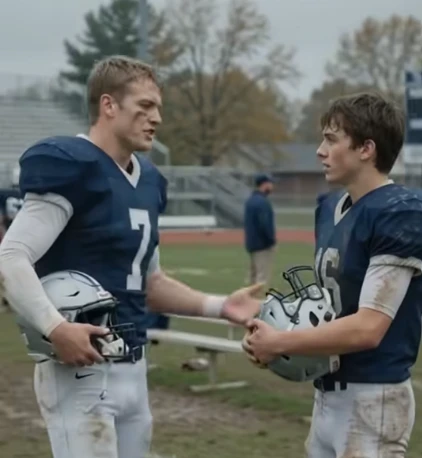
Another player asked what he should do if a captain bullied him.
I told him to document it.
Tell more than one adult.
Keep copies outside the team system.
Ask teammates to speak while the event is still fresh.
And if the first coach looks away, go higher.
“What if everyone is afraid?” he asked.
“Then fear needs witnesses too.”
After the talk, I walked toward the old practice field.
The mud pit was gone.
The school had improved the drainage.
A small plaque stood beside the visitor gate.
It did not carry my name.
At my request, it read:
THIS FIELD USES INDEPENDENT PERFORMANCE RECORDS BECAUSE ATHLETES DESERVE ACCURATE CREDIT FOR THEIR WORK.
Beneath that:
BYSTANDERS ARE PART OF EVERY TEAM’S SAFETY SYSTEM.
The plaque mattered more than preserving the location where I had been humiliated.
The goal was not to turn my worst afternoon into a monument.
The goal was to make repeating it harder.
People usually tell the story beginning with Hunter’s words.
“This is what weakness looks like.”
Then they describe the mud.
The famous coach.
The folder.
The scholarship.
It creates a satisfying ending.
The bully attacks the wrong kid.
A powerful man arrives.
The victim is secretly valuable.
The bully loses everything.
But that version carries a dangerous lesson.
It suggests cruelty becomes serious only when the victim turns out to be important.
Coach Raines knew that.
That was why he later apologized for his first question.
One afternoon at Kingsley, he sat beside me after practice.
“I asked Hunter whether he knew who he touched.”
“I remember.”
“I should have asked whether he knew what he had done.”
I looked at him.
“Why?”
“Because your scholarship should not have been the reason the field became silent.”
He was right.
Hunter did not become wrong when Coach Raines opened the folder.
He was wrong while the assistant coach looked away.
He was wrong while parents whispered.
He was wrong before anyone knew my statistics.
The document only removed the excuse that people had mistaken weakness for permission.
The deeper failure belonged to everyone who saw a child in the mud and waited for a famous person to decide whether he mattered.
That was the truth I carried longer than the scholarship letter.
Hunter believed I was Bench Trash because the team taught him some players existed only to support other people’s futures.
Mayor Caldwell believed my statistics could be transferred because he controlled the adults recording them.
Coach Pike believed public money and private influence were close enough to exchange.
Coach Reed believed protecting his career required sacrificing my safety.
Other players believed laughter made them less responsible than the person giving orders.
I believed silence protected my father from another burden.
Every person had an explanation.
The investigation forced us to examine what those explanations allowed.
In the end, Hunter had talent.
I had talent.
Other players had talent too.
Fairness did not require turning Hunter into a boy who had never been good at lacrosse.
It required removing the numbers, money, and fear that made honest comparison impossible.
My scholarship was real.
His inflated ranking was not.
His pressure was real.
So was his cruelty.
My restraint was real.
So was my need to ask for help sooner.
Truth did not simplify us.
It returned each action to the person who owned it.
Hunter’s goals became his.
My assists became mine.
The adults’ decisions became theirs.
And the mud remained only mud.
It could no longer define who belonged on the field.
The End.





