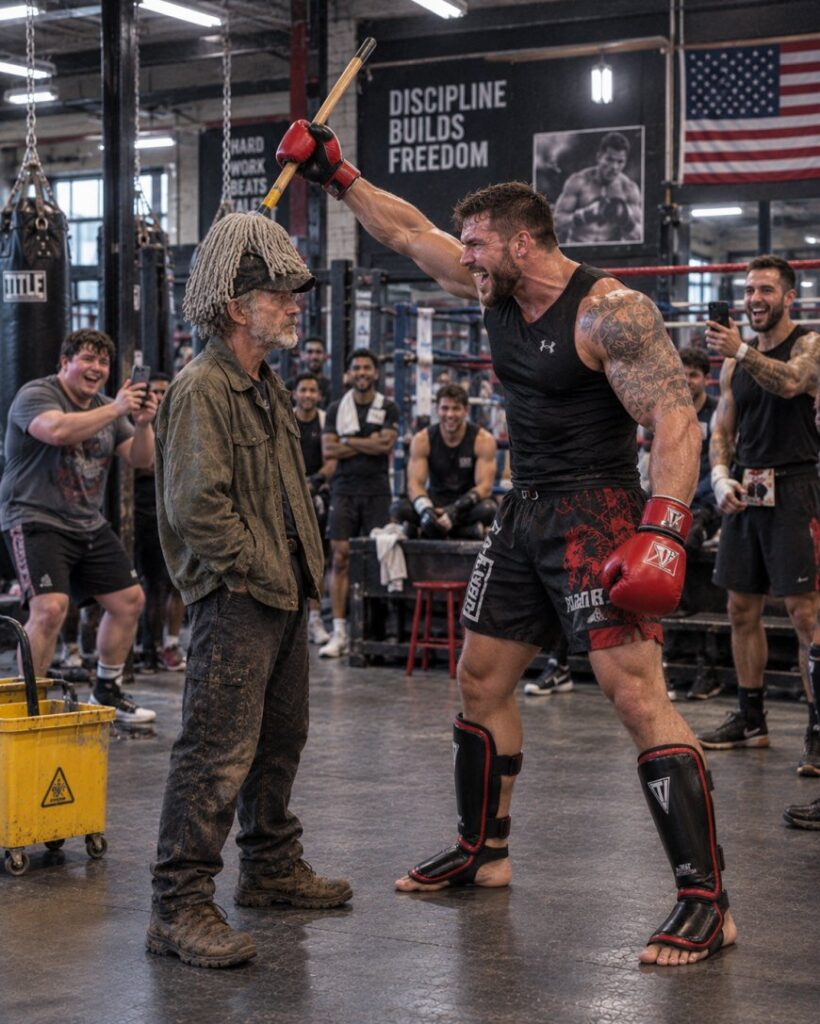
His voice was steady, but there was a weight to it. A heaviness that I’d never heard before.
“He pulled me out of the wreckage. Carried me three miles to the evac point. He didn’t have to. He could have left me. But he didn’t.”
Frank took a sip of his coffee.
“He taught me what I taught Trent. That strength isn’t about winning. It’s about surviving. It’s about protecting the people next to you. It’s about knowing when to fight and when to walk away.”
He looked at me. “I’m telling you this because I want you to understand. I’m not a hero. I’m not some wise old sage. I’m just a man who made a lot of mistakes and got lucky enough to learn from them. That’s all.”
I nodded. “That’s more than most people get.”
Frank smiled — a real smile, not the sad, weary expression he usually wore. “Yeah. I guess it is.”
We sat there in silence for a while, the gym quiet around us, the night pressing in against the windows. Then Frank stood up, his knee popping, and reached for his mop.
“Same time tomorrow?” I asked.
He looked back at me. “Same time tomorrow.”
He went back to work. I watched him for a while, the rhythmic squeak-shh-squeak of the mop filling the empty gym. Then I went home.
Months passed. The gym changed. The fighters changed. Trent became a regular, not just as a fighter but as a mentor. He started helping the younger kids, the ones who reminded him of himself. He was patient with them. Kind. He taught them what Frank had taught him.
Frank kept working. He kept mopping. He kept watching. He kept teaching, in his quiet, unassuming way.
And then, one day, he didn’t show up.
I wasn’t worried at first. Frank was an old man with a bad knee and a van that barely ran. He was allowed to be late. But when he didn’t show up the next day, I started to worry.
I went out to the alley. His van was still there, parked in its usual spot. But the back doors were closed, and when I knocked, there was no answer.
I opened the door.
Frank was lying on his cot, his eyes closed, his hands folded on his chest. He looked peaceful. Calm. Like he was sleeping.
But he wasn’t sleeping.
I called 911. They came. They took him away. They said it was a heart attack. They said it was quick. They said he probably didn’t feel any pain.
I didn’t know what to say. I didn’t know what to do. So I just stood there in the alley, watching them drive away, the cold wind biting at my face.
Frank was gone.
The funeral was small. A few guys from the gym. Toby. Trent. A couple of veterans I’d never met before. They told stories about Frank — stories I’d never heard. Stories about a young man who’d joined the Army to escape a bad home. Stories about a soldier who’d served three tours in the desert. Stories about a man who’d lost everything and still found a way to keep going.
Trent spoke last. He stood up in front of the small crowd, his voice shaking, his eyes wet.
“Frank taught me that strength isn’t about hurting people,” he said. “It’s about helping them. It’s about knowing when to fight and when to walk away. It’s about being there for the people who need you.”
He paused, wiping his eyes.
“I didn’t deserve his help. I didn’t deserve his patience. But he gave it to me anyway. And I’m going to spend the rest of my life trying to be worthy of it.”
He sat down. The room was silent.
I stood up. I didn’t have anything prepared. I didn’t have any wise words. I just had a memory.
“Frank used to say that real strength is forged in the quiet, brutal fires of survival,” I said. “And that it never needs to prove itself by tearing others down. I didn’t understand what that meant at first. But I do now.”
I looked around the room. At Toby. At Trent. At the veterans I’d never met. At the men and women who’d been touched by Frank’s quiet, steady presence.
“He was the strongest man I ever knew,” I said. “And he spent his last years mopping floors and emptying trash cans. That’s who he was. That’s what he chose to be. And that’s what made him great.”
I sat down. The room was silent.
After the funeral, Trent and I went back to the gym. We stood in the middle of the sparring ring, looking at the blue canvas, the harsh overhead lights, the wall-to-wall mirrors.
“He’s gone,” Trent said.
“Yeah,” I said. “He’s gone.”
We stood there for a long time. Then Trent walked over to the supply closet, pulled out the mop, and started working.
The floor wasn’t going to clean itself.
I kept the gym open. I kept the lights on. I kept the heavy bags swinging. But something was missing. Someone was missing.
I’d catch myself looking for him — the quiet old man in the faded surplus jacket, pushing his mop across the mats. I’d hear the squeak-shh-squeak of the mop and turn around, expecting to see him. But he wasn’t there.
He was never there.
But his lessons were. His words. His example. They lingered in the gym like the smell of bleach and old wool. They echoed off the tin ceiling like the sound of a heavy bag.
Trent kept training. He kept fighting. He won more bouts, then turned pro. He was good. Really good. But he never let it go to his head. He never forgot what Frank had taught him.
And every night, before he left the gym, he’d walk over to the supply closet, pull out the mop, and clean the floors.
Just like Frank used to.





