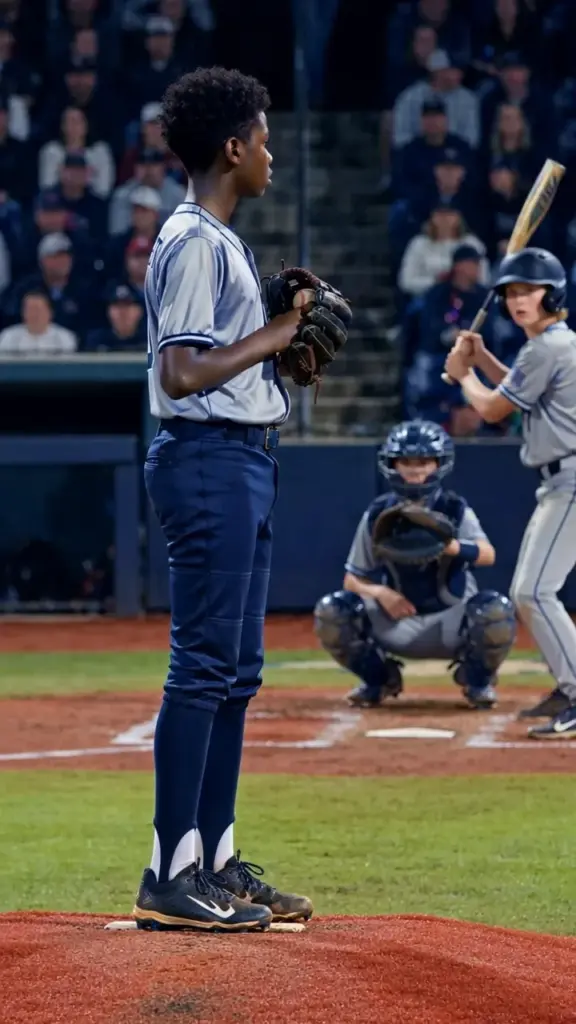
He had dreamed of being the pitcher who recorded the final out.
Instead, he had watched someone else do it.
And strangely, he didn’t feel disappointed.
He felt relieved.
Later that night, Turner sat in a quiet medical room while his father stood beside the door.
The doctors had arranged further evaluation of his throwing arm.
No one yet knew how serious the injury was.
His father looked exhausted.
“I didn’t know you were hurting.”
Turner stared at his hands.
“I didn’t tell anybody.”
His father sat down.
For several seconds, neither spoke.
Then Turner whispered, “I thought you’d be disappointed.”
His father looked up.
“Why?”
“Because I didn’t finish.”
The older man swallowed.
He remembered every time he’d told Turner to push harder.
Every time he’d praised him for ignoring exhaustion.
Every time he’d said champions never quit.
He had thought he was teaching determination.
He hadn’t realized what his son was hearing.
“I’m sorry,” his father said.
Turner looked surprised.
“For what?”
“For making you think a baseball game mattered more than you.”
Turner’s eyes filled.
His father moved closer.
“You don’t have to earn my pride by hurting yourself.”
For the first time that night, Turner began to cry.
Three weeks later, Westbridge held its championship celebration.
The players stood on the school stage.
The trophy gleamed beneath the auditorium lights.
Coach Bennett stepped toward the microphone.
He thanked the students.
The families.
The assistant coaches.
Then he called Turner forward.
The crowd applauded.
Turner walked onto the stage wearing a simple blue shirt, his throwing arm resting comfortably at his side as he continued following medical advice.
Bennett handed him the microphone.
Turner hesitated.
Then spoke.
“Everybody keeps asking me about the 104-mile-per-hour pitch.”
The audience laughed.
Turner smiled.
“But that wasn’t the most important pitch of the night.”
The room grew quiet.
He looked toward Daniel Reyes.
“The most important pitch was the one I didn’t throw.”
Daniel looked up.
Turner continued.
“I thought being a leader meant finishing everything myself.”
He paused.
“But sometimes it means trusting somebody else to finish.”
The audience applauded.
Turner looked toward Coach Bennett.
“And sometimes the person who tells you to stop is the person who cares most about your future.”
Bennett lowered his head.
The applause grew louder.
Months later, Turner returned to the baseball field after completing his rehabilitation and receiving medical clearance.
His first session wasn’t spectacular.
His fastball was slower.
His timing felt unfamiliar.
He had to rebuild gradually.
But this time, he wasn’t chasing a number.
He was learning to listen.
To his body.
To his coaches.
And to the people who cared about him.
One afternoon, Daniel Reyes joined him for practice.
“Hey,” Daniel said.
Turner looked up.
“What’s up?”
Daniel smiled.
“Think you’ll ever throw 104 again?”
Turner considered the question.
Then shrugged.
“Maybe.”
Daniel laughed.
“That’s it?”
Turner smiled.
“Yeah.”
He picked up a baseball.
Looked toward home plate.
Then added, “But next time my coach tells me to stop, I’m stopping.”
Daniel grinned.
“Probably a good idea.”
Turner laughed.
And for the first time in years, he threw a baseball without feeling that his entire future depended on where it landed.
Because the pitch that shook the stadium wasn’t the one that made him a better player.
It was the warning he finally learned to hear.
The End.