Sometimes I did.
I missed the early mornings.
The discipline.
The feeling of helping someone discover what they could accomplish.
But I didn’t miss the pressure.
Or the way people sometimes forgot that athletes were human beings.
“Parts of it,” I admitted.
Sadie nodded.
Then smiled.
“Maybe you could teach people the good parts.”
I looked at her.
“What do you mean?”
“Like how to be brave without being mean.”
I laughed softly.
“That’s a pretty good idea.”
She returned to her dinner.
But I kept thinking about what she’d said.
Two weeks after the incident, I received a letter.
It came in a plain white envelope with no return address.
Inside was a handwritten note.
Mr. Mercer,
My name is Daniel Price. I saw what happened at the arena. I recognized you immediately.
I want you to know something.
You didn’t fail me.
You were the only coach who told me to stop when I needed to.
I’ve spent years wishing I had listened.
If you’re willing, I’d like to see you again.
I sat at the kitchen table for a long time.
The paper trembled in my hands.
I had imagined meeting Daniel again hundreds of times.
In some versions, he was angry.
In others, he blamed me.
I had never imagined receiving a letter like this.
Three days later, I drove to the rehabilitation center where Daniel worked as a mentor for injured athletes.
He was thirty-six now.
His movements were slower.
His speech sometimes required patience.
But when he saw me, he smiled.
“Coach.”
That one word nearly broke me.
I crossed the room.
We embraced.
For a long time, neither of us spoke.
Then Daniel laughed.
“Still teaching people lessons?”
I shook my head.
“Not anymore.”
He looked at me.
“That’s a shame.”
I sat beside him.
We talked for nearly two hours.
About his recovery.
About the gym.
About the people we’d lost touch with.
Eventually, I told him about Sadie.
He smiled.
“She sounds like a good kid.”
“She is.”
Daniel nodded.
“Then maybe she deserves to know the whole story.”
I looked down.
“I don’t want her thinking fighting makes someone important.”
Daniel leaned forward.
“Then don’t teach her that.”
I looked at him.
He smiled.
“Teach her what you taught me before everybody else started talking about money.”
I swallowed.
“What was that?”
“That the person in front of you matters more than the fight.”
I stared at him.
Daniel continued.
“You didn’t leave because you stopped caring about the sport, Grant.”
He paused.
“You left because you cared too much to pretend everything was okay.”
For the first time in years, I allowed myself to believe that leaving had not erased the good I’d done.
A month after the arena incident, Rhett Dugan requested a private meeting.
This time, the message came through an attorney.
He wanted to apologize.
I almost refused.
Then I thought about Sadie.
About what she would learn if I spent the rest of my life treating Rhett as nothing more than the worst five minutes of his career.
I agreed to meet him in a conference room at the sports center.
No cameras.
No reporters.
Just Rhett, his attorney, and me.
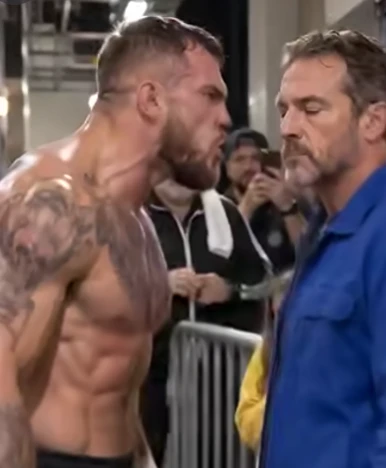
When he entered, he looked different.
Not physically.
He was still enormous.
Still powerful.
But the confidence that had filled the arena corridor was gone.
He sat across from me.
For several seconds, he stared at the table.
Then he spoke.
“I was wrong.”
I waited.
Rhett swallowed.
“I lost the biggest fight of my life. I was angry. I thought everyone was laughing at me.”
He looked up.
“Then I saw your daughter holding that phone.”
I said nothing.
“I convinced myself she was filming me.”
“She was nine.”
“I know.”
“She picked up a phone you knocked out of someone’s hand.”
Rhett lowered his eyes.
“I know.”
I leaned forward.
“You frightened her.”
His expression tightened.
“I’m sorry.”
I studied him.
Then asked, “What are you going to do differently?”
Rhett looked confused.
“What?”
“An apology matters. But what happens the next time you lose?”
He stared at me.
I continued.
“Because you’re going to lose again someday. Everybody does. What matters is whether another person has to pay for your disappointment.”
Rhett looked toward the window.
For a long time, he said nothing.
Then he nodded.
“I’ve started working with someone.”
“A counselor?”
“Yes.”
“Good.”
He took a breath.
“I also wanted to ask you something.”
I waited.
“Would you ever consider coaching again?”
I almost laughed.
“No.”
Rhett nodded slowly.
“I figured.”
He stood.
Then extended his hand.
I shook it.
Not because everything was forgiven.
Not because I suddenly trusted him.
But because he’d taken responsibility without demanding that I make him feel better.
Sometimes that was where change began.
Six months later, the Belidge Community Sports Center opened a new youth program.
It wasn’t an MMA competition team.
There were no championship belts.
No rankings.
No promises of fame.
We called it Strong Without Fear.
Children learned balance, coordination, basic self-protection, and how to recognize situations they should leave rather than escalate.
We talked about boundaries.
Respect.
Asking for help.
And why the safest fight was often the one that never happened.
Daniel visited during the first week.
He spoke to the children about recovery, courage, and the importance of listening when someone said they were hurt.
Sadie helped distribute water bottles.
She wore a bright yellow T-shirt and carried a clipboard almost as large as her torso.
At the end of the first session, she approached me.
“Dad?”
“Yes?”
“Can I ask you something?”
“Always.”
She looked toward the children leaving the gym.
“Do you think Mom would like this?”
I felt my throat tighten.
I looked around the room.
At Daniel laughing with a group of parents.
At the children putting away equipment.
At the volunteers cleaning the mats.
Then I looked at my daughter.
“Yes,” I said softly. “I think she’d love it.”
Sadie smiled.





