Malik refused the first time.
He agreed a week later.
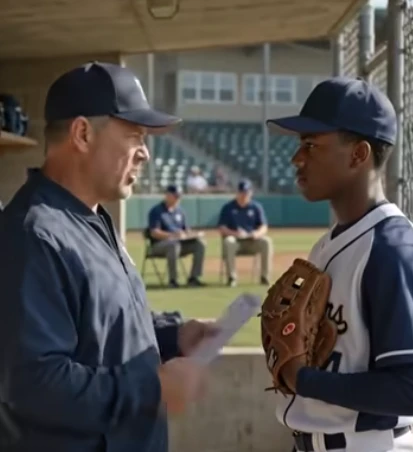
They met at a public baseball field.
Darius sat in the bleachers while Malik practiced ground balls with Daniel.
Afterward, Malik approached him.
“You still play?” Darius asked.
“You know I do.”
“I saw the season videos.”
“From where?”
“Daniel sent them.”
Malik sat two seats away.
“Why did you stop calling?”
Darius looked toward the infield.
“At first, Preston’s attorney warned that any contact would reopen the theft case.”
“Then?”
“I started drinking.”
Malik said nothing.
“I lost jobs.”
“I slept in my truck.”
“I kept telling myself I would come home once I fixed everything.”
“And you never fixed it.”
“No.”
“You could have come home broken.”
Darius looked at him.
Malik’s voice shook.
“Mom and I were already broken.”
Darius covered his face briefly.
“I know that now.”
“No, you know the sentence.”
Malik stood.
“You don’t know the years.”
Darius did not stop him.
Before Malik left, his father said, “You should not use that glove anymore.”
Malik turned.
“Why?”
“The webbing is worn.”
“You think I don’t know?”
“I can repair it.”
Malik stared at him.
Then placed the glove on the bleacher.
“Repair the glove.”
He walked away.
It was not forgiveness.
It was one task.
Sometimes repair began there.
Two weeks after the corrupted showcase, the foundation held an independent evaluation at another stadium.
No team coaches were allowed near the scoring table.
Every player’s statistics were verified through raw game footage.
The foundation invited Carter too.
Some parents objected.
They believed he should be punished for benefiting from his father’s scheme.
Avery disagreed.
“Carter does not receive Malik’s numbers.”
“He does not receive his father’s money as merit.”
“But he still receives the right to be evaluated for what he can actually do.”
Malik respected that decision.
Fairness did not require replacing one rigged result with another.
It required removing the rigging.
Darius watched from the highest row of the bleachers.
Tanya sat near the field.
He did not sit beside her.
Not yet.
Malik stepped into the batter’s box.
The first pitch was a fastball on the outside edge.
He drove it into right-center field.
The ball struck the wall.
Malik reached third standing.
On defense, he fielded a hard ground ball behind second base.
He planted.
Turned.
Threw across his body.
The first baseman caught it before the runner reached the bag.
The scouts wrote.
Radar guns rose.
No coach told Malik to disappear.
No donor controlled the scoreboard.
In his final at-bat, Malik struck out.
A real strikeout.
The pitcher threw a sharp breaking ball beneath his hands.
Malik swung honestly and missed.
He returned to the dugout smiling.
Tanya noticed.
“So now you enjoy striking out?”
“That one belonged to me.”
The scholarship committee met for forty minutes.
Avery returned carrying three envelopes.
The foundation had decided not to award only one full scholarship.
After recovering money diverted through Preston’s program, it funded three.
One went to Malik.
One went to a catcher from another state.
The third was reserved for a former player whose records had been manipulated, allowing him to attend community college and continue playing.
Carter received a partial academic-athletic offer from a Division II school.
His verified performance did not justify the original full scholarship.
But it showed enough ability for an honest opportunity.
Preston had never trusted his son to earn anything smaller.
Carter accepted it.
Malik opened his envelope.
The scholarship covered tuition, housing, meals, and books.
Tanya read the amount.
Then she pressed the paper against her chest.
For years, she had told Malik not to place the entire family’s future on baseball.
Now the sport had finally opened a door.
But not because a wealthy man allowed it.
Because the records survived long enough for someone to ask what had been changed.
Avery held out her hand.
“You earned this.”
Malik shook it.
Then he looked toward the highest row.
Darius remained seated.
He did not clap loudly.
He did not move toward the field.
He seemed to understand that Malik’s victory was not his moment to claim.
Malik gave him one small nod.
Darius nodded back.
That was all.
It was enough for that day.
Coach Turner and Preston Vance went to trial the following year.
Former players testified.
Parents described paying additional fees after Turner threatened to reduce playing time.
Scouts presented emails showing requests ignored or answered with false information.
Daniel admitted that he noticed isolated problems earlier but failed to investigate deeply.
“I accepted explanations because challenging them could have cost my position,” he said.
“That choice helped the scheme continue.”
Carter testified against his father.
Preston’s attorney called the red notebook a child’s attempt to gain attention.
Carter read each entry aloud.
He explained when he wrote it.
Where he heard the conversation.
Which instruction later became a roster change or false report.
Then the prosecutor reached Malik’s page.
“What did you believe ‘make him disappear’ meant?”
“I thought Malik would be removed from the team.”
“When did you realize it meant more?”
“When I saw his apartment address.”
“Why did you bring the notebook to the showcase?”
Carter looked toward Malik.
“Because Coach Turner told him to fail.”
“And?”
“I realized my success had become something other people were being forced to manufacture.”
Preston lowered his eyes.
Carter continued.
“My father kept saying he did everything for me.”
“He never asked whether I wanted to become the kind of player who needed another boy to play badly.”
Darius also testified.
He admitted signing blank dealership forms.
He admitted accepting money from Preston.
He admitted leaving his family.
The defense attempted to use those choices to discredit all his evidence.
Darius did not resist.
“I made cowardly decisions,” he said.
“That does not make these bank records false.”
“You abandoned your son,” the attorney said.
“Yes.”
“You expect this jury to trust you?”
“No.”
Darius looked toward the evidence screen.
“I expect them to verify the documents.”





