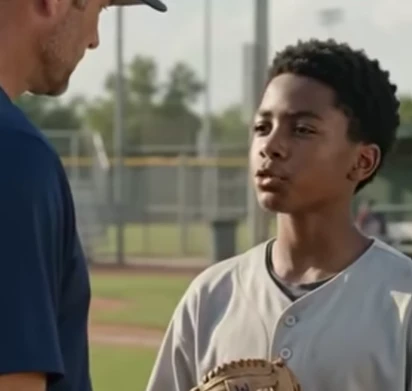
Perhaps Lawson realized that sending Isaiah away without a throw would look worse than allowing him to fail.
He smirked and reached into a bucket.
He selected the oldest ball he could find.
Its seams were flattened, and the leather had turned gray.
“Fine.”
He tossed it toward Isaiah.
“But don’t embarrass yourself.”
Isaiah caught the ball with his bare hand.
Denise touched his shoulder.
“Breathe,” she whispered.
Isaiah walked to the mound.
The silver tape around his cleats flashed in the sun.
Each step made the left shoe creak.
He placed the old glove beneath his arm and rubbed the baseball between his palms.
The mound was smooth and firm.
He had never stood on dirt that good.
Most of his practice happened behind Lincoln Middle School, where the pitcher’s mound was only a patch of hard ground with a piece of broken rubber buried near the top.
Sometimes he practiced at the abandoned tennis courts behind their apartment.
He threw at a square Denise had painted on a sheet of plywood.
Other nights, he pitched beneath the orange lights of the grocery store parking lot while his mother timed his motion between passing cars.
He had no private coach.
No strength trainer.
No expensive travel team.
He had a wall, an old glove, and a memory.
The memory belonged to his father.
Daniel Brooks had taught Isaiah to grip a baseball before Isaiah could read.
“Don’t squeeze it,” Daniel used to say.
“Let the ball rest against your fingers like a bird.”
Daniel’s hands had been enormous.
He could hide the baseball behind his back and make it reappear beneath Isaiah’s ear.
He showed Isaiah how to turn his front shoulder, how to drive from the ground, and how to finish over his knee.
But the grip was unusual.
Daniel placed his index and middle fingers slightly off the seams.
His thumb rested almost sideways beneath the ball.
“It looks wrong,” Isaiah had once said.
“Most good things look wrong before they work.”
Isaiah still used that grip.
A fourteen-year-old catcher named Tyler Ames crouched behind home plate.
He wore new red equipment and a helmet painted with the North Ridge logo.
Coach Lawson handed Tyler a mitt.
“Give him a target,” Lawson said.
Tyler settled low.
Isaiah stood behind the rubber.
He closed his eyes.
For one second, the field disappeared.
There was only the sound of his father’s voice.
Find the smallest place in the glove.
Throw through it.
Isaiah opened his eyes.
He lifted his left leg.
The torn cleat bent at the taped seam.
His hands separated.
His body moved forward.
The baseball left his fingers with a sharp whisper.
It crossed sixty feet and six inches almost too quickly to follow.
The ball slammed into Tyler’s mitt.
The catcher rocked backward.
His right knee came off the dirt.
A father holding a radar gun stared at the screen.
The digital numbers flashed red.
No one laughed.
Tyler pulled off his mask.
His eyes were wide.
Coach Lawson stepped toward the radar gun.
“That thing calibrated?”
The father looked offended.
“Yes.”
“Check it.”
“It’s checked.”
Lawson turned toward Isaiah.
“Throw another.”
Isaiah looked at him.
“You said three.”
“I know what I said.”
Tyler reset behind the plate.
This time he braced his right foot more firmly.
Isaiah rubbed the old ball.
He could feel one raised seam beneath his middle finger.
He lifted his leg again.
The second pitch struck the glove even harder.
Tyler’s arm snapped backward.
The radar gun flashed.
A murmur traveled through the parents.
Someone near the fence said, “That’s impossible.”
Another person said, “He’s thirteen.”
Coach Lawson removed his sunglasses.
For the first time that morning, he looked uncertain.
“Again,” he ordered.
Isaiah stared at the catcher’s glove.
The smallest place.
Throw through it.
His third pitch was lower.
It crossed the inside corner and exploded into the pocket.
Tyler fell backward onto the dirt.
The ball remained in the mitt.
The radar gun displayed 99.
Phones rose throughout the bleachers.
A woman gasped.
One of the boys in line whispered a word his father immediately corrected.
Coach Lawson walked toward the gun.
He took it from the parent and struck the side with his palm.
“Battery could be weak.”
“Weak batteries don’t add velocity,” the man replied.
Lawson aimed the gun toward another field where an older player was throwing.
The screen showed 74.
He pointed it back toward Isaiah.
Before Isaiah could throw again, an elderly man seated behind home plate slowly rose.
He wore tan trousers, a navy jacket, and a cream-colored baseball cap with no logo.
A wooden cane rested against the bench.
Until that moment, nobody had paid him much attention.
He had arrived alone.
He had not spoken to any parents.
He had watched the pitchers through a pair of small binoculars and written brief notes in a leather notebook.
Now the notebook lay open on the bench.
The man was not looking at the radar gun.
He was staring at Isaiah’s throwing hand.
More specifically, he was studying the way Isaiah’s fingers rested on the ball.
Then his eyes moved to the faded initials inside the borrowed glove.
D.L.B.
The old man stepped down from the bleachers.
He moved slowly at first.
Then he left his cane behind and pushed through the crowd.
“Son,” he called.
Isaiah lowered the baseball.
The man walked directly onto the field.
Coach Lawson raised one hand.
“Sir, you can’t be out here.”
The old man ignored him.
He stopped ten feet from Isaiah.
“Where did you learn that grip?”
Isaiah looked toward his mother.
Denise had gone completely still.
“My father taught me,” Isaiah said.
The old man’s face lost its color.
“What was his name?”
Denise stepped between them.
“Who are you?”
The man reached inside his jacket.
Several parents shifted nervously.
He removed a leather identification wallet and opened it.
Inside was a Major League Baseball scouting credential.
Samuel Whitmore.
Senior Special Assignment Scout.





