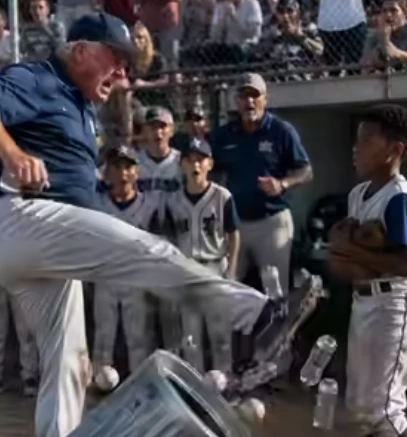
He was not talking about the tired pitcher he refused to replace.
He was looking only at Marcus.
Marcus opened his mouth.
“Coach, I—”
“Don’t talk.”
Marcus froze.
Coach Hale stepped closer.
“You missed that last ball.”
Marcus swallowed hard.
“It hit the fence before it reached me.”
The coach laughed bitterly.
“Excuses.”
The word made some parents in the bleachers shift uncomfortably.
One assistant coach, Eric Nolan, looked down at the dirt.
Marcus saw him.
Coach Eric had been the one who warned Coach Hale in the sixth inning that the pitcher was exhausted.
He had also been the one who told the outfield to adjust deeper before the final batter.
Coach Hale ignored him.
Now Coach Eric said nothing.
Marcus felt a deep loneliness open inside his chest.
He looked toward the dugout.
His teammates stared at the ground.
Some looked angry.
Some afraid.
Some confused.
But no one stepped forward.
Coach Hale raised his voice.
“This is what happens when players fold under pressure.”
The entire field heard it.
Marcus’s eyes filled with tears, but he blinked them back.
He would not cry in front of the coach.
He would not give him that too.
“I tried my best,” Marcus whispered.
Coach Hale shook his head.
“Your best lost us a championship.”
The words did what the scoreboard could not.
They broke something.
Not just in Marcus.
In the whole team.
Because every boy standing there knew Marcus had not lost the game alone.
Baseball did not work like that.
Seven innings.
Dozens of pitches.
Missed signs.
Bad throws.
Strikeouts.
Walks.
Choices.
A one-run loss never belonged to one kid.
But Coach Hale needed it to.
And Marcus was the easiest name to point at.
Then, from near the dugout rail, one of Marcus’s teammates spoke under his breath.
“That wasn’t Marcus’s fault.”
It was Eli Turner, the second baseman.
Small voice.
Barely loud enough.
But Coach Hale heard it.
His head snapped toward Eli.
“What did you say?”
Eli’s face went pale.
He opened his mouth, then closed it.
Coach Hale took one step toward him.
“I asked you a question.”
Eli looked at Marcus.
Then at the ground.
“Nothing, Coach.”
Coach Hale turned back to Marcus with a satisfied glare.
“That’s what I thought.”
Marcus lowered his eyes again.
Around him, the field seemed to stretch wider.
The bleachers farther away.
His mother too far to reach him.
His teammates too scared.
His coach too angry.
And the truth too quiet.
But near the scorer’s table behind home plate, an older man had not looked away.
He had gray hair, a plain navy cap, reading glasses hanging from his shirt collar, and an official scorebook open in front of him.
His name was Samuel Whitaker.
Seventy years old.
Retired math teacher.
Volunteer scorekeeper for the league.
For the entire game, Samuel had sat quietly behind the table, recording everything.
Every pitch.
Every hit.
Every error.
Every substitution.
Every coaching decision that had to be marked.
He had not cheered.
He had not argued.
He had not interfered.
His job was to keep the record.
And unlike anger, the record did not choose a scapegoat.
Samuel looked down at the scorebook.
Then back at Marcus.
Then at Coach Hale.
His jaw tightened.
He had heard enough.
But he did not stand yet.
Not quite.
He turned one page.
Checked the final inning.
Checked the play.
Checked the earlier errors.
Checked the sixth inning.
Then he placed one finger on the page where the truth began to tell a different story.
And while Coach Hale continued standing over a thirteen-year-old boy in the dirt, blaming him for a loss that belonged to many decisions, Samuel Whitaker slowly closed his pen.
The sound was small.
Almost nothing.
But it was the first sound of the truth getting ready to stand up.
Part 2
Marcus Reed stood in front of Coach Hale with dirt on his knees and tears burning behind his eyes.
He wanted to disappear.
Not walk away.
Not run.
Disappear.
There were too many faces.
Parents in the bleachers.
Players from the other team still celebrating near first base.
His own teammates pretending not to look.
Assistant coaches standing like statues.
And his mother frozen halfway down the bleacher steps, one hand gripping the rail.
Marcus could feel her trying not to rush onto the field.
She had always told him,
“Carry yourself with respect, even when others forget theirs.”
But respect felt heavy in that moment.
Too heavy for a thirteen-year-old boy being blamed in front of an entire ballpark.
Coach Hale was not finished.
He paced in front of Marcus now, speaking louder with every sentence.
“You had one job.”
Marcus looked up.
“Coach, the ball—”
“One job.”
The coach jabbed a finger toward left field.
“Keep the ball in front of you.”
Marcus’s lips parted.
“It hit the fence first.”
“Stop saying that.”
“But it did.”
Coach Hale’s face darkened.
“Are you calling me blind?”
Marcus shook his head quickly.
“No, sir.”
“Then stop making excuses.”
A few parents looked at one another.
They had seen the play.
Not perfectly, maybe.
Not from the same angle.
But most of them knew the ball had gone deep into the corner, hit low near the fence, and bounced strangely.
Even if Marcus had reacted instantly, it would have been a difficult play.
Even if he had fielded it cleaner, the runner was fast.
Even if the throw had been perfect, the catcher still had to hold the ball.
But Coach Hale talked as if the game had been simple.
As if one kid had decided the outcome.
As if Marcus had stood there and let the championship slip away.
Eli Turner shifted near the dugout rail.
His father, Mark Turner, sat in the bleachers with his arms crossed, looking uncomfortable.
Eli wanted to speak again.
He had been on the field.
He had seen Marcus sprint.
He had heard Coach Hale call the defensive shift too late.





