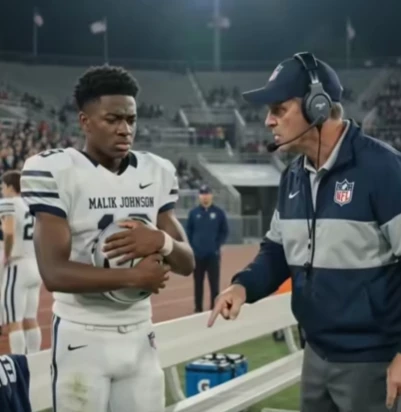
Until then, talent was attitude.
Talent was raw.
Talent was undisciplined.
Talent needed to learn patience.
Those words followed Malik from the first day of varsity practice.
Raw.
Undisciplined.
Not ready.
Malik first heard them after running the fastest forty-yard dash the team had ever recorded.
The players gathered near the track while assistant coaches held clipboards.
Coach Cole Martinez, the receivers coach, clicked the stopwatch and stared.
“Run it again,” he said.
Malik bent over, hands on knees.
“What was it?”
“Run it again.”
So Malik ran again.
The second time, players shouted before he crossed the line.
Cole looked at the stopwatch.
Then at Coach Pierce.
“Randall.”
Pierce walked over.
“What?”
Cole showed him the time.
Pierce’s expression did not change.
“Hand-timed.”
Cole frowned.
“Everybody’s hand-timed.”
“Do it with the laser later.”
They did.
Malik ran faster.
By any honest measure, he should have been starting by the second game.
He could play wide receiver.
Slot.
Returner.
Corner if needed.
On scout team, he made starting defenders look like they were turning in mud.
He caught passes behind his body, above his head, one-handed near the sideline.
He ran routes with a strange quiet violence, cutting so hard defenders reached for air.
The players knew.
The assistant coaches knew.
The underclassmen knew.
The team managers knew.
Even the equipment guy, Mr. Ross, who had been taping ankles since before Coach Pierce bought his first whistle, knew.
“That Johnson boy moves like somebody pushed fast-forward,” Mr. Ross said one afternoon.
Malik smiled.
“Thank you, sir.”
“You thanking me like I gave it to you. I just saw it.”
But seeing and saying are different things.
Coach Pierce did not say it.
Instead, he started senior Tyler Brent at slot receiver.
Tyler was not bad.
He was solid.
Reliable hands.
Good family.
Father on the booster board.
Mother chair of the fundraising gala.
A trainer who came to the field twice a week and wore shirts with his own logo.
Tyler’s family had donated the new weight room scoreboard.
Everyone knew that too.
Nobody said it near microphones.
In the first game, Malik got three plays.
One decoy route.
One kickoff coverage.
One screen pass called back for holding before the ball reached him.
In the second game, he did not enter until East Harbor was ahead by twenty-eight.
He returned one punt forty-seven yards before stepping out at the twelve.
The crowd exploded.
The student section chanted his name.
On Monday, Pierce told him in film review,
“You got lucky on a broken lane.”
Cole Martinez stared at the floor.
Malik said nothing.
That became his survival method.
Silence.
Not because he had nothing to say.
Because every time he spoke, Coach Pierce called it attitude.
“Coach, can I get reps with the ones?”
“Earn them.”
“I had the fastest time.”
“Track is in spring.”
“I know the playbook.”
“You know enough to think you know it.”
“Did I miss an assignment?”
“Watch your tone.”
So Malik stopped asking.
His mother did not.
Renee worked front desk at a dental office and cleaned offices three nights a week.
She came to every game in her navy East Harbor sweatshirt, sitting near the forty-yard line with a folded blanket and a plastic cup of coffee.
After the fourth game, when Malik never left the sideline, she waited near the fence.
Coach Pierce walked by.
“Coach?”
He turned with the tired smile adults use when they recognize a parent they do not want to talk to.
“Mrs. Johnson.”
“My son hasn’t played.”
“He’s developing.”
“He was player of the week in summer camp.”
“Camp is not Friday night.”
“He knows the plays.”
“Mrs. Johnson, Malik is talented. No one denies that.”
“Then why is he standing?”
Pierce’s smile thinned.
“He needs maturity.”
Renee’s face stayed calm.
“What did he do?”
“It’s more about readiness.”
“What does that mean?”
“It means I won’t put a young man in a position to fail before he can handle it.”
Renee looked toward Malik, who stood near the locker room entrance holding his helmet.
“He’s been handling harder things than football since he was thirteen.”
Pierce’s eyes cooled.
“With respect, personal hardship does not override coaching judgment.”
Renee nodded slowly.
“With respect, neither should favoritism.”
Pierce’s jaw tightened.
“Good night, Mrs. Johnson.”
The next week, Malik was listed third on the depth chart.
Not second.
Third.
Behind Tyler Brent.
Behind a sophomore named Cooper Hall who had dropped two passes in the last game but whose father owned the car dealership printed on the team banner.
Malik saw the chart taped near the locker room door.
He stared at it for a long time.
Cole Martinez came up beside him.
“I’m sorry.”
Malik did not look away from the paper.
“Did I do something?”
Cole hesitated.
That was answer enough.
“Did I?” Malik asked again.
“No.”
“Then why?”
Cole looked toward the coaches’ office.
“Sometimes adults make decisions they dress up as development.”
Malik looked at him.
“What does that mean?”
“It means keep working.”
“I am tired of keeping working while other people keep playing.”
Cole nodded.
“You have every right to be.”
That surprised Malik.
Most adults told him to be patient.
Cole did not.
Patience is easier advice when you are not the one being erased.
The season rolled forward.
East Harbor kept winning, but the wins grew ugly.
The offense slowed.
Tyler ran the wrong option route in the Ridgeview game and Pierce blamed the quarterback.
Cooper fumbled a punt and Pierce said it was a teaching moment.
Malik returned one kickoff in week seven because both starters were winded.
He took it seventy-two yards.
The stadium lost its mind.
Pierce called timeout afterward and pulled him aside.
“You showboating?”
Malik blinked.
“I ran.”
“You looked back.”
“There was a guy behind me.”
“You think every play is about you.”
Malik looked around.
At the scoreboard.
At his teammates pounding his helmet.





