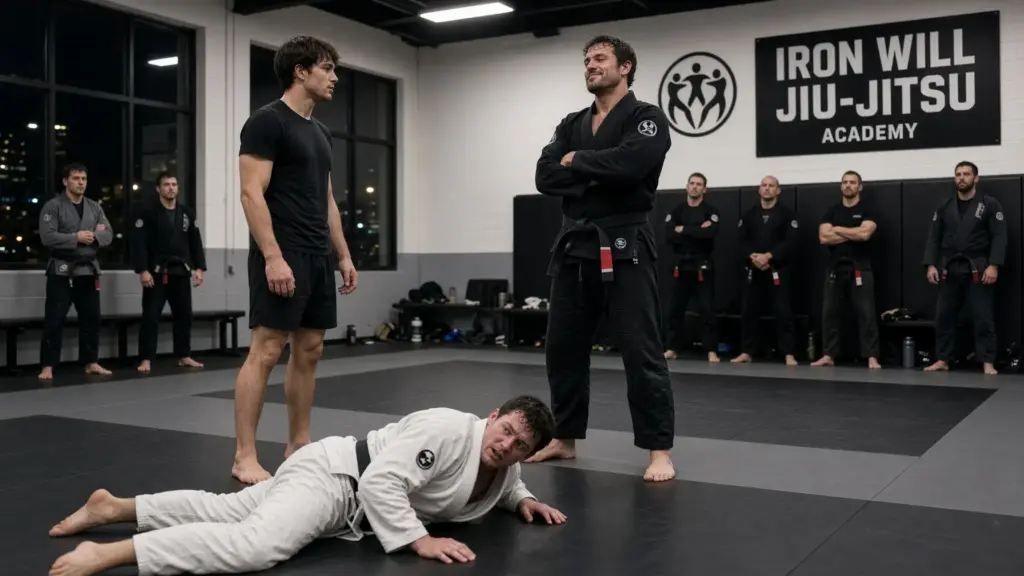
The Brother Who Never Fought Back
“Thursday.”
Noah nodded.
“Do you remember what happened?”
I swallowed.
My throat felt scraped raw.
“Travis wouldn’t let go.”
My brother’s expression didn’t change, but something in his eyes did.
He turned toward the head instructor, a forty-six-year-old man named Patrick Sloan.
“Call an ambulance.”
Patrick hesitated.
“Ethan seems alert now.”
“He lost consciousness after pressure was applied to his neck.”
“He’s sitting up.”
“That doesn’t mean he’s safe.”
Patrick looked at me.
I nodded.
“Please call.”
For the first time that evening, somebody did exactly what I asked.
Patrick reached for his phone.
Travis laughed.
“Seriously? An ambulance?”
Noah ignored him.
He crouched beside me.
“Stay seated. Don’t try to stand yet.”
I looked at his bare feet.
He had left his shoes near the entrance.
His socks were folded inside them.
For reasons I couldn’t explain, that small detail frightened me.
Noah hated stepping onto mats.
He hadn’t done it in almost seven years.
And now he was kneeling beside me in the middle of Harbor Point Jiu-Jitsu, with twenty people watching.
Travis stepped closer.
“Hey, man. If you’ve got something to say, say it to my face.”
Noah looked up.
“I already asked what happened.”
“Then maybe you should stop acting like I’m some kind of criminal.”
Noah stood slowly.
“Did Ethan tap?”
Travis crossed his arms.
“He tapped when the choke was already finished.”
“Did you release?”
Travis smirked.
“Eventually.”
Nobody laughed.
Noah glanced toward Patrick, who was speaking with emergency dispatch.
Then he looked back at Travis.
“Thank you.”
Travis frowned.
“For what?”
“For answering.”
My brother had once been a professional grappler.
Not an ordinary one.
At twenty-four, Noah Cole had been considered one of the most promising submission specialists in the country.
He was six feet one, lean, unusually patient, and almost impossible to intimidate.
He won tournaments in California, Nevada, and Texas.
He competed internationally.
And by twenty-seven, he had earned a black belt under one of the most respected coaches in the sport.
His professional record included victories over opponents who outweighed him by forty pounds.
But Noah never liked attention.
He rarely celebrated after winning.
He never posted photographs of injured opponents.
He disliked interviews.
When reporters asked how he defeated larger competitors, he usually answered with something unhelpfully simple.
“I practiced.”
Our father used to joke that Noah could win a world championship and still forget to tell his family.
But seven years earlier, something happened.
Something that changed him completely.
During an invitational tournament in San Diego, Noah faced a young competitor named Lucas Bennett.
Lucas was twenty-two.
Talented.
Aggressive.
Desperate to prove himself.
The match was competitive.
Noah secured a submission late in the second round.
Lucas tapped.
Noah released immediately.
But when Lucas tried to stand, he collapsed.
The medical team rushed onto the mat.
The incident was later attributed to an underlying medical problem, not misconduct by Noah.
That distinction mattered to everyone except Noah.
Lucas survived, but his recovery was long and difficult.
Noah visited him twice.
Then stopped competing.
He didn’t announce a retirement.
He didn’t hold a farewell seminar.
He simply packed away his medals and disappeared from professional competition.
Eventually, he became a physical education teacher.
He coached children’s swimming during the summer.
And he developed a quiet dislike for anyone who treated another person’s safety as a measure of toughness.
That was the brother standing in front of Travis Mercer.
And Travis had no idea.
The paramedics arrived twelve minutes later.
They asked me questions.
Checked my condition.
And recommended hospital evaluation because I had lost consciousness after a chokehold.
Noah insisted on accompanying me.
As the paramedics prepared to leave, Travis approached again.
“Hey, Ethan.”
I looked at him.
He shrugged.
“No hard feelings, right?”
I stared.
My throat hurt every time I swallowed.
I could still remember the moment my vision disappeared.
And this man wanted reassurance.
Before I could answer, Noah spoke.
“Not now.”
Travis turned.
“I wasn’t talking to you.”
Noah didn’t move.
“He’s going to the hospital.”
Travis laughed.
“Man, you’re really protective.”
Noah looked at him.
“He’s my brother.”
“Yeah, I figured.”
“Then you understand why I’m concerned.”
Travis stepped closer.
“Maybe you should come back sometime. I’ll show you what a real round looks like.”
Noah studied him.
Then answered.
“No, thank you.”
Travis smiled.
“Scared?”
My brother didn’t respond.
He simply walked beside the paramedics as they helped me toward the ambulance.
That should have ended it.
But Travis couldn’t stand being ignored.
“That’s what I thought!” he shouted.
Noah kept walking.
At the hospital, the doctors evaluated me for possible complications from the neck compression.
Fortunately, they found no evidence of serious injury during the initial assessment, although I was given instructions about symptoms that would require urgent attention.
Noah stayed beside me.
For nearly an hour, we barely spoke.
Then I asked him something.
“Why didn’t you fight him?”
Noah looked up from his phone.
“What?”
“Travis.”
He frowned.
“Why would I fight him?”
“Because he hurt me.”
Noah put his phone away.
“Ethan, you were unconscious.”
“I know.”
“You needed medical attention.”
“I know.”
He leaned forward.
“Then what would fighting Travis have accomplished?”
I looked down.
“I don’t know.”
“Exactly.”
I hesitated.
“But you could’ve beaten him.”
Noah smiled faintly.
“Maybe.”
I stared at him.
“Maybe?”
“He’s a black belt. He’s strong. He’s experienced. I haven’t competed in years.”
I shook my head.
“You’re better than him.”
Noah considered that.
“Even if I am, that doesn’t make fighting him useful.”
I wanted to argue.
But I couldn’t.
He continued.
“If I’d challenged him, everybody would’ve watched us. They would’ve talked about who won.”
He paused.
“And the conversation would’ve stopped being about what he did to you.”
I looked toward the hospital curtain.
Then whispered, “He laughed when I passed out.”
Noah’s expression softened.
“I know.”
I swallowed.
“That was the worst part.”
My brother moved his chair closer.





