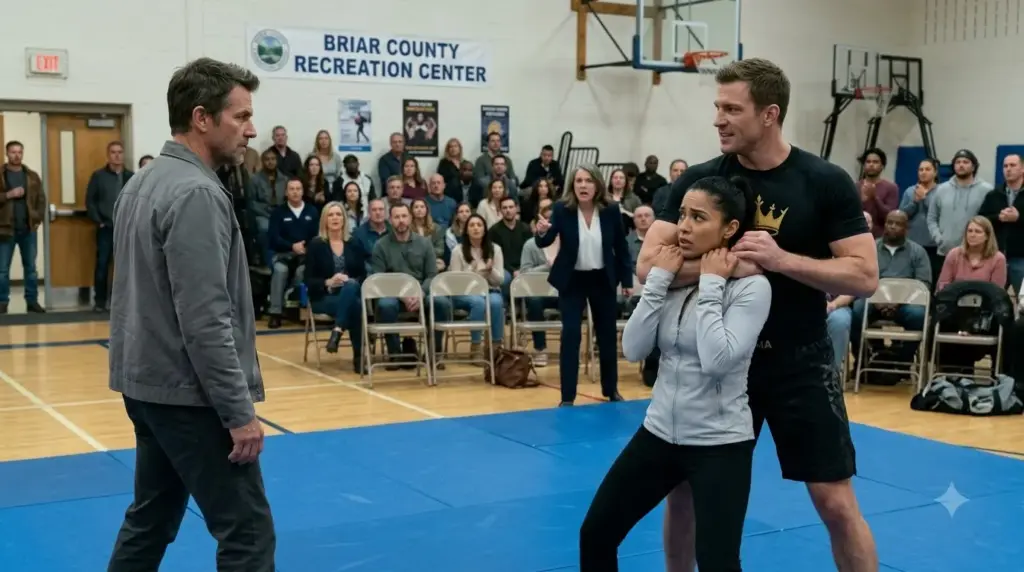
Some described being mocked for asking to stop.
Others recalled injuries they believed could have been avoided.
Rex dismissed the accusations publicly.
But the video told a troubling story.
Lena’s repeated tapping was clearly visible.
So was his refusal to release immediately.
Daniel provided a factual witness statement.
He declined television interviews.
When a reporter asked why he had intervened, he gave a simple answer.
“Because someone needed help.”
Six weeks later, Lena met Daniel at a small café near the recreation center.
She had recovered physically, but returning to teaching still frightened her.
“I keep thinking I should’ve fought harder,” she admitted.
Daniel shook his head.
“You communicated clearly. The responsibility to release belonged to him.”
She stared at her coffee.
“I used to love teaching.”
“Do you still?”
Lena hesitated.
“Yes.”
“Then don’t rush yourself. You can decide when, or whether, to return.”
She looked up.
“You’re not going to tell me to be brave?”
Daniel smiled.
“Bravery doesn’t require you to ignore what happened.”
For the first time in weeks, Lena felt understood.
Three months later, the Briar County Recreation Center reopened its self-defense program.
The organizers had introduced stronger safety procedures, clearer instructor responsibilities, and a confidential system for reporting misconduct.
Lena returned gradually.
Her first class had only seven students.
Sophie was among them.
When Lena entered the room, the girl hurried forward.
“Miss Ortiz!”
Lena smiled.
“Hello, Sophie.”
“Are you teaching again?”
“I’m going to try.”
Sophie hugged her.
“I’m glad.”
During the class, Lena demonstrated a simple defensive movement.
Then she stopped.
“Before we continue, I want everyone to remember something.”
The students listened.
“If something feels unsafe, you have the right to stop. You never have to prove your courage by allowing someone to hurt you.”
Sophie raised her hand.
“Even if they’re stronger?”
Lena nodded.
“Especially then.”
A year later, the recreation center held another Founders’ Day exhibition.
This time, there were no celebrity fighters.
No cameras following arrogant champions.
Just local instructors, families, and children demonstrating what they had learned.
Daniel attended quietly.
He stood near the same exit where he’d watched the incident unfold.
When Lena noticed him, she smiled.
“You still prefer standing?”
He chuckled.
“Old habit.”
She looked toward her students.
“They’ve worked hard.”
“I can see that.”
A young boy stepped onto the mat.
He attempted a basic escape, lost his balance, and stumbled.
The audience remained quiet.
Lena smiled encouragingly.
“Take your time.”
The boy tried again.
This time, he succeeded.
The room erupted in applause.
Daniel watched as the boy bowed proudly.
Then Lena approached him.
“Thank you for what you did that day.”
Daniel shook his head.
“You don’t owe me anything.”
“I know.”
She smiled.
“But I’m grateful you stood up.”
As the exhibition ended, Sophie approached Lena.
“Miss Ortiz?”
“Yes?”
“Do you think I’m strong enough to protect myself?”
Lena knelt beside her.
“Strength isn’t only about fighting.”
Sophie frowned.
“What else is it?”
“Knowing when to leave. Knowing when to ask for help. And knowing that nobody has the right to hurt you just because they’re stronger.”
Sophie thought about that.
Then smiled.
“I think I understand.”
Across the room, Daniel quietly picked up his jacket.
He left without applause, photographs, or recognition.
He hadn’t come to prove he was tougher than a champion.
He had simply refused to ignore someone in danger.
And Lena understood something she would teach for the rest of her life.
The fighter believed his strength gave him the right to decide when someone else’s suffering mattered.
But the calm stranger understood that true strength means knowing when to stop—and having the courage to intervene when someone refuses.





