“You Don’t Belong Here,” the Black Belt Said While Holding the Choke — Then a Calm Man Said, “Let Her Go.”
Chapter 1: The Man Who Refused to Look Away
Nobody at Stillwater Combat Academy would later agree on the exact moment things went wrong.
Some said it happened when Damon Kessler first mocked the new student. Others believed the trouble began when the head instructor left the training floor. But Lena Ortiz would remember one detail more clearly than anything else.
She had tapped three times.
And Damon hadn’t let go.
At twenty-four, Lena had joined the academy for reasons that had nothing to do with becoming a champion. She worked long shifts as an emergency medical technician, lived alone in a modest apartment outside Portland, Oregon, and wanted to learn how to feel more confident in unfamiliar situations.
She wasn’t naturally athletic. Her first month of Brazilian Jiu-Jitsu had left her sore, frustrated, and occasionally embarrassed.
But she kept coming back.
She liked the discipline. She liked the technical challenges. Most of all, she liked the idea that strength could be developed without cruelty.
Until that Thursday afternoon, she had believed everyone at Stillwater shared that understanding.
Damon Kessler was the academy’s most celebrated black belt.
Thirty-four years old, six feet tall, broad-shouldered, and handsome in the polished way of men who spent considerable time watching themselves on camera, Damon had collected regional championship medals and built a substantial online following.
He was also the academy owner’s favorite instructor.
His photograph hung beside the entrance.
His tournament trophies occupied an entire display case.
And when Damon spoke, younger students usually listened.
Lena had made the mistake of questioning him.
It happened during a demonstration of defensive grappling techniques. Damon had explained that smaller students should rely on speed rather than resistance when escaping a controlling position.
Lena raised her hand.
“Wouldn’t positioning matter more than speed if someone is much stronger?”
It was an ordinary question.
But Damon stopped speaking.
He looked at her.
“Excuse me?”
Lena felt the attention of twenty students turn toward her.
“I was just wondering whether positioning would be more important than trying to move faster.”
Damon smiled.
Not warmly.
“How long have you been training?”
“Six weeks.”
“Six weeks.”
He repeated the words as though they were a joke.
“And you’re correcting a black belt?”
“I’m not correcting you.”
“Then come here.”
Lena hesitated.
Damon pointed toward the center of the mat.
“Come on. Since you’ve got questions, let’s demonstrate.”
Several students exchanged uncomfortable glances.
Lena walked forward.
She had no reason to believe her instructor intended to hurt her.
That trust would become the most painful part of what happened next.
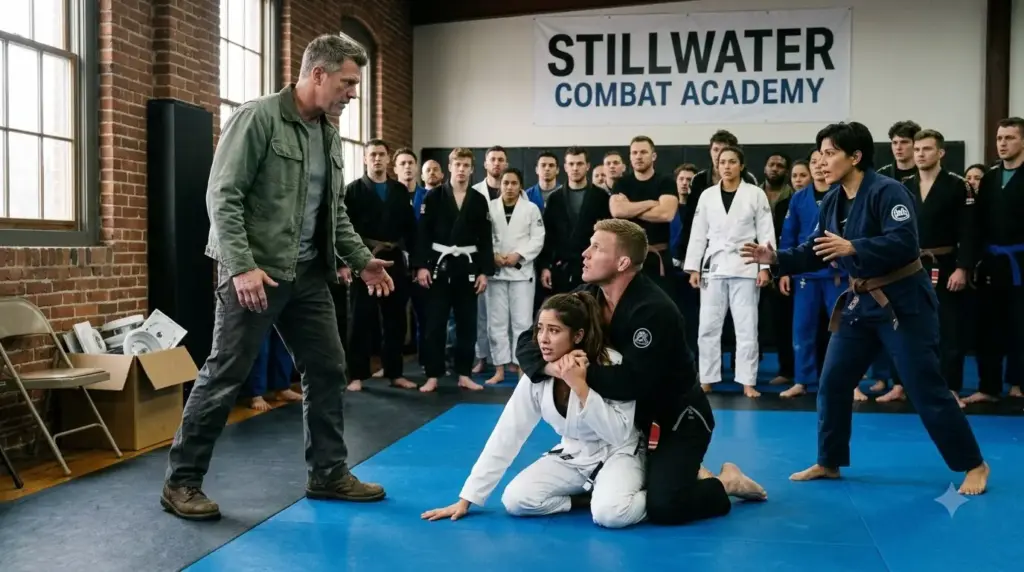
Damon positioned himself behind her and began explaining a rear choke.
At first, his movements were controlled.
He described the importance of recognizing danger early and responding before an opponent established a secure hold.
Then his tone changed.
“People like Lena come in here thinking a few classes make them experts.”
A few students laughed nervously.
Lena tried to smile.
“I didn’t say that.”
Damon tightened his position.
“Here’s your chance to show everybody what you know.”
Lena attempted the escape they had practiced.
It didn’t work.
Damon adjusted his grip.
“Come on. Use that positioning you were talking about.”
She tried again.
He prevented the movement.
The pressure increased.
Lena tapped the mat.
Once.
Twice.
Then against his arm.
Three unmistakable taps.
Damon didn’t release.
Instead, he leaned close enough for only her and the nearest students to hear.
“You don’t belong here.”
Lena tried to speak.
She couldn’t.
Her vision began to narrow.
The room around her seemed to tilt.
And somewhere beyond the circle of watching students, a chair scraped against the floor.
“Let her go.”
The voice was calm.
Low.
Almost conversational.
Damon glanced over his shoulder.
A man in a faded green work jacket stood beside the folding chairs near the exit.
He appeared to be about fifty, with short dark hair turning gray at the temples, a weathered face, and paint stains along one sleeve.
He had arrived forty minutes earlier carrying replacement ceiling fixtures.
Nobody knew his name.
Nobody had paid him much attention.
He had been waiting quietly for the facilities manager.
Now he was looking directly at Damon.
“Stay out of it,” Damon snapped.
The stranger didn’t move closer.
“She’s tapped.”
“I’m teaching.”
“She’s not participating anymore.”
Damon’s expression hardened.
“Who are you supposed to be?”
The man ignored the question.
“Release her. Now.”
Something in his voice made the nearest students step backward.
Not because he shouted.
Because he didn’t.
There was no excitement in his expression.
No desire to prove himself.
He looked like a man who had recognized an emergency and was unwilling to pretend otherwise.
Damon hesitated.
That hesitation lasted only a moment, but it was enough for another instructor, Michael Grant, to realize what was happening.
“Damon!” Michael shouted. “Let go!”
The stranger pointed toward a student standing near the wall.
“Call emergency services.”
The student immediately reached for his phone.
Damon finally released the hold.
Lena collapsed sideways, coughing violently.
The stranger knelt beside her without touching her neck.
“Can you hear me?”
She nodded weakly.
“Don’t rush to stand,” he said. “Help is coming.”
Michael moved toward Damon.
“What the hell were you doing?”
Damon stood and adjusted his uniform.
“She panicked.”
Michael stared at him.
“She tapped.”
“She wasn’t in danger.”
The stranger looked up.
“She was struggling to breathe.”
Damon scoffed.
“And you’re a doctor now?”
“No.”
“Then keep your opinions to yourself.”
The stranger turned back toward Lena.
“Can you tell me your name?”
“Lena,” she managed.
“All right, Lena. I’m Samuel.”
His voice softened.
“You’re not in trouble. Just concentrate on staying comfortable while we wait for the paramedics.”
Lena’s eyes filled with tears.
Not because of the pain alone.
Because someone had finally said she wasn’t in trouble.
For the past several minutes, she had felt as though she were being punished for asking a question.





